

A Primer for Managers
How to level up your management skills
✨ Hey there this is a free edition of next play’s newsletter, where we share under-the-radar opportunities to help you figure out what’s next in your journey. Join our private Slack community here and access $1000s of dollars of product discounts here.
Over the years of running Next Play, we’ve received countless messages from people asking for advice about how they can level up in their career. A lot of the time these questions touch on the topic of management. How can I become a manager? How can I manage more people? How can I work with my manager better?
I asked Orin C. Davis, Ph.D. to share his best advice, and I was impressed with the depth and practicality of of his answers. Whether you are an experienced people manager or someone new to the job or simply hoping to one day become a people manager, I think you’ll find these ideas useful and applicable to your situation.

TL;DR
After training and coaching executives, managers, early-career employees, and business students over the last 15 years, I’ve noticed a few gaps in the advice that is given to new managers, especially in the startup world. So, I put together a compendium of key recommendations and implementation methods for new managers that are less commonly found in the standard advice guides.
In brief, here are the recommendations:
1) Seek out opportunities to catch people being excellent and make it normal to celebrate the wins; it reminds people that they matter and that their work matters.
2) Start with a listening tour to get to know the team and its work, and then schedule 1:1’s [bi]weekly that cover both work and growth; you postpone/skip these at your peril.
3) All meetings need to have curated attendee lists, agendas, and prep; meet only for topics that are sensitive, creative, or complex decisions that need to be made quickly.
4) Start and end each day with a standing meeting; the start meeting is goal-setting and resource allocation, and the end meeting is progress reports and high-fives.
5) Keep tabs on everyone on the team, and keep track of everything the team is doing. Find a system for this that includes both dashboards and details, because admin is a key part of a manager’s duties.
6) As much as possible, give employees control over where, when, and how they will work. When you give a task, make sure there is mutual understanding about what it means for the task to be “done, well, on time, with the resources given”.
7) Prep hard conversations carefully, and act like a CORGI (with Curiosity, Optimism, Respect, and [presumption of] Good Intentions). Remember that assholery is primarily caused by time crunches.
8) Trust and be patient with yourself. Mastering management skills takes time.
Introduction
Congratulations on your promotion to manager! Hopefully, you took some time to enjoy the heady feeling and the delight at the increased salary. If you didn’t, do it now. Seriously -- pat yourself on the back and/or accept this virtual high-five from me and the many other people you’ve been working with who are happy for you. It is important to celebrate yourself and your wins, because it’s a key first step towards being an effective manager. There are a number of other steps that it will be important to take as you establish yourself as a manager, and many of these have the benefit of being both tried and tested in the real world and rooted in decades of research in positive psychology and organizational behavior (studies and resources linked throughout for reference).
1) Look for the wins and celebrate them
As mentioned, start with yourself on this. Surprisingly, it is not always comfortable to celebrate wins, and that’s something you not only need to learn yourself, but also need to help your team learn. One of the reasons why it’s hard to celebrate wins is that people are afraid that honoring what they do well violates the taboos against bragging and arrogance. Granted, there are times and places to celebrate, but one of the first is in your own heart. Give yourself permission to appreciate your hard work, effort, and good fortune (there’s always some luck involved!), and pay attention to any internal barriers you hit. What might help you to accept the success and celebration a bit more easily? Keep all this in mind as you start paying attention to the people on your team and helping them to recognize and celebrate their wins. As you track and celebrate the wins on this team (more on the tracking below), make sure you are encouraging others to notice and highlight the successes of others, as well as the team overall. Make high-fives and shoutouts the norm, and remember that none of this precludes serious handling of the negative stuff (see below). Another facet of celebrating wins is “strengths spotting“ (seeking opportunities to catch people using their character strengths to good effect), which is part of how managers do the critical job of helping employees to feel like they matter and that their work matters. Make sure that you and your team have a habit of catching other people doing what they do best and using their values in action (assessment here). This, of course, requires you to know your team well, which you will do in 1-on-1’s.
2) Schedule consistent [bi]weekly 1-on-1 meetings with every member of the team.
One of the biggest pitfalls of management is that managers who fail to understand their team members cannot motivate, challenge, coach, advise, guide, or develop them. No matter how closely you may have worked with people previously, now that you are at a different level, the relationship is different and you need to get to know these folks in a different way. A key method for this is to have consistent, weekly or biweekly 1-on-1 meetings (”1:1s”) for at least 15 (weekly)/30 (biweekly) minutes, and you should be having these 1:1s with every direct report you have (if you have >10 direct reports, set up team leads that can do weekly 1:1s, and you do weekly 1:1s with the team leads, and have a rotation for the rest that averages no more than three 1:1’s per day). There is a lot of temptation to skip these meetings because there are many demands on people’s time, and the 1:1 seems like a really easy thing to cut/reschedule, but don’t do it unless there is an emergency you would expect a client/customer to accept!
When you first start out as a manager, though, you need to begin with a “listening tour” in which you are having long and detailed 1:1’s with every member of the team that gives you a clear view of each person’s background and work and queues up topics for future weekly meetings. These early meetings are going to be long (60 minutes or more for the first 4-6 weeks), and you should budget time for that in addition to the 1:1s that you will be conducting on the [bi]weekly basis. And yes, this does mean that your ramp-up time as a manager is likely to include a bit of overtime, but the amount of efficiency that will create and stress that will save you later is absolutely going to be worth it. In these early meetings, you will learn about your employees’ motivations, which helps you find ways to make their jobs meaningful, keep them engaged, and empower them to perform at their best. You will also get a better sense of their strengths and talents, which will allow you to delegate tasks more effectively and give employees better job control (see below).
The [bi]weekly 1:1 meetings are the foundation of your management system, and are comprised of 4 parts: (a) shooting the breeze (casual chat/icebreaking); (b) top-of-mind items; (c) check-ins on ongoing work; (d) growth and development.
(a) The “shooting the breeze phase” is common in many countries, and is an important part of the conversation. It need not be long, but it often gives people random insights into each other’s lives that can come in handy for bonding and showing genuine appreciation for one another. This phase includes questions like how people spent their weekends, their reaction to [positive news event that aligns with their interests], and so on. Talk about the weather if you must (people love complaining about it or delighting in it), but break the ice somehow. Some managers like to start off by asking about stress levels, engagement levels, and positivity levels, and use that as a baseline for the conversation.
(b) The top-of-mind items are urgent and/or tactical questions about tasks, assignments, or deliverables that probably should have been discussed in real-time but weren’t for some reason. The trick is to make sure that these items don’t hijack the meeting, which requires either coming to a fast consensus about next steps for each of them or scheduling a longer chat about the relevant topic(s). This whole section of the meeting should take no more than 2 minutes, and while that seems like an insufficient amount of time, proper preparation (see below) makes it possible. In fact, some 1:1s should be able to skip this section (make that your goal)!
(c) Check-ins about ongoing work involves going through all of the projects that the team member should have been working on since the last 1:1 and getting a status update, as well as quick Q&As. Once again, it’s easy for this to hijack the meeting, so make sure each item is handled within 2 minutes or a separate chat is scheduled.
(d) The growth and development part of 1:1s is often the most important but also the least urgent, and that means it tends to get skipped far too often. Always save the last third of the meeting time for this section, and if you find yourself running out of time that means you are likely getting your 1:1 hijacked by top-of-mind or check-in items, and that means you need to schedule longer 1:1s or additional project meetings and also extend the existing meeting to have at least 5-10 minutes of developmental discussion. The goal of this part of the conversation is to discuss how your team member is growing and developing, whether in terms of knowledge, skills, or behaviors. As every team member should have ways in which they are developing, you can check in on their progress, and if they have recently hit a checkpoint or did something cool, that’s a win to celebrate and an opportunity to set a new milestone to pursue. This is also a fine time to talk about their longer-term goals, their motivations, their values systems, and the ways in which they want to make an impact both within the company and outside of it. Despite your best hopes, it is unlikely that you are going to keep this team member for their whole career, and you want to ensure that their time on your team is one of professional growth and maturation, as that will make your team a desirable one to be on and will encourage top talent to seek you out.
One of the best techniques for growth and development conversations is the plus/delta technique. When you have to give feedback/advice/coaching, talk about the pluses (what they did well) and then the deltas (change behavior/result X to behavior/result Y). Make this a constant part of 1:1’s, and keep a record of pluses/deltas so that you also have short- and long-term patterns and trends to highlight (in plus/delta fashion!), celebrate, and/or provide as a basis for promotion/growth/raises/etc.
The most important pro-tip for 1:1s, though, is for both participants to have prepared for the meeting and sent out an agenda in advance. In fact, this should be the norm on your team.
3) Meetings must have agendas, curated attendee lists, advance preparation, and not be replaceable by an email
Whether it’s a 1:1 or a larger meeting, it is in the best interests of everyone’s time and energy if people know why they are there and what they are supposed to accomplish while they are present. Over and above the logistical benefits of doing this, as well as having a guide for how long to spend on topics, a focused agenda also enables meeting attendees to be cognizant of the value that they contribute at the meeting and a feeling that their value is recognized. It makes meetings much more effective when you know exactly why you’re there and so does everyone else. That creates a default meeting culture of respect for everyone present and the contributions they are expected to make, and also allows for high-level contributions because the agenda made clear what people are supposed to prepare. Moreover, those who need to be present for a topic but not to contribute also know why they are at the meeting, and can either take good notes or prepare questions.
A proper agenda looks something like this:
Agenda for The Alan Parsons Project
Monday, 3-4 PM PT, Stereotomy Room
Attendees: Alex Acharya, Brett Benson, Chris Chu, Dale Dominique, Emerson Ebo
• 3:00-3:10: Topic 1
o Goal 1: [Person(s) responsible for achieving goal and the roles each will play]
o Goal 2: [Person(s) responsible for achieving goal and the roles each will play]
• 3:10-3:35: Topic 2
o Goal 1: [Person(s) responsible for achieving goal and the roles each will play]
o Goal 2: [Person(s) responsible for achieving goal and the roles each will play]
o Goal 3: [Person(s) responsible for achieving goal and the roles each will play]
• 3:35-3:50: Topic 3
o Goal 1: [Person(s) responsible for achieving goal and the roles each will play]
• 3:50-3:55: Confirmation of Action Items and Next Steps
Notice that there is some slush time in case something runs over. But, if something looks like it is going to run over by more than 2 minutes, then another meeting should be scheduled to cover that Topic/Goal. Optimally, someone will discover over the course of their preparation that the allotted time is insufficient or overkill and suggest a revision to the agenda. This way, everyone stays on track, everyone knows what to expect, and everyone can contribute effectively and efficiently. Set a deadline for finalizing agendas before the meeting (optimally, 0.5 * [length of meeting in hours] * [number of attendees]).
One of the most important reasons for sending out the agenda in advance is that people can remove/shift items from the agenda by recognizing that something can be covered effectively through other means. Ironically, most things actually can be addressed either in an email, in a live document that multiple people are editing, or asynchronously in a chat.
Here’s how to know that an actual discussion/meeting is necessary:
1) The item requires creativity, collaboration, and/or feedback from multiple sources in which people will need to build on one-another’s ideas in real time.
2) The topic is sensitive, highly-detailed, and/or entails nuance, and both verbal and non-verbal cues will support effective navigation of the issue.
3) A complex decision needs to be made quickly and consensus is required.
4) There are enough visuals and/or physical items required that sharing a space is the only way to keep everything available at once.
5) The folks required at the meeting enjoy one another’s company (NB: this is still inefficient, but the camaraderie may make it worthwhile to have a meeting anyway).
6) The people working together have not yet built sufficient trust in one another’s capabilities and thought processes that they can expect excellence in asynchronous work (in which case the manager needs to give this point deliberate thought so that the team can develop the requisite trust during the meetings).
7) The goal is to develop relationships, and there happens to be work that people can do together in real-time even though the tasks could be done asynchronously.
8) Someone is being celebrated.
But, when a meeting is required, it should end with everyone’s knowing the next steps they each need to take on the topic (even if it’s “wait for an update whose timing will be decided at [date/time]”) and any action items on which they need to follow up.
In addition to 1:1’s and project/task/ideation meetings, one of the most important meetings a team can have is the twice-daily “standing meeting”, complete with its own agenda (etc.).
4) Start and end every day with “standing meeting” (and prep for it)
One of the best ways to keep yourself and your team on track is to start and end every day with a standing meeting (my full recommendations here). This is a meeting (15 minutes max) in which every person highlights what they are working on that day and then people schedule follow-ups.
For the start-of-day meeting, here are the main questions:
1. What are my 1-2 main goals to accomplish today?
2. What else am I working on today that people need to know about?
3. What are the resources I need from others (including their time) to accomplish my main goals for today?
Everyone should come to the meeting with their answers ready to be displayed and fully explained in under 1 minute, so preparation is a must. The meeting begins with all answers being displayed, everyone’s taking 1-2 minutes to look at all of the answers, and noting anything unclear. In each person’s minute, they review and explain their answers and take quick clarification questions. This ensures that the everyone knows what everyone else is doing, and whether others on the team will need time/resources from them. In the second part of the meeting, after everyone has gone, people set up resource allocation (e.g., time, effort, materials) and schedule any meetings for the day for coordination and/or collaboration on tasks.
At the end-of-day standing meeting, everyone should be answering three questions:
1. How did I do an awesome job today? (It’s not bragging if everyone’s doing it.)
2. How well did I accomplish the 1-2 main goals I reported at start-of-day standing meeting?
3. To whom, and/or about what, am I grateful today? (This is where you high-five individuals on your team.)
Again, this requires preparation, all answers posted and reviewed in the first 1-2 minutes, and everyone gets 1 minute.
Some teams like to do a mid-day check-in, but it’s optional.
One of the best features of these meetings is that each one feeds the next, so this builds a virtuous productivity cycle with a number of advantages, including easier scheduling of meetings and focus blocks (which allows for more flow in the workplace), ensuring that everyone is clear on the team’s common/individual goals, building team culture and morale, helping people to see how their work matters and has impact, and clear tracking of time and resources.
The latter advantage is especially important for you as a manager, because your primary job is coordination, which in turn means tracking the team’s tasks, time, and resources.
5) Maintain trackers of everything the team is working on, the resources it has, and the people it comprises
Like it or not, a key part of a manager’s job is admin, and that means keeping track of projects, resources, tasks, time, progress, and so on. Ultimately, you are responsible for ensuring that the team’s deliverables actually materialize with sufficiently high quality, and your primary role is coordinating and integrating the efforts of the team. In order to do that, you need to have a pulse on what everyone is working on and the progress being made. There are a zillion different methodologies and technologies for doing this, and if the leadership above you hasn’t established a method, you are free to choose your own. As this can be overwhelming, consider first the three main methods of tracking, each of which contains all of the same information but centers around a different viewpoint:
1. Task Lists: These are lists of projects and the subtasks involved with them. Each line item has assignees and a due date. The central viewpoint is the set of specific tasks that needs to be done and the order in which they occur.
2. Gantt Chart: This provides a timeline overview of the whole project. Each piece of the project is mapped onto the timeline, and this centers around which tasks are being done during which time periods.
3. Kanban Board: This is a board whose viewpoint focuses on stages of completion. On these boards, each [sub]task/project is a “card” that is moved from stage to stage (e.g., to-do, started, drafted, reviewed, completed) as progress is made.
Almost every project tracker/system is rooted in one of those three styles, and because they all contain the same information, they are interchangeable (and many apps will let you switch between these “views”), so use whatever works for you.
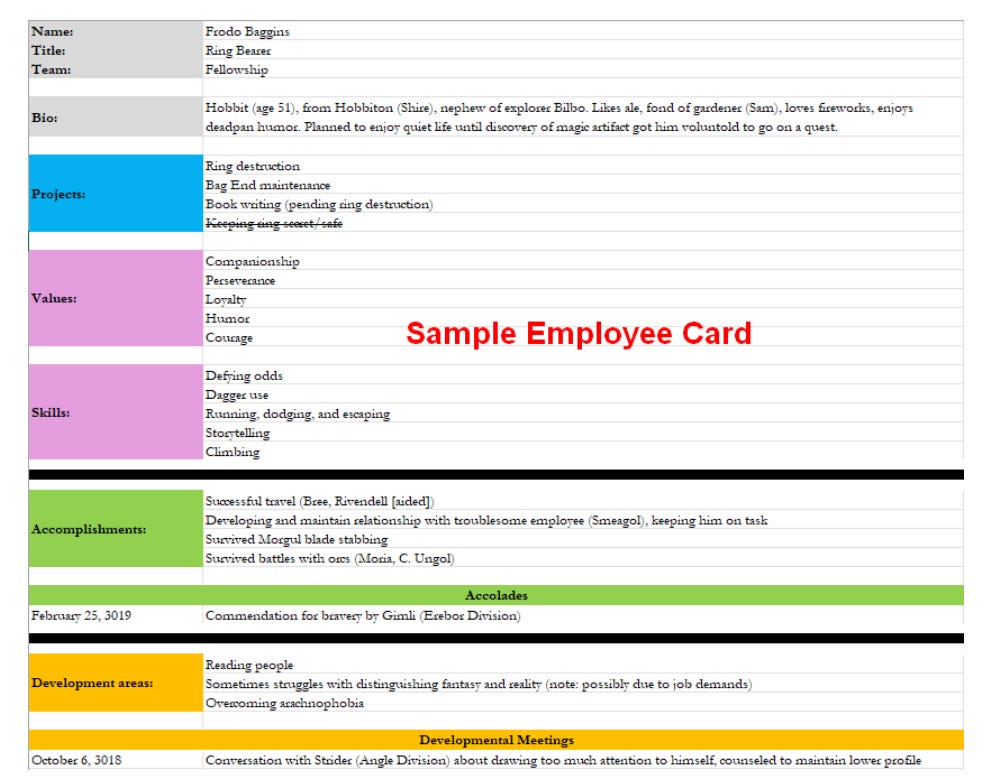
In addition to tracking projects, you are going to need to track the growth and development of each employee, so create a “card” for each one (sample below), and include their bios (including motivations and strengths), values, skills (current, developing, aspiring), and projects. Keep a record of their accomplishments, and every time you give an accolade, make sure that you log it, as well (remind your employees to do likewise and to keep their own such files -- always good to have a backup in case someone forgets to log something).
While managers definitely run the risk of overload with so much going on, taking the time in the early weeks to set up a system that provides simple summaries (e.g., dashboards, Kanban, etc.) and easy paths to the details is very much worth the investment.
As a pro-tip, don’t focus so much on how time is spent unless you are seeing people getting overworked. It’s not about the hours people put in but the quality of their work. If your full-time employees can effectively do everything you need them to do while putting in only five hours per day, do not assume that they can do more with the other three hours. People are limited in the amount of deep work that they can do each day, and while there is no consensus as to how many hours that is, many think it is four hours (given where that number comes from, it’s probably fewer). As such, do not penalize people for being efficient.
One of the other top things that you can do to reduce the amount of information that you have to process and manage is to give your employees as much job control as possible by maximizing the amount of freedom and autonomy they have.
6) Maximize employees’ job control
Among the biggest challenges that a new (and sometimes even an experienced) manager faces is accepting that they bear responsibility for the team and its outcomes but that no good will come of controlling every little thing that happens. People will make mistakes (so will you!), Murphy’s Law will haunt you, new demands will come out of nowhere, and sometimes it’s going to feel like the dung hit the proverbial fan. And in those moments, when all you want to do is become the puppet master of your team, the secret is to take a deep breath or eight, and start delegating.
Remember that, under normal circumstances, no one wants to do a bad job. If you assign tasks to people, they are very likely to step up and deliver even when the team is under fire.
But, those normal circumstances are when the team trusts you, and the primary way to build that trust is by maximizing employees’ job control. That is, whenever you give someone a task, your only concern should be that it is:
a) done (= minimum acceptable result)
b) well (= what the result should be like under both normal and optimal circumstances)
c) on time (= the due date for the final deliverable and any interim items)
d) with the resources given (e.g., budget, tech stack, etc.)
So, in your delegation process, make sure to go through each of those four attributes. After all, these will serve as the basis for any performance review, so making sure they are clear and mutually understood makes the feedback and review processes far smoother. Once everyone is clear on “done, well, on time, with the resources given”, the key is to step back and let them do their jobs.
To the greatest extent possible, let employees decide when, where, and how they will work. This is giving them job control, and is one of the most important ways in which managers can promote employee engagement and wellbeing.
If they have questions or need further resources, they [should] know that your door is open and/or that they can ask for your time, but otherwise you are going to give them the freedom to do what they do best. For early managers, this is probably a bit nerve-wracking, but the only way to build trust is for people to navigate instances of vulnerability effectively. That said, the trust between managers and employees may need to start small, and that’s one of the reasons why teams do standing meetings at the beginning and end of the day. It gives everyone on your team the chance to keep you apprised of what’s going on each day without getting into the intricate details. When you can see that things are progressing, it’s easier to trust that the details are fitting the standing meeting summaries. Of course, if the results look different from what you have been led to expect, this could be a problem, and that’s where hard conversations become necessary.
7) Handle hard conversations like a CORGI: with Curiosity, Optimism, Respect, and [presumption of] Good Intentions
Sometimes, things just don’t work out. People make mistakes, there are miscommunications, overworked people don’t have capacity, and so on, which can lead to failures, fights, and finger-pointing. These can all be fatal for teams, so you are going to have to jump in and lead some hard conversations. A great technique for handling these fraught situations is to act like a CORGI:
Be Curious: Ask questions, and keep both the questions and the answers focused on the facts. Stick to Who? What? Where? and When?, and make sure that any Why? is answered with a series of facts. The other person(s) in the conversation will likely want to get into editorials, explanations, face-saving, finger-pointing, and so on. Shut that down by using gentle questions (and, if necessary, gentle admonitions) to refocus on the facts. For example, “I hear what you’re saying, but when X happened, what followed right after [that? Can we go back to that first?]” Similarly, “I understand that you are expressing frustration with [person], but for now it’s important that we focus on the specific events that happened. Can you tell me more about X?” Or, “We can get to responsibility later, but for now we need to get a clear idea of what went wrong. Can we go back to X?” The trick here is doing as much listening as possible and ensuring that people feel understood. Once they are, they are more likely to listen to you, and also to recognize what the deal is and what may need to happen even before you start talking.
Be Optimistic: Come into the conversation with the sincere conviction that, through the efforts of everyone involved, the team has the willpower and waypower to ensure that everything is going to work out as well as possible. Remember that everyone wants that to be true so, given the opportunity and wherewithal to do so, people really will aim for the best outcome. Your role is to take the lead on initializing that optimism by coming into the meeting with a countenance and attitude that makes it very clear that we’re here to work it out and that we can come to an effective and reasonable resolution. With that context established, there is less of a need to get defensive and a greater willingness to cooperate so that the team can recover, which in turn allows you to focus on the solution-seeking that is needed to overcome the situation.
Be Respectful: Give people their dignity, even in the worst of situations. They are professionals, even if there is a clear incident on the docket that suggests otherwise. Remember that you are dealing with people who are vulnerable, and if responsibility needs to be taken and/or consequences are to be imposed, this is going to cost/hurt, and you are going to be seeing them at a low point. Treating people with respect, as fellow professionals, and as you would want to be treated if you were in that position, goes a long way towards helping people accept the content of a tough conversation. Even if you need to take a hard line where there is no room for discussion, respect the fact that this isn’t what the other person wants and treat them as though whatever is going on is not a personal reflection upon them but rather a necessary consequence of the situation. As much as possible, attribute anything good to a person, and anything bad to a situation.
Presume Good Intentions: Some 99% of the people you will meet and work with have good intentions and want to do good. When you need to have hard conversations with them, especially about a situation in which they did not do the level of good that they may have wanted, one of the best and most important things you can do is treat them as though they are good people who would have done their best if possible. Building on the idea above that you should assume anything negative is more about the situation than about them, treating any lapse in goodness as being a glitch rather than a norm can help keep the conversation on an even keel and make it easier to focus on solutions and remedies. Also, it’s a lot easier to accept consequences and responsibility if you don’t think that doing so means you’re a bad person. Again, give people the dignity of being presumed a good person. Even if they aren’t, or have very much failed to act like one, they are more likely to cooperate and collaborate if you focus on the issue/behavior rather than the person themselves.
In no way does CORGI behavior make hard conversations easy, but it will certainly make them easier, and may prevent some bridges from getting burned. As a bonus, getting good at this can actually help you to manage up if you find yourself on the tougher end of a hard conversation. So, practice, practice, practice! Think through how the conversation could go and prepare yourself for different directions that the discussion could take so that you are prepared to address even uncomfortable branches with equanimity.
And always remember: people are assholes because they are in a time crunch. That may not be an acceptable excuse, but knowing that explanation and coming in with that assumption will give you a huge advantage in hard conversations. It will also help you to recognize and prevent your own assholery.
8) Trust yourself to learn and grow; mastery takes time
Like any other skill, management takes time to master. Some people have a natural talent for it, while others need training just to get down the fundamentals, but everyone will need hard work to be at the top of the management game. Be patient with yourself, and show yourself grace as you develop excellence (which is also good to do with your employees).
Even with the core recommendations that I gave here, there is far more to learn and do (I give semester-long courses and corporate trainings on this, but there’s some additional information on my blog). But, the eight principles here are definitely where I recommend making your start as a manager. Work through these, make your mistakes, learn from them, and remember to find your own path and style of management. Once you do, that will be a serious win, and one that you will readily celebrate.
Got questions? Email Odavis (qllab.org) or schedule a chat or consultation.
Special thanks to Lisa Sansom and Stephanie Hauck for comments on earlier versions of this article.
Author Bio:
Orin Davis earned the first doctorate in positive psychology, and is a self-actualization engineer who enables people to do and be their best. Dr. Davis has worked both in and with startups for over a decade, and helps them enhance their products, go-to-market strategies, value propositions, pitches, culture, and human capital. In addition to working across a host of industries, Dr. Davis has been a single digit employee in several startups (c-level in one), and has been an advisor and board member for companies in the wellness, HR, education, and tech spaces. He consults for companies worldwide on human capital strategy (e.g., hiring, performance management, diversity/inclusion), and serves as an executive/career coach for a wide range of clients.
Thanks for reading!
 | A guest post by
|