

✨ Hey there this is a free edition of next play’s newsletter, where we share under-the-radar opportunities to help you figure out what’s next in your journey. Join our private Slack community here and access $1000s of dollars of product discounts here.
It’s very common for people and companies to procrastinate important decisions. For example, we hear all the time from people in the community that they’d like to be applying for more jobs but just have not found the time to send any cold emails to companies. Or that they’d like to start a company but have not been able to carve out more time to work on it.
I get it. Big decisions can be hard. But that does not mean they should be slow.
You may be underestimating the impact of working quickly. Most people seem to. This essay does a good job of describing why working quickly is more important than it seems:
“The obvious benefit to working quickly is that you’ll finish more stuff per unit time. But there’s more to it than that. If you work quickly, the cost of doing something new will seem lower in your mind. So you’ll be inclined to do more. The converse is true, too. If every time you write a blog post it takes you six months, and you’re sitting around your apartment on a Sunday afternoon thinking of stuff to do, you’re probably not going to think of starting a blog post, because it’ll feel too expensive.”
This idea very much applies to startups. Speed matters. You have probably worked at a company where every decision seems to be taking 10x longer than you’d like it to. You have a meeting about a decision. And then a meeting about that meeting. And then there’s a bunch of discussion, and documentation, and process. And by the time you actually make the decision, weeks have passed and you still do not have many learnings.
Neil Tewari, the co-founder/CEO of Conversion, puts it bluntly: “at an early-stage startup, the only thing that (really) matters is speed of experimentation.”
Experimenting with ideas was how Neil and the Conversion team found product-market fit. Working quickly has been core to this approach.
“Our first product wasn’t marketing software. I shudder to say it — but it started with NFTs in Roblox. Then billboard ads in Minecraft. Then a Mariah Carey Roblox concert. Then an AI website builder. We were fast builders. I picked James as my cofounder because he’s the smartest builder I know. We could ship anything.”
As Neil and James were reflecting on their experiments, they stumbled into the valuable insight that would shape their company:
“I was spending more time inside clunky marketing tools than talking to users. Just trying to get leads into a list, send a relevant email, and track what happened next felt like a full-time job. Nothing worked the way it should. CRM data was a mess. Segments didn’t update. Campaigns looked broken in half our users’ inboxes.”
“We assumed it was a “just us” problem. Until we started talking to other marketers. They weren’t manually fixing a few workflows here and there like we were. MarOps leaders were spending 50%+ of their whole week fighting tools that should have been helping them. So we pivoted again.”
Many experiments later, and they’re now scaling Conversion, a B2B marketing automation platform that’s grown to nearly 8 figures ARR, surpassed 4,000 customers, and done so while maintaining a culture that moves quickly. They recently raised a $28m Series A with backing from funds like Abstract Ventures and OpenAI. And they are hiring for many interesting roles in SF, like a founding account executive, founding growth person, founding product designer, and engineers.
We thought it’d be interesting to dig a bit deeper into what it’s like to work at Conversion. To learn about the culture, how they make decisions, and where they are headed. We cover all that and more in this Next Play Spotlight.

Major thanks to the Conversion team for sharing behind-the-scenes details and supporting Next Play.
“If You Want Something Done, Ask a Busy Person To Do It”
In speaking with hundreds of founders and companies over the years, one thing I have noticed is that the difference between being in the top 10% of effectiveness and the top 1% is staggering. While you may expect minor differences, it ends up being pretty stark. The best of the best greatly outperform the others, and often do so by applying untraditional methods to move the needle. They do things you would not expect, and that often leads to outlier-ish outcomes.
The Conversion team has reached nearly 8-figures in revenue with a very small team. They have a product customers really use and love. And in many ways, they are in the top 1% of high-performing teams.
They’ve gotten this far by really leaning into their belief in taking bets on great people, regardless of their background. Many members of their team never graduated from college and others come from totally unrelated backgrounds. Here’s what their team had to say on their approach to team building and why it’s key to their unique culture.
“Our team comes from all kinds of non-traditional backgrounds. Some members dropped out of college. One learned English at 12. Another is both an engineer and an accomplished artist. What they all share is a drive for excellence, a can-do attitude, and relentless scrappiness. Those are the qualities we look for when hiring, and they’re what make our team so incredible.”
“At Conversion, we make bets on raw talent early, give them real ownership, and watch them grow faster than anyone expected.”
“I joined Conversion when I was 19. I’d never had a full-time job and had never built anything close to what our product is today. My lack of experience was never a problem for Neil and James. I was obsessed with startups, hungry to learn, and excited to work hard alongside an incredible team. That’s all that mattered.”
“Shreya, who just joined our GTM team, is a perfect example of the type of person that thrives at Conversion. She had never been in a Sales role prior to joining the team but loves people, understanding their pain points, and helping solve them. Six weeks after joining the team, Shreya owns entire deal cycles and has closed two 6-figure contracts.”
“Our approach to people is shaped by Neil and James, who both dropped out of Berkeley before finishing their degrees. Across the team, there’s a shared belief: nothing is outside your scope. If you care about something, you should have the freedom to work on it.”
“Our biggest strength is the belief that speed and execution matter more than direct experience. Startup problems are unique and change fast. People who can adapt and stay passionate are far more effective than those who rely on playbooks.”
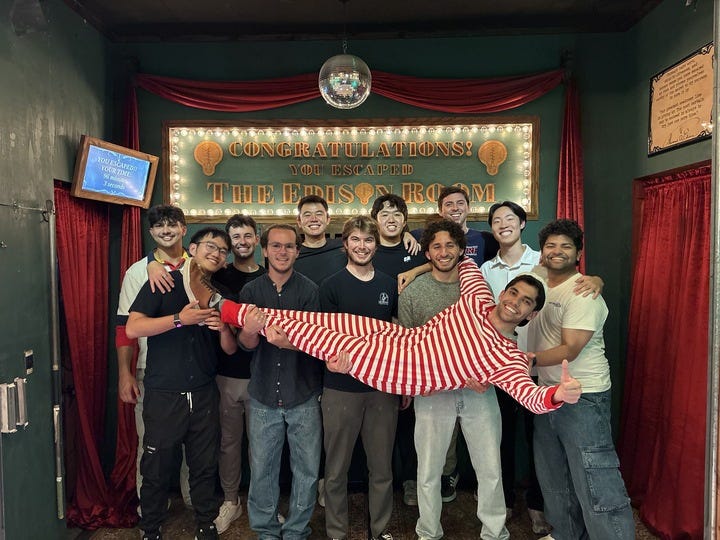
The Conversion team’s philosophy goes beyond hiring. They’re relentless about building products that actually make a difference. Even after generating millions in revenue, they’ve pivoted more than once to stay true to one goal: delivering real, lasting value to users.
The mission:
“One of our core principles at Conversion is to build things that are genuinely useful and help people. Our product development process relies heavily on talking to the teams we’re building for. There was a two-month stretch where all I did was speak with marketing teams to truly understand what matters most to them. I still hold the record - 208 discovery calls!”
“Before we set out to build a Marketing Automation Platform, we were focused on SEO tools for teams. Those tools did well and brought in millions in revenue. Still, we chose to pivot. There were some financial reasons (it was difficult to scale contract sizes) but more importantly, we felt we could create something that truly changed how teams worked. That conviction led us to pursue a much larger and more meaningful challenge.”
Their focus on building products that truly matter is evident in every decision they make and every meeting they run.
“At Conversion, the best idea wins. A lot of teams say that, but for us it’s genuinely true. While everyone has their specialty, people are encouraged to explore beyond their domain. Engineers contribute to outbound efforts, and designers ask the business team for feedback on new UX patterns. It makes the work more fun and pushes everyone to pursue real excellence.”
“We don’t have frequent meetings but when we do, you realize very quickly it can be hard to discern who’s the boss and who’s not. There’s no “meeting leader”. There’s no hand-raising. Ideas are thrown around and questions asked left and right. Every member of the team actively defines the future of the product and direction of the company.
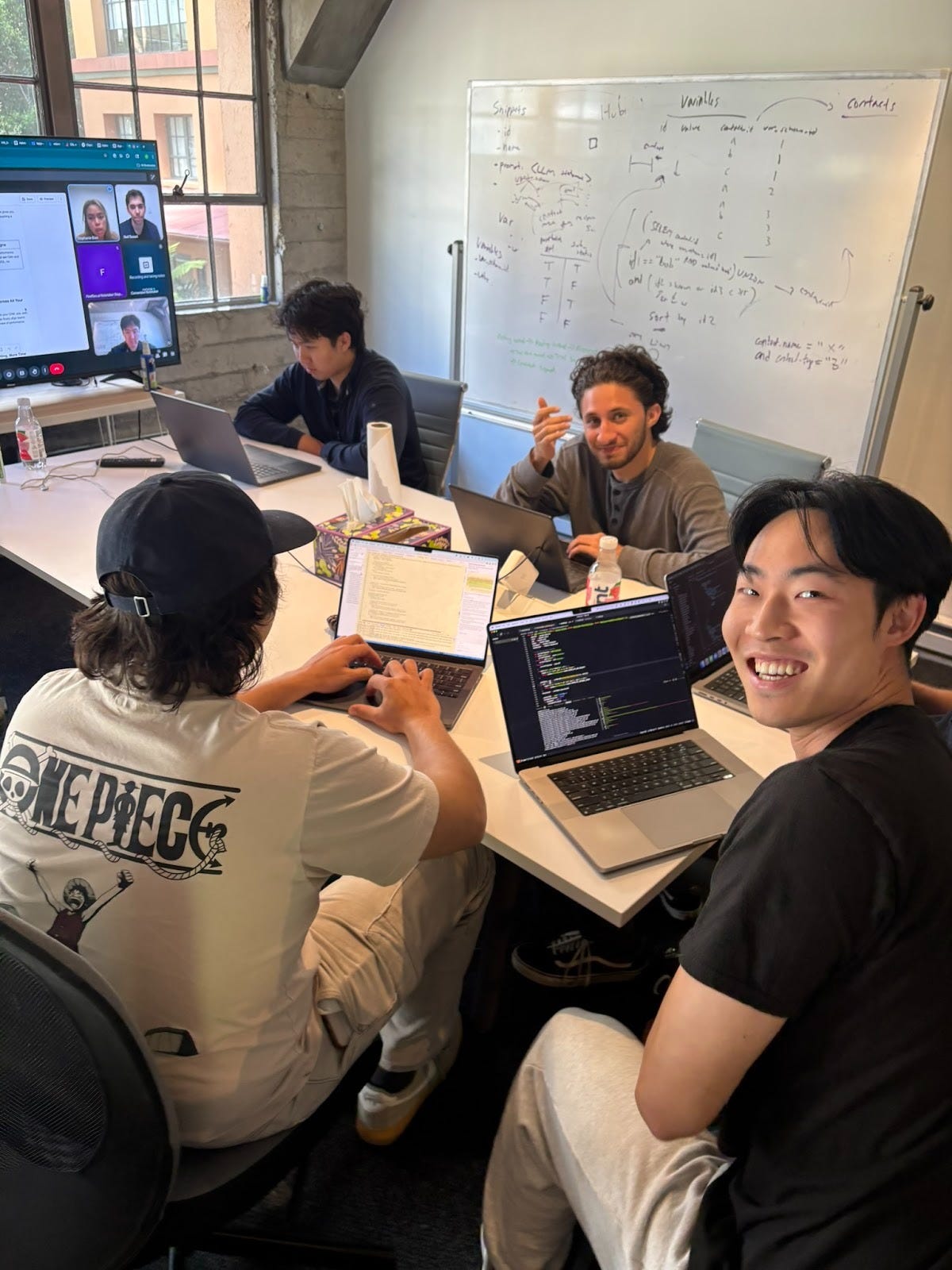
Conversion’s culture seems to be the result of deliberate design, not chance. The founders, Neil and James, share the belief that great culture must be actively built. They’ve dedicated time, energy, and resources to cultivating an environment where people feel connected and valued. In the high-pressure world of startups, that foundation often determines whether a team continues to progress or begins to stall.
“I love the little rituals we have as a team. Product launches go along with a candlelight ritual. Acai is eaten religiously on Fridays. Our backend engineer Tayler cooks dinner for the whole team regularly. Movie nights at Levi’s. The team loves spending time with one another and it makes the office a genuinely fun place to be in.”
“I think we do a really good job of striking a balance between having a high performance culture where a lot is expected from everyone while also fostering an environment where we genuinely care about each others’ wellbeing.”
“Something I appreciate about our team is that we provide feedback constructively and frequently. It sets the tone for a healthy environment where you’re not second-guessing your value on the team.”
“One of my favorite Conversion stories is from our Hawaii offsite. During the trip, Neil suggested we do a “medium-dificulty” hike. We all agreed. The hike he chose was Stairway to Heaven, considered to be one of the most difficult trails in Oahu. It also happened to have been the most windy day of the season which made crossing the narrow paths between the mountains quite perilous… We like to think that if we were able to survive that hike, everything else should be a piece of cake.”

As you can see, the Conversion team really focuses on providing value and a strong sense of ownership shared across the team. Everyone is committed to focusing on the important results without getting bogged down by hype and vanity metrics.
“We are fundamentally a get-shit-done team, and that ethos is carried across the business.”
“Our team stays focused on our customers without getting caught up in what’s hot on Twitter. We don’t push ideas like 996 or broadcast inflated ARR metrics. We work hard because we care, not because it’s mandated.”
“I love how transparent our team is. Everything is shared. Our finances, roadmap, board meetings. We’re all equally invested in the success of the company and are included as such.”
“Neil is pseudo-religious about a single domain at one time. He chooses a particular vertical to tackle (building sales playbook, maximizing recruiting, optimizing ad budget) and will heads down spend 20 hours in the weeds and talking to 10+ experts on how to do it best. He compiles a guide for someone to own it and then passes it off. It’s rare to see a founder who cares so much about pure execution and doesn’t care about podcasts or Forbes 30u30.”
Working more quickly means increasing the speed to which you achieve useful results. The latter is an important qualifier—the useful results—because it’s common for people to misinterpret working quickly as an excuse for wasting resources or as causation for sloppiness.
But you will not find that at Conversion. In many ways, their approach to building their company is proof that it’s possible to work quickly while being thoughtful. The two ideas are not actually in conflict.
A great example of this is looking at how the Conversion team approaches recruitment. They need to hire people quickly in order to keep up with market demand, as they are receiving lots of attention and applications from interested candidates.

You could easily imagine things getting sloppy—maybe they end up hiring the wrong people or dropping the ball on the candidate experience. But that’s not what’s happened. They have very much prioritized treating every candidate in their process with respect and care.
“It’s not that hard to be kind. If someone isn’t the right fit, tell them. If they’ve taken the time to meet your team, take five minutes to write a note back. We are asking folks to take hours out of their weeks to consider us, and it’s easy to underestimate the emotional and mental toll recruiting takes! It’s a hard process.”
“Sometimes, a candidate you pass on becomes a customer. Sometimes, they refer your next great hire. Sometimes, they just remember that your company treated them like a human. To founders and recruiting teams: I have a plea. Please treat candidates with respect. This shouldn’t be a radical idea, but lately, it feels like one. In this job market, I’ve seen too many recruiting teams and founders lose basic decency.”
You can look at many aspects of the Conversion business. The product. The brand. The culture. When you dig deeper, you’ll see that thoughtfulness does not have to get in the way of moving quickly.
If you are interested in learning more, Conversion is hiring for many interesting roles in SF, like a founding account executive, founding growth person, founding product designer, and engineers.
And if you are looking for more job opportunities, be sure to check out Next Play.
Its interesting reading all these conversations with startups because as someone who has yet to see myself represented in any photo of any of the company profiles you've done, it just reinforces how much of a closed loop and echo chamber the startup space can be. Hike in Hawaii? What if someone is less abled or has a chronic illness? Regular movie nights? What if someone has caring responsibilities?
Genuine question for you: is there space in the startup world for people who are highly capable but refuse to buy into the "hustle and grindset" culture that most of these articles radiate?