

✨ Hey there this is a free edition of next play’s newsletter, where we share under-the-radar opportunities to help you figure out what’s next in your journey. Join our private Slack community here and access $1000s of dollars of product discounts here.
TL;DR
If you only have a minute or two, here’s what you should know about Northslope.
Built on a $450B OS. Northslope builds mission-specific AI applications on top of Palantir’s operating system. The team is led by ex-Palantir engineers who helped build that OS. They’re funded and led by former Palantir executives and recently became Palantir’s first (and only) Vanguard: Elite partner.
Solving problems that actually matter. Some startups are in search of a problem. Fighting for product-market fit. Northslope has the opposite problem: there are near-infinite problems available for them to solve—problems like building rockets and delivering higher quality healthcare.
Leaning into the FDE model. The vast majority of Northslope’s team has the job title Forward-Deployed Engineer (FDE). If you’re unfamiliar, these are people who embed themselves directly into customer companies to make purpose-built software for specific outcomes. This, Northslope’s founder Bill Ward says, is the way that quality software is made.
Like a special ops team for software. Working at Northslope is a “choose your own adventure” experience. Your job description can’t predict exactly what you’ll work on because Northslope’s job is to solve, well, almost any problem that can be solved with software. The team has a flat hierarchy (their founder simply lists himself as an FDE on LinkedIn), and standards are high. If you join, expect to be surrounded by lots of smart people who will push you to do your best work.
Imagine there was a Fanduel-esque sportsbook for predicting startup success, and you were an oddsmaker. One day, a new file came across your desk. The facts were as follows:
Builds real-world software for real-world problems on top of a ~450B operating system (OS).
The team is made up of many people who originally helped build that OS.
Started as a bootstrapped business, proving their profitable business model before raising any strategic capital.
Found product-market fit fast, grew 6x in 2025, and has many large enterprise customers.
Chances are you would rate this company pretty favorably. You might even find these facts strange. What kind of early-stage startup runs a default profitable model? What “operating system” are we talking about? What does the company actually build? What do the people on the team do? How does any of this work?
I have just provided you with some facts about Northslope, a startup quite different from most of the other companies we write about at Next Play. Northslope is a team of engineers and operators, many of whom used to work at Palantir, who build applied AI software on top of Palantir’s OS.
Northslope is not a startup in search of a problem, desperate for product-market fit. No, the problems that Northslope’s customers face are both plentiful and important. Last year, they automated revenue management for one of the world’s largest solar operators. They helped build rockets. They helped a company process billions of dollars in weekly payments. And they solved quality metrics reporting for a major hospital, “taking people off paperwork and putting them on patient care.” I’m just naming a few.
Joining Northslope is like joining a special operatives team of sorts; a flat hierarchy with some of tech’s top talent who must be ready to go solve big software problems in the real world at a moment’s notice. Your job description cannot possibly say what you will be working on because Northslope’s problems are the world’s problems, and the world is an unpredictable place.
Curious about what it’s like to work at a company like Northslope, I sat down and asked the team some questions. How does the model work? What does collaboration look like? Who should consider joining?

A different way to solve problems
First, the model.
There is one approach to building software in which you create a rigid product with a bunch of general-purpose features. You ship that product out to the world and hope that people find some of it useful. Most software is made this way, and this approach can sometimes work very well.
Then there is the approach that Bill Ward, Northslope founder, describes: “The way you build high-impact software is by forward-deploying and building against specific missions and outcomes. You build for the people, business models, and data that make an organization special - bespoke software that compounds their competitive advantage, instead of commoditizing it.”
This second approach, which is usually called the Forward-Deployed Engineer (FDE) model, is what Palantir pioneered in the mid-2000s. You build a core platform (like Palantir’s Gotham or Foundry) which is capable of doing a near-infinite number of things. Then, you embed your own engineers—your FDEs—into customers’ companies to help them build specific software applications for their problems.
In the early days of Northslope, Bill Ward & co. found themselves working with a massive retail chain that was struggling with tax reporting. No existing SaaS product worked, so they were paying millions per year to a big 4 consulting firm to take care of it, which was expensive and still led to mis-filed taxes and fines. Enter: Northslope.
“We sent two people for three months and built custom, mission-specific software that allowed their internal team to run the entire process themselves. They eliminated the high seven figure annual contract, integrated all their data, filed on time, could respond quickly to state disputes, and avoided penalties. All while dramatically reducing operational overhead.”
This story captures the essence of the FDE approach: it is all about delivering tangible outcomes that move the needle.
Instead of creating a piece of software that kind of works for a lot of companies, you create lots of different pieces of software that work really well for specific companies. The commonality is that they are all built on the same platform; the same operating system.
The market for building on Palantir’s operating system is huge. As of this writing, Palantir is worth approximately $450B. Their customers include everyone from Wendy’s, where they make sure the company doesn’t run out of Frosties, to the United States government.
But although Palantir popularized the FDE model, they are not a consulting firm. “This was hard for a lot of people to understand when I worked at Palantir,” Bill said. And, still, there are many companies with important problems who need help building on top of Palantir’s foundations. So there is some tension:
Who is going to help the 1,000s of companies that need purpose-built AI applications on Palantir’s OS?
Enter: Northslope. A team of 95+ people, mostly FDEs, many of whom helped build Palantir itself. A team ready to tackle some of the world’s biggest problems at the drop of a hat.
The everything company
One year after founding Northslope, Bill Ward posted the following on his LinkedIn:
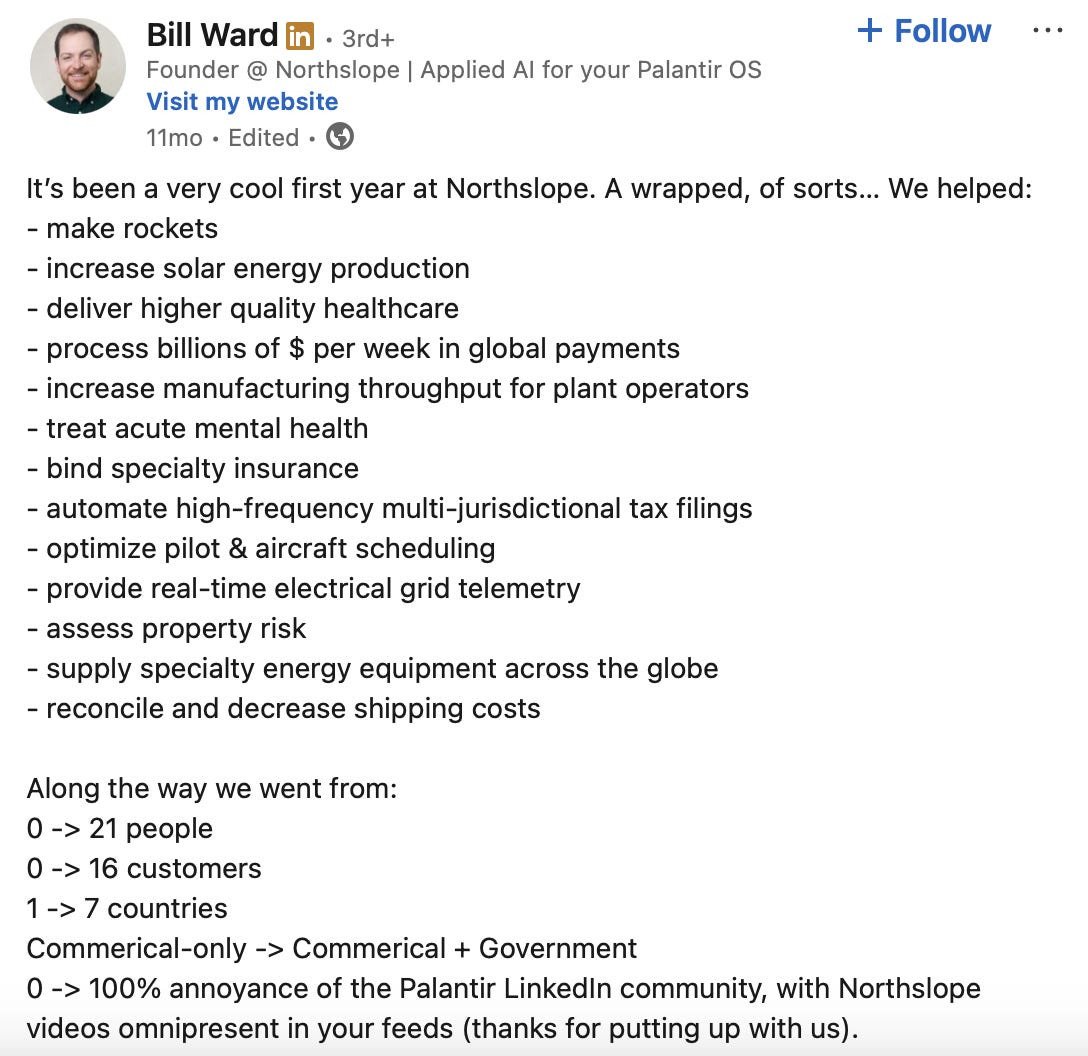
It is a rare few startups that get to make such a large impact—and on so many problems—so quickly. But this was not new terrain for Bill, nor for many of the ex-Palantir engineers (like Nathan Cole and Michael Gamble) that he hired.
“Northslope’s rapid growth has been impressive and puts them in a category of their own,” Palantir’s Global Head of Commercial Ted Mabrey said in a major announcement that Northslope would be the first company in Palantir’s new Vanguard: Elite partner category.
The nature of the work makes it both exciting and unpredictable. “This is a choose your own adventure company,” Northslope’s CCO Max Helzberg told me. “Come in, get exposure to different problems, and start to build your own practice; your own company within the company.”
I asked Bill what the FDE onboarding experience was like at Northslope: “Monday of week three, you’ll be on your first customer project. You’ll show up—hopefully in their office, maybe on zoom—and ask: ‘What is the hard problem you have?’ They’ll describe it, and you’ll start building software iteratively with them.” Within two to three days, Bill says, you’ll ship something, get it in front of a user, and then build the next version.
One other benefit of Northslope’s business is that it does not necessarily need to follow the traditional VC path. Though Bill Ward describes Northslope as a software company, not a consulting business, it has had revenue since day one, and earns as it builds.Their seed round helped to accelerate hiring and product development , but don’t mistake Northslope for the “who cares, let’s just raise every year and figure out profit later” sort of organization. Northslope raises money to aggressively invest in better serving more customers, in more places, not to survive and pivot.
Flat hierarchy, tall responsibility
If you want to build a truly great sports franchise—like the Bill Belichick-era Patriots—you need a few things. You need a lot of great talent. You need high standards, both personally and collectively. You need a deep level of trust and respect between every single player. And you need players to recognize that the team wins as a team; there’s no hero ball. Everyone helps everyone else. The hierarchy is flat.
From what I can tell, Northslope seems to have all of these ingredients.
On the talent front, “Bill’s superpower is convincing incredibly talented individuals to work with him, figure out their superpower, and unblock and unleash them,” Max Helzberg said. Perhaps the best metric to demonstrate this success is that, at least at one point, the team was more than 90% staffed by Palantir alumni; people who, generally speaking, have plenty of options as to where they’d like to work.
“Individually, everyone is very competitive and holds themselves to high standards. However, they understand that we win as a team and it’s important to give feedback, share learnings, and help others along the way,” said one of Northslope’s recruiters.
“The org is supremely flat. Everyone is an equal. Coworkers are friends. Everyone cares,” someone else told me. And there is perhaps no better, albeit superficial, evidence of this than that Bill Ward, who founded the company, lists himself on LinkedIn as a Forward-Deployed Engineer. Just like any other engineer. In some contexts this could seem performative—is the hierarchy really flat?—but at Northslope a flat hierarchy is the natural default. For a company like theirs, it is the most effective way to work.
High standards mean high trust, too. “The level of trust awarded to all Northslopers from day 1 was the biggest appeal to me. Everyone is brought here because of a distinct skillset that they bring, and they are immediately trusted to use that skillset on implementations,” said another FDE.
It may not surprise you to learn that the team moves quickly. Nikhila Obbineni, an FDE who previously worked at BlackRock, was “looking for a place where I could wear multiple hats and move fast. I wanted to own things from the ground up rather than be a small cog in a massive machine. Here, I can go from ideation to implementation in days.”
As for the fun stuff? The company does twice yearly full-team offsites, the most recent of which was in Portugal. But plenty of companies do that. More unique were tidbits like: “The London office independently created a meme subculture revolving around frogs, while the NYC office independently created a meme subculture revolving around pigs.” Regarding the latter, I can confirm that everyone I talked to mentioned a game called Pass the Pigs. If you want to play, well, first you’ll need to apply.
Speaking of…
Should you join Northslope?
There are a lot of credible reasons why a smart and talented person would want to join Northslope. That is not something you can say about every startup in the world. One early employee explained it well:
“My fulfillment in a job boils down to three things, which are really hard to find together: smart and caring people, a business being built for the long-term, and teammates I’d lay down my professional life for. Northslope was the first company I found in a long, long time where all of these were true.”
One reason you may want to join is you’d like to join the startup equivalent of a high-performance sports team. You’d like to work somewhere where the standards are high. Where everyone cares a lot. A place where you can be surrounded by smart people (probably smarter than you!) every day.
Or perhaps you’d like to join Northslope because you want to put your skillset to work on real problems. Problems like, as we covered earlier, helping companies build rockets and deliver healthcare. Maybe you are bored of a job you do not think is particularly meaningful; maybe maintaining the same old codebase for years on end is not pushing you to your limits. If you want to use your talents in the real-world for products that will actually be used—not for a startup in search of a problem—consider Northslope.
You may also want to join because you share Bill Ward’s vision for Northslope, a vision for “all of the world’s most important institutions should be able to run like SpaceX - building their own software for their own specific missions We’re building the applications on the Palantir operating system that enable them to do that.”
This vision alone, if you believe Northslope can achieve it, is reason enough.
But who are Northslopians, really?
“The people who really thrive here are the ones who get genuinely excited about untangling messy problems. Like when you finally crack that complex data pipeline at 10pm and you’re actually pumped about it. They’re intellectually curious to the point of obsession, spending lunch breaks refining solutions just because the current one bugs them,” Nikhila Obbineni said.
People who don’t fit in well are people who “want a detailed instruction manual,” and people who “want a clear ladder to climb based on a prescriptive list of milestone/achievements.” Northslope is a flat, choose-your-own adventure company; corporate ladder-climbing is a far cry from its culture.
If you want to join, Northslope is currently hiring across multiple departments (mostly engineering and operations) at their offices in London, Dubai, Denver, Washington D.C., Seattle, and New York. Fill out an application if something seems relevant, but don’t forget that you can also get more creative and you can consider sending a useful cold email to the right person at the company.