

Actually useful ways to use AI to help you land a job at a startup
Practical advice of what to avoid and what to focus on
✨ Hey there this is a free edition of next play’s newsletter, where we share under-the-radar opportunities to help you figure out what’s next in your journey. Join our private Slack community here and access $1000s of dollars of product discounts here.
(This is a human written guest post!)
Enough! Enough of the AI-generated-advice preaching that I need to be using AI. The kind you find all over Linkedin and Twitter these days. The “10 hacks you can use to boost your productivity 937% using these AI tools.” The “you have to try these tricks they will change your life!” I am sorry but these claims are simply misleading and not actually useful.
At least from my point of view, the reality is that the current state today (early 2025) is that AI is a tool. It can certainly be useful in particular domains, but its effectiveness largely depends on how you use it.
That is only to say there are PLENTY of unproductive ways to use AI. And that very much applies to the category of “How to use AI in your career search.”
Not to be overly critical but I am personally not a believer in many of the suggestions people have made about how you can build these fancy AI systems to figure out what’s next and land your dream job. Sure you could build those things. But I don’t think you should.
I do think there are extremely useful things you could do with AI. But you have to be careful. Because what often happens is people get caught in these overly complicated rabbit holes and convince themselves they are making progress when in reality they are lost in the sauce.
These of course are just my opinions, and they are definitely subject to (and likely will) change as the landscape evolves, but here’s what I think are some of the actually useful ways you can use AI to help you land a job (along with some commentary around things you can avoid).

Practical ways to use AI to help you land a job
Step one: stop.
Whaaaat?
Yes, I want you to stop. My number one recommendation is to STOP thinking of AI as this magical black box that’ll solve all your problems and get you the perfect job that’ll improve your life.
Indeed, sometimes AI can look and feel magical. But I think blindly leaning too far into magical thinking can land you in many weird and unproductive places.
You start out by “vibe coding” a pretty simple idea…but you end up spending hours building and troubleshooting and watching weird Youtube videos about this sophisticated messy system, all because you wanted to achieve something pretty simple in the first place. I do not want to discourage you from experimenting, go ahead and do that! But beware of getting sucked in and forgetting what’s important.
I also want you to stop thinking you need AI to radically alter your job search. Just because you can build something does not mean you should. Just because it’s possible to spin up a project does not make it a good idea. Try to focus on what matters!
It’s my opinion that in order to land a great next job at a startup, you do not need:
I am making this list of what not to do explicit because time and time again I see people thinking these are good ideas. I do not think they are, and I think you can end up wasting lots of time (and money) with these distractions.
You do not need an AI-powered mass-market outreach method. I hear of people saying they are using AI to apply to 1000 jobs a day! I do not think you need to apply to 1000 jobs a day. I think that will lead to lots of noise in your life and lots of wasted time. (Curated, human emails I think work a lot better for startups).
You do not need an AI-written resume and cover letter. I think you can and should write these artifacts yourself. You could try to outsource it to AI but I think two things will happen. One is that it’ll look like it’s written by AI. Maybe there’s a way around this with some special prompting but two is that you’ll lose out on a huge benefit of manually writing your resume and cover letter: self reflection. The point, at least in my point of view, of writing these things out is taking the opportunity to sharpen your ability to explain what you’ve done in the past and what you’d like to do in the future. Chances are that if you cannot write those out very well, you’ll have a tough time explaining things in the interview. Consider these as opportunities to practice.
You do not need a fancy job tracking system that you custom vibe coded to match your particular needs. Even if you are able to build this relatively quickly, I would suggest just using a Spreadsheet or Document. They work sufficiently fine. Maybe you should use AI voice recorders to take notes in meetings and then keep those notes organized in a spreadsheet but TBD how necessary that is.
You do not need an AI-enhanced Linkedin. I do not think you need an ai-generated profile picture and cover photo. You certainly do not need an obviously generated Linkedin description that uses a bunch of buzzwords. I think people will like the fact that you are a human. If you are wondering whether or not people can tell I’ll save you the time: they can tell. (At least right now in 2025!)
You do not need an AI-interview-cheater. I have heard of people using tools to cheat on interviews. Cheat is a strong word. We can use the word “assist them” on interviews. This may work for bigger companies but I think working at a startup is very much built on trust. It’s a small team and you will not have anywhere to hide. If you cheat on your interviews, and the actual job comes, how will you be prepared? If you say to yourself: “Well these interviews are stupid. I will be ready once the actual job comes.” I’ll then ask: “Why do you want to work at a company with stupid interviews? Have you given them this feedback? What did they say?” I think this will lead to a lot more productive of a discussion than you could imagine (pending how you say it, can look really good as a candidate if that’s your honest perspective).
You do not need to post AI-generated advice all the time thinking it’ll improve your personal brand. I have got to be honest that one of the reasons I don’t really like scrolling Linkedin a lot of the time is what I see is AI generated advice telling me to use AI to make me more productive. Feels like a bit of a weird loop.
You do not really need an AI search engine. You could use AI to build some set of scraping tools that’ll help you land a job. Maybe that’d be smart and helpful. But there are many interesting curations of jobs (including the ones we share on the Next Play newsletter and platform). I still think curation is the hard part, and I think curation, at least right now, is best done manually (because it requires a level of taste that we’ve not yet seen in AI systems). Perhaps at some point curation will be better done by machines, and maybe there are some quantitative measures you can focus on today that’d help you better find the right fit, but I don’t expect this to be a game-changer.
Quick interruption: if you are looking for a co-founder, you may like this list of 61 people open to meeting a cofounder we put together here:
Some of the actually useful ways to use AI today
Now I am not a total cynic. There are a few things I would suggest trying with AI that could actually help you land a job. I’ll try to be as specific as possible. As mentioned, I’m biasing towards very practical use cases but let me know (hi@nextplay.so) if I am missing any really useful ones. And yes, I expect this list to grow over time.
#1 - Be more prepared for interviews.
I think it’s very possible and useful to use AI to prepare for interviews. You can use AI to automate research. Research that a lot of people don’t typically do before doing an interview.
What kind of research? I would research everything I possibly could about a company and the market landscape: Who is the company? Who is the founder? What does the company do? How has it evolved over time? Who is their biggest competitor? Who is their best public comparison? What do their customers say about them on Reddit?
You get the idea.
Plug those prompts into your favorite AI search engine. You can use AI search tools to answer many of these questions more efficiently (but even if you don’t use AI, you should still do this!!).
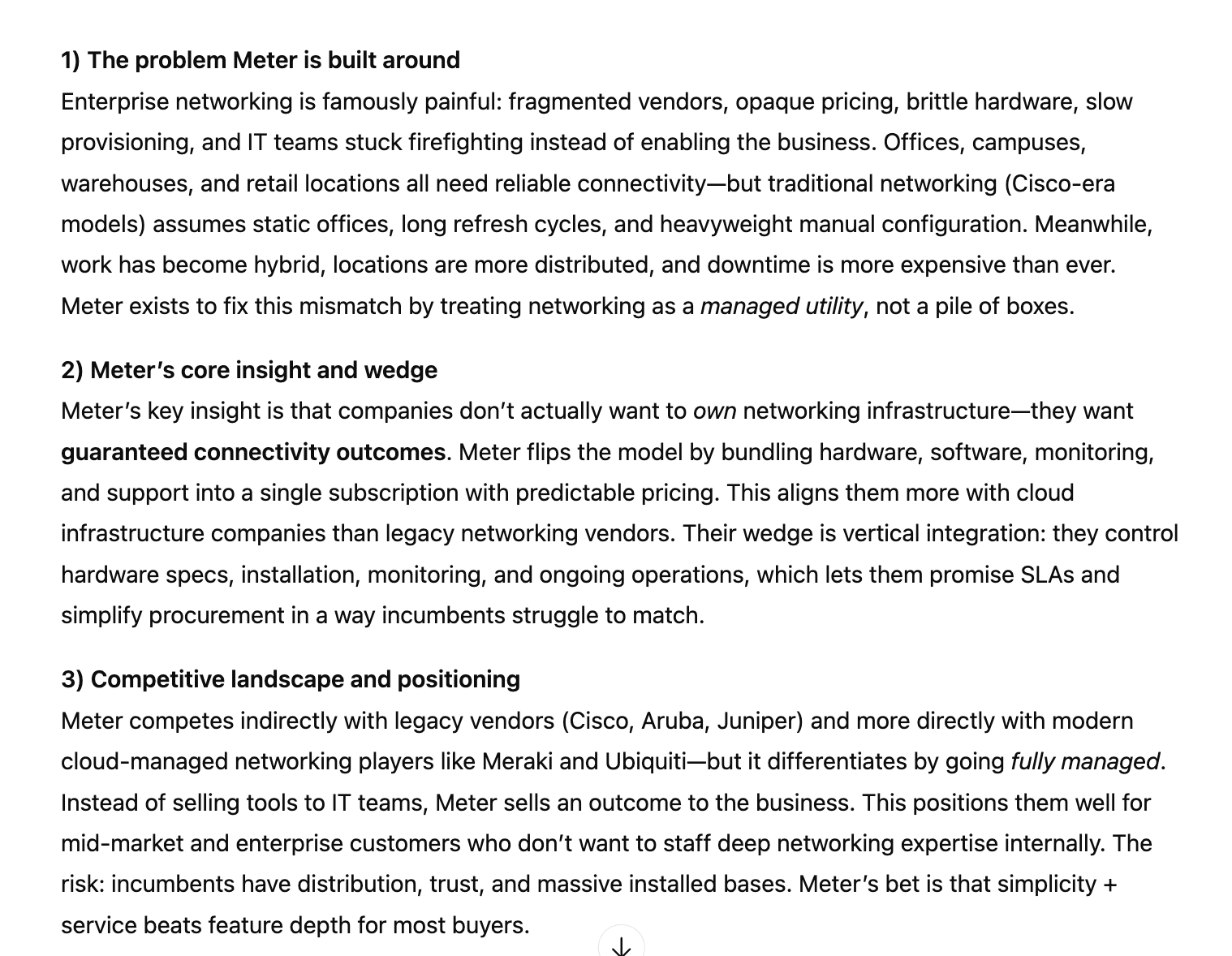
Here’s a real, super simple example if I were applying to work at Meter:
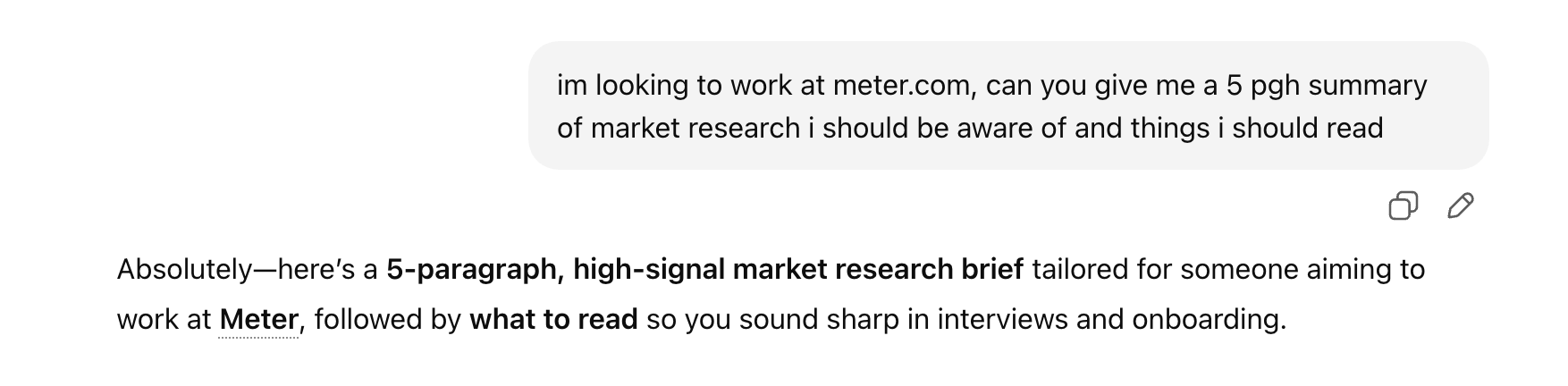
You can see in this excerpt the report is pretty interesting:
You can go further by using AI to ask you practice questions. Simply ask it to ask you sample questions or pretend to be a job interviewer. You can even ask it to pretend to be an interviewer from that particular type of company, and it can help you generate relevant questions.
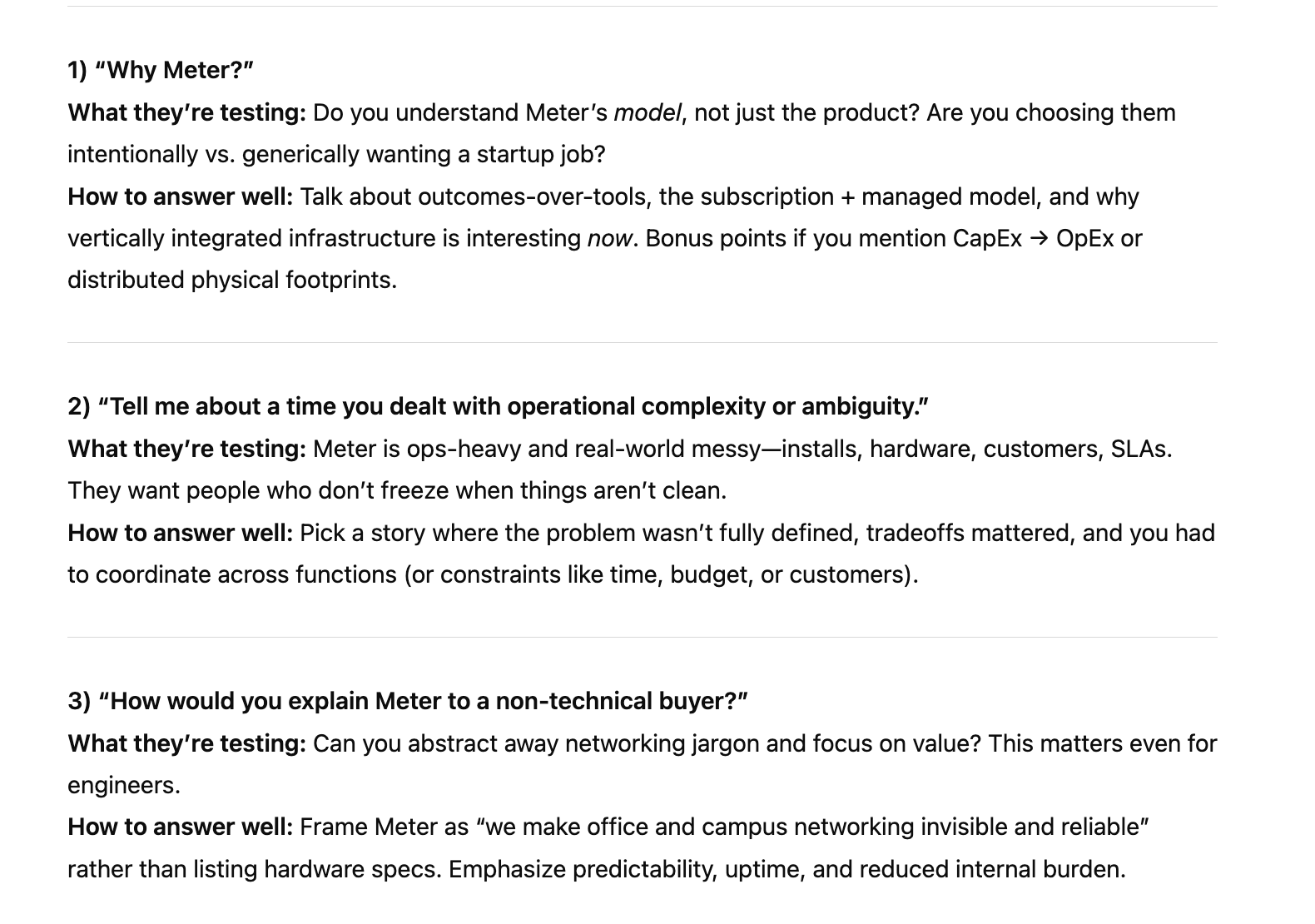
You’ll want to think for yourself about your answers. But it can also give you feedback on your answers.
You can do all of this via simple chat. I am less of a fan of the two-sided audio interactions at least right now because they feel very inhuman still but sometimes speaking your answers is useful.
Spending even a few hours doing this can really boost the depth of your answers. All that being said, be careful about just repeating what AI says to say. I’d be skeptical of those suggestions.
#2 - Get people’s attention in your job search.
I would try to use AI to be creative in your outbound to companies. That doesn’t mean mass-emailing 1000s of people. Instead, take basically the opposite approach.
What if you spent one hour vibe coding SOMETHING that’d make your application stand out. Imagine you were applying for a job at a hot startup.
What if you built a little mini game…something like Mario or Snake or Pokemon…using a vibe-coded AI tool to show “hey I really care about this company, I’m not just going to apply with a resume and cover letter, I also built this fun game that expresses why I’m interested.” I would really try to think outside the box and get creative. I think that’s where these tools can be particularly useful right now is in giving you a platform to showcase your independent mindedness, which can be a really attractive feature to startups.
If you don’t currently for example have a personal website, and don’t know how to code, I would probably use an off the shelf drag and drop website builder. Maybe you could use AI but I don’t think they result in better outcomes than something like Cargo or Squarespace or Shopify. Some of them have some AI tools but I have not used them much.
Here are two practical examples that you could do in the next 60 minutes:
If I wanted to work at Netic, an AI startup for home services businesses, I’d use something like Lovable or Claude Code to vibe code a little game/simulator that showcased my ability to understand and empathize with the target customer they are going after. You could add little easter eggs that connected to why they should hire you in particular. I think you could realistically do an interesting version of this in less than 30 minutes.
If I wanted to work at a VC fund, I’d make a site that showcased all the companies in the fund’s portfolio. I would add a bunch of meta data to the site so it could be a useful tool for job-seekers, and something the fund could promote to its audience.
There are many more ideas here. I’ll share more very practical examples in a future edition - but ping me hi@nextplay.so if you had questions.
#3 - Using AI productively at work.
If you think of AI like any other tool, then it’s obvious that something you could do with AI that’d actually help you in your job search is learn how to use it productively.
That could mean building skills and actually proving that you can use it in a way to help a business or person achieve useful outcomes.
This is much harder to do than you may think. A lot of the time people show me their AI projects and I’m left wondering: What’s the point?
That’s also true with most projects in general it’s just that because AI has a lower barrier to entry, it’s easier for people to get started without thinking about the purpose of their idea.
But I do not want to discourage you from a) experimenting and b) building things out. I think you could get really good, for example, at using AI to help you code faster. Or using AI to help you design customer service agents that can actually be productive and useful. I think the list of things that AI can do is likely going to grow quite a bit very soon.
I think you’ll need to continue to sharpen your ability to actually use it productively - and so that is what this bullet is about. Focusing on using it productively. That could mean using AI coding tools, AI email tools, AI voice recording tools, etc. There’s lots you can do. Just have to be thoughtful about it.
#5 - Proving you can learn quickly while not getting distracted.
I think this is a real concern amongst founders I’ve talked to lately. They are concerned that smart people are being sucked into obsessing over AI and forgetting how to actually be useful contributors on their teams.
All they talk about is high level AI stuff; they forget to talk about what actually matters - getting work done! That being said, a useful trait startups look for is someone’s ability to learn, and learn quickly. How can you get great at this? You can probably find a way to use AI to learn new things faster. That could be about AI itself, yes, but also just more generally.
Again, I fully expect this list to grow over time. And I’m likely missing things. (Let me know hi@nextplay.so).
But in general, I think the best way to land a job at a startup is to show not tell. I think AI can help you do that, but isn’t the only way to go about it. If you want more tips, I share loads of practical ones here:

And some more ideas here:

Solid take on cutting through the AI hype. The point about resumes and cover letters being practice for articulating your value is underrated—if you can't write it clearly, chances are you can't explain it in real time either. I've noticed the "AI interview assist" stuff creates this weird disconnect where poeple outsource thinking but then have no substance when work starts. The vibe coding idea tho, that's creative and shows initiative without crossing into gimmick teritory.