

Should you join: Ashby
A behind-the-scenes look at Ashby’s unique, high ownership engineering culture
✨ Hey there - this is a free edition of next play’s newsletter. This is part of our series Should You Join, where we go behind the scenes on interesting companies. Our hope is that documenting these sorts of details, which never really make it to big publication press releases, can help you a) discover more interesting opportunities and b) inspire you to think creatively (for any of your own endeavors). You can join our private Slack community here and access $1000s of dollars of product discounts here.
Run a survey of 100 people in tech and ask them which are the most stereotypical words to describe a startup’s culture. I bet two words would take the crown: “ownership” and “autonomy.” These words are so widespread that I think an alien landing on planet Earth could reasonably come to the conclusion that it’s illegal to run a startup without using them.
All of this makes it a bit awkward, and perhaps ironic, to say sincerely that “ownership” and “autonomy” are the two best words to describe the engineering culture at Ashby.
But hear me out: while ownership and autonomy are used often, they are very rarely true. A startup promises a low-meetings culture but by month two you’re in Zooms all day long. A startup says there’s no red tape but then you’re babysat by a product manager, reduced to little more than a glorified LLM; you don’t even get to decide the color of a button.
It’s no surprise, then, that my software engineer friends roll their eyes when they hear another startup talking about all the ownership and autonomy they give their engineers.
Ashby, however, is a rare example of a startup (and not an early one either; they’re at Series D) where all of the promises about engineers getting to carry out their own vision seem to be actually true. Rolling your eyes at the ownership and autonomy claims, in Ashby’s case, could mean missing out on a rather unique place to work as a software engineer.
“Everyone always asks, ‘is it really true how your culture works?’” Abhik Pramanik, co-founder and VP of Engineering at Ashby, told me. “They’re skeptical. And they ask for examples. The thing we constantly have to do is to show people that this is actually how we work. Because everyone pitches these abstract principles, and the reality is when you peek under the hood, it’s not really happening [at lots of other companies].”
The remainder of this essay is designed to get into the details about what it’s really like to work as an engineer at Ashby. We’ll cover many of the questions you might have in response to reading Ashby’s career pages or marketing materials. And, hopefully, we’ll help you effectively underwrite Ashby as an interesting startup to consider joining.
Some quick background on Ashby
Due to the nature of the product, most of the Next Play community probably already knows what Ashby is. But, if you don’t: Ashby is recruiting and, recently, HR software. For years, it has been one of the main ways for startups to run hiring (posting jobs, tracking candidates, etc).
Ashby raised a $50M Series D back in July of 2025 and now has 100,000+ weekly active users and 5,000+ customers. It has just over 400 employees and is a remote company, mostly distributed across the Americas and Europe. Hopefully this is helpful context for the rest of the essay!

What does the average week look like for an engineer?
You wake up, have breakfast, and walk to your computer (or an office space you rent). You turn on your monitor. And then you spend the next 8-ish hours focused almost exclusively on one thing: building and shipping features you most likely made the product and design decisions for.
Are there a billion Slack messages coming through? No, because Slack is used “exclusively for social conversations or very urgent matters,” Inês Tavares, an engineering manager, said. “Our primary means of communication is email, which reduces the number of interruptions.”
Are there dozens of meetings on your calendar? No, because the engineering team at Ashby has “about 3 hours of meetings at most per week,” Abhik (co-founder) said. This is often hard for people to believe, which is why Ashby puts an engineer’s calendar in their job descriptions; “people don’t believe that this is actually possible or they think it’s cherrypicked,” Abhik said. “But it’s not. Our engineers just don’t have many live meetings. We write instead.”
Ashby takes this rather unique approach to product engineering (where engineers are autonomous and responsible for features from defining product and design requirements to shipped) because they believe it is more effective. Sure, they could choose to put their engineers on calls for half of the day and have PMs and designers handholding every step of the way. But that, in Ashby’s view, is a less productive way to build product. Instead, engineers focus on doing great work and basically nothing else.

There are PMs at the company, but they spend most of their time talking to customers and defining the strategy for their area. “When I was a PM at past companies,” Abhik told me, “I was babysitting engineers… They would come and ask ‘hey should I make this button blue,’ or ‘hey where should this button go,’ and I didn’t want to deal with that. I felt like the engineers should know the right answers.” In other words, PMs at Ashby aren’t Jira jockeys; they are actually managing the product.
Lots of engineers at other companies feel helpless, Abhik said, because they’ve been in the kinds of organizations where they have to run every single decision by a designer or product manager or both. “At Ashby, you don’t have to do that,” he said. “In fact, you shouldn’t.”
One other benefit of this high-ownership, autonomous approach is that it’s more conducive to people who have responsibilities in real life. “As a female engineer and a mom,” Mujda Alamzai-Oh said, “I feel like I’m always trying to decipher from vague statements and hand-wavy promises whether a company is going to be a good place for me to work. I can say that Ashby is a great place to be a mom… No one bats an eye if I have to take my kid to a doctor’s appointment or have to work weird hours because childcare fell through.”
Your average week at Ashby, then, is in some ways up to you. Decide what to work on. Do a great job at it. Be effective. And the rest should fall into place.
How do things actually ship?
If I know engineers, then the answer to the previous question was probably not enough to visualize exactly how stuff gets done at Ashby. There are questions you may have: who writes the product specs? What is the roadmap like? The Jira tickets? Who updates who? And so on.
The basic structure is rather straightforward: every feature usually has one engineer, and this engineer works on the feature from product spec to ship. This means that engineers are “responsible not only for the technical implementation but also for most product decisions and the entire project management, including timelines,” Inês Tavares said.
And generally speaking, there are no:
Jira tickets
Deadlines
Estimates
Standardized playbooks for organizing work
“Each engineer is trusted to put their best work forth and organize in the best way they see fit,” João Carvalho, a site reliability lead, told me.
You also won’t find frequent check-ins from management as you work towards shipping. As opposed to most companies, which have a ‘pull’ model (e.g. daily standups, 1:1s, sprint planning, constant nudges and progress updates), Ashby has a ‘push’ model. “The expectation is that you are going to do what it takes and will push out information as needed,” Mujda Alamzai-Oh told me. Update people when it’s time to update them; it’s that simple.
Downstream of this philosophy is that there is no formal roadmap. “Our belief is that long-term roadmaps are often used as a crutch to placate customers,” Mujda said. “Sales can then point to a roadmap in order to close deals. At Ashby we focus on product velocity.”
This flexibility has paid off in practice. When remote work and generative AI caused companies to get a flood of fake or spammy job applications, “our flexibility allowed us to solve this fast,” Arjun Nayini, a product manager who started as a product engineer, told me.
How do engineers know they’re doing a good job?
Perhaps there is an elephant in the room… How does any of this get enforced?
You can imagine a lazy and/or mediocre engineer with 40 free hours per week to do as they wish, and then “as they wish” is distracting themselves with Slay the Spire 2 and not being particularly productive towards any of their actual goals. But Ashby is a successful company with a popular product and their engineers ship fast, so this doesn’t (usually) happen. How?
One answer is Ashby’s hiring bar. It is not easy to get a job at the company. But that’s not a super practical explanation. As for how engineers at the company know they’re working on the right things, the answer is that engineers at Ashby get a lot of feedback, mostly written.
Most companies need to have layers and layers of process because “they don’t have a strong feedback culture,” Abhik said. You can get “reasonable outcomes” this way, he told me, but not “exceptional ones. With us, we rely on engineers to make their own decisions.”
When you join, there are 30/60/90 day reviews and then annual reviews afterwards. “But we also give frequent feedback outside of those occasions,” Inês said. “We have an unusually high frequency of feedback.” Multiple engineering managers at Ashby told me that they view their job as being a coach of sorts; lots of this coaching comes in the form of frequent written feedback.
What kind of engineer doesn’t work out at Ashby?
In the early days, more than half of the engineers Ashby hired didn’t work out (!). But today, Abhik said, it’s a lot less, “probably less than 25%.” The number is still not that low, and it is admittedly difficult to be a successful engineer at the company. The main reason you might not work out is if “you can’t take on the ownership,” Abhik said.
It is not easy to go from a ticket-churning workplace to one where you all of a sudden have all of this time and autonomy to decide what to work on and how to work on it. If Ashby’s description of ownership scares you, there is a chance you won’t be a good fit. I’d anticipate more of a “FINALLY!” reaction from the kind of engineer who would thrive in this kind of environment.
The other strength you need to have (or learn fast), which is not often a default for engineers, is great written communication skills. “A lot of the people who don’t work out just kind of go off into a hole, build something, and then it’s three weeks too late that we heard you made this decision, and we have to unwind it.” The cost of working in a culture where people aren’t bothering you all the time is that you need to be proactive about knowing when to communicate and how.
The third most likely failure mode I can think of is if you are the kind of person who needs or wants a lot of face-to-face social interaction. Because Ashby is remote and engineers don’t have many meetings, you will spend most of your time working, literally, alone. You may only talk to your coworkers live once or twice a week. You’re not going shoes-off in a buzzing NYC office that looks like a European designer’s living room. Where you work and who you talk to is up to you! For some people this is wonderful and promises the opportunity to be highly productive without distractions; for other people it takes away an important part of going to work.
What is the social culture like?
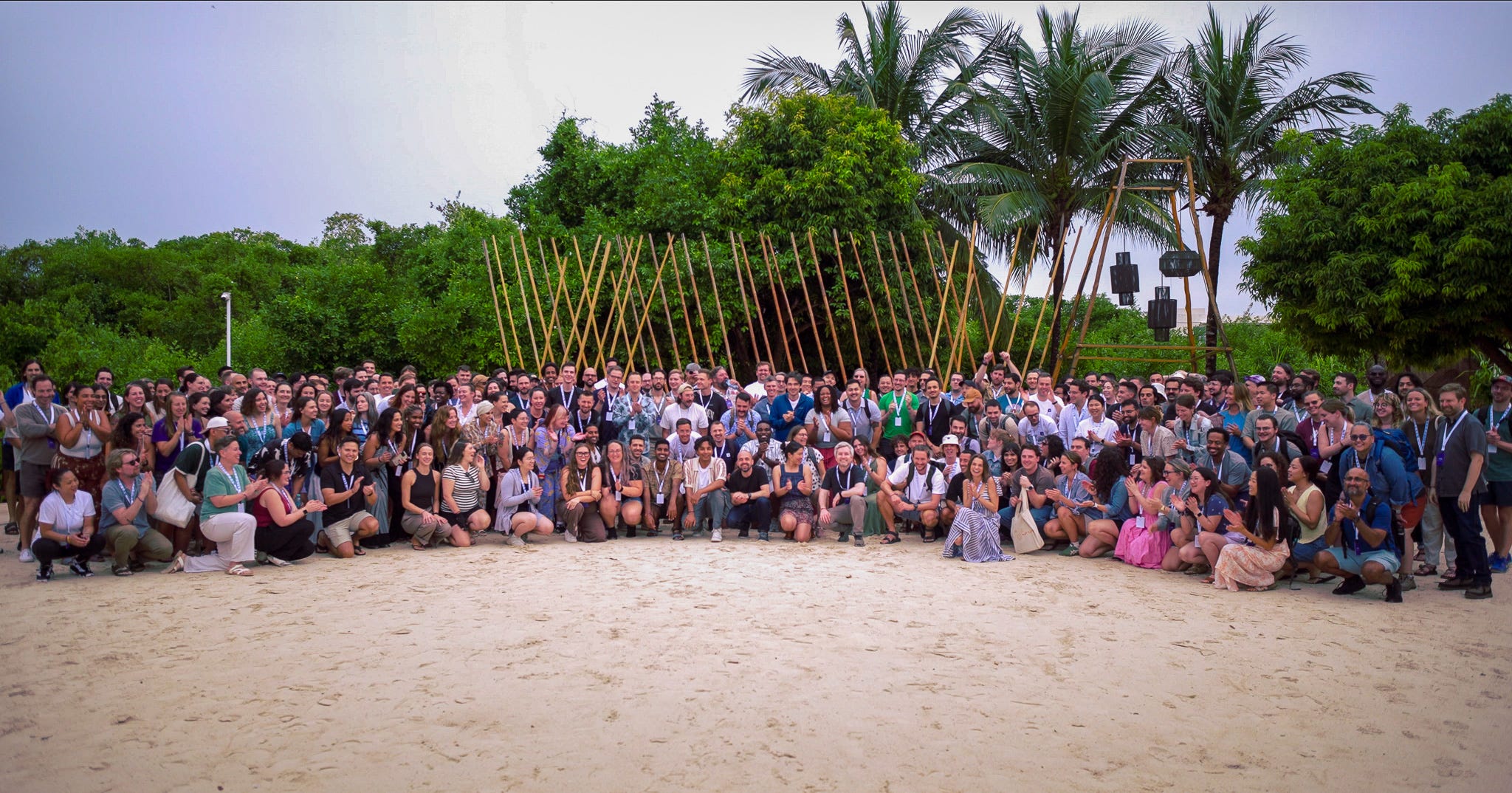
I don’t want you to get the impression that Ashby does nothing to build camaraderie among teammates. Because they do! Quite a lot, actually, for a remote company.
The company runs two week-long retreats per year; everyone is invited. This year, that happened in Lisbon, and the annual Cancun retreat will happen soon too. “All 500 people will be in Cancun this year,” Abhik said. “And then generally we do coffee chats on a weekly basis in each region. So we have an Americas coffee chat and a Europe coffee chat.”

Individual teams can also set up their own social functions and culture. What marketing does might be different from sales, which might be different from engineering, which might be different from specific parts or geographies within the engineering organization.
Cultural fit is a pretty important thing at Ashby. “There were a lot of firsts for me,” Graham Murdoch, a design engineer, said. “Remote, async, spec-driven. Very low drama. In six years I’ve never had any sort of interpersonal issue. We hire for culture as much as engineering skill.”
Why should you join now?
Ashby is a Series D startup; sometimes this is when tech companies peak. (Loom, for example, sold to Atlassian not long after their Series D and at a lower valuation than said funding round.) And if Ashby were to maintain a narrow vision of strictly recruiting software, it’s possible that the remaining TAM would not be huge. But that’s not what Ashby is doing.
“Today we’re just doing recruiting software,” Abhik said, “but we are now expanding our TAM to be fairly massive… [for example] with a product we just launched called People Workflows. If you look at Workday today, it’s like a $30B company. It was more than $60B. We believe that this is a $60B market.”

“We’re growing revenue by well over 100% YoY,” he said, “and our growth rate is actually increasing. Our software is used by the fastest-growing companies (e.g. OpenAI, Linear, Notion), and our metrics—from NRR to gross margin—are best-in-class for B2B SaaS.”
Growth so far is great. And if Ashby does what they’d like to do, their market will expand from recruiting (a few billion) to HR software (possibly well over $60B) and beyond. Lots of room.
Of course, if you are an engineer deciding where to work, you may care more about the near-term details than the long-term plan. So another reason you might join is that Ashby already has more than 100,000 weekly active users who will actually use the products you build. “You ship a product and get feedback the next day,” Abhik said. You don’t get that experience at much earlier startups. “You might not even get a user at all.”
There’s not a real desperation to exit, either. “We’re not chasing the next jump in valuation or looking to cash out ASAP,” Graham Murdoch told me. “From the start we’ve been trying to create a company that we want to work at. So that’s meant being more conservative in certain situations, or not overreacting to industry trends.”
Finally, I’d encourage you to be thoughtful about everything you’ve read so far and self-scout a bit; do you think you would be a good fit here? Do you think you could handle the autonomy well (and/or have you done so in the past)? Does the high-responsibility, mostly written, remote culture sound like a place you could go do great work?
If so, I’d encourage you to check out Ashby’s open roles here.
You can also read some of their internal documentation about how they work here (personal deadlines), here (writing specs), and here (engineering excellence) to get a feel for things.
Thanks to Ashby for supporting Next Play and making this essay possible.
* * *