

Should you join: Avoca
A missed call is the most expensive mistake in home services. Avoca picks up the phone
✨ Hey there - this is a free edition of next play’s newsletter. This is part of our series Should You Join, where we go behind the scenes on interesting companies. Our hope is that documenting these sorts of details, which never really make it to big publication press releases, can help you a) discover more interesting opportunities and b) inspire you to think creatively (for any of your own endeavors). You can join our private Slack community here and access $1000s of dollars of product discounts here.
I am going to make you a job offer that seems ridiculous: you get a phone, and your goal is to answer it. If you answer, you make $10,000. If you don’t answer, you make nothing. The phone is going to ring at least a few dozen times per day. What would you say?
You would probably say that it sounds like the easiest job in the world. I would agree. You would then ask me what the catch is. And I would answer by adding a few constraints:
You are never actually in the office
You are busy with other work all of the time and can rarely pick up
Calls often come in simultaneously (and they won’t call back)
You will get calls when you’re not around to answer them (at dinner, at 4AM)
Who cares, you say, $10,000 is a lot of money! “I’ll just hire a team.” But people are expensive, and you can only hire so many. Each of them works a shift and then goes home; on nights, weekends, and holidays, the phone rings in the dark. People get sick. They quit, and they quit often. When there are more calls than people to answer them, the calls wait on hold and aren’t afraid to hang up. Oh, and sometimes, your stressed-out call team makes mistakes.
Trickier than you thought, eh?
What I have just described is the problem that most home services businesses in the United States (think HVAC, plumbing, electrical, garage door, and similar) have to deal with. For these businesses, one call can mean many thousands of dollars, but picking up the phone is hard. Scheduling is hard. Follow-ups are hard. Re-engaging dead leads and old customers is hard.
Doing the actual, important work—the work that keeps America running—is hard enough. Running a smooth front-office operation on top of it is, for many, basically impossible.
This is what the startup we are covering today, Avoca, is solving. Over the past 3 years, Avoca has become the market leader in AI-powered front office software for home service businesses. They’re used by many of the largest services companies in the country. And in April, Avoca raised a Series B at a $1B valuation to continue fueling their growth to become, as co-founder Tyson Chen told me, “a massive, generational ($100B+) company that serves as the agentic AI layer for the multi-trillion services economy.”
So…
What is Avoca building? How does it work? How will they win? And should you join?
The product
Avoca answers the phone for home services businesses. It does other things, too (like web chat, outbound campaigns, and analytics), but got its start taking calls and booking jobs.
The way Avoca gets used is rather straightforward:
A potential customer calls.
Avoca’s AI agent picks up in seconds.
The customizable agent takes personal information and books the job; often within 90 seconds
The booking syncs directly into the business’s CRM, like ServiceTitan.
Calls don’t go to voicemail, and customers don’t wait on hold or navigate one of those clunky automated menus (called IVR). If a call is too complex or for some reason can’t be handled by Avoca’s AI, it’s passed smoothly off to a human with all of the relevant context prepared so the human can pick up and know exactly what is going on.
I think the size of the impact here is perhaps hard to grasp if you do not run (or have never worked with) a home service business. But this is a really, really big deal. “I can run a $100M business with 9 CSRs because Avoca handles 70% of our entire call volume — all while booking at a higher rate than ever before,” Bryan Enders, President at H.L. Bowman, said.
Answering calls is the cornerstone, but Avoca is a full front-office platform. For instance, the software can also run outbound campaigns (e.g. to chase a $15k estimate that went dead a few months ago, or to re-engage a customer who hasn’t called in a while). It handles web chats and texts through the same brain, so an online lead gets the same response as a phone call. And it coaches the human CSR team (this was actually Avoca’s first product!) by scoring calls and flagging ways to improve for the future.
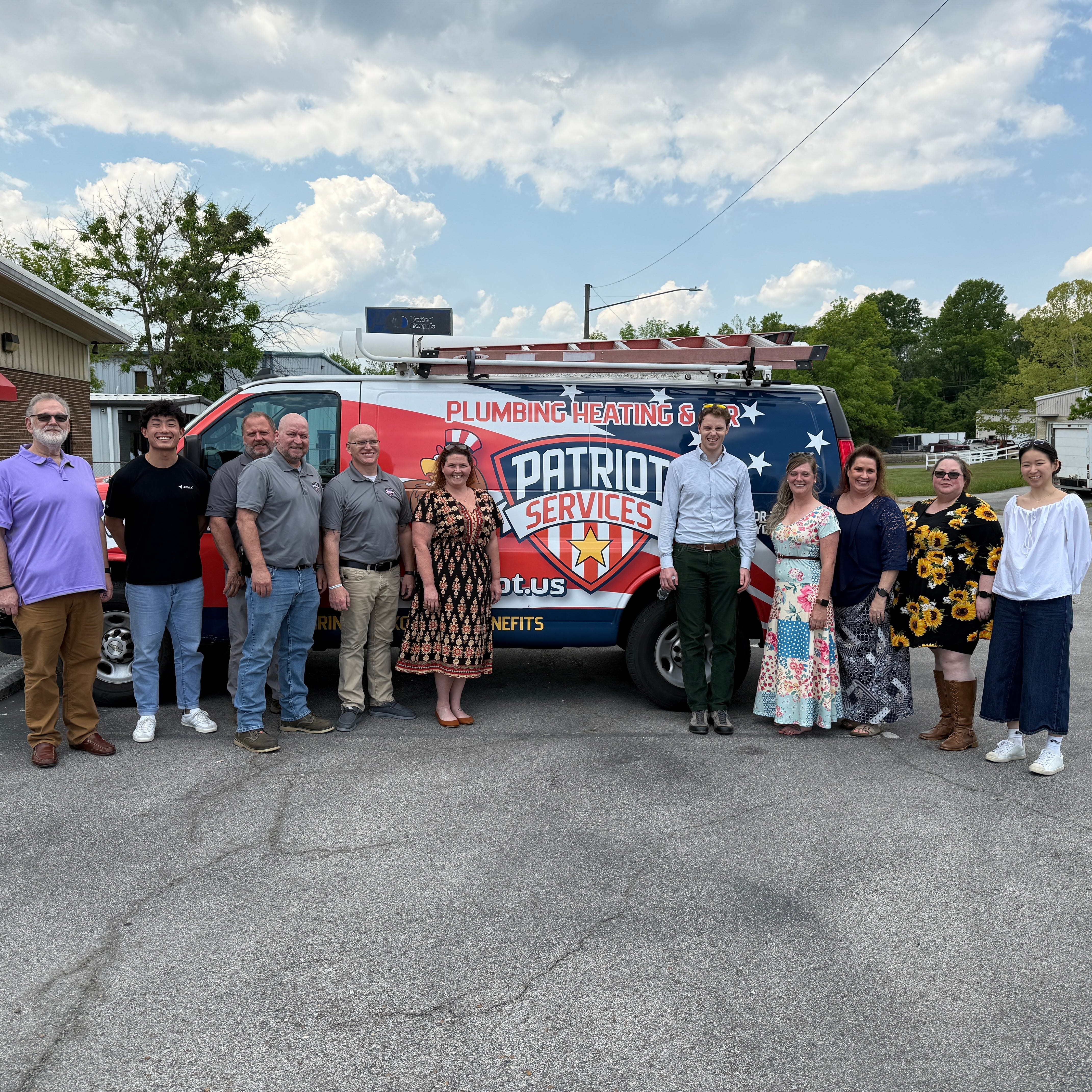
The whole platform is built by a team that spends a lot of time with the customers using it, which is part of why the software is so effective. “When a customer told us a five-minute route on Google Maps was actually forty minutes for a truck that can’t take the parkway, we shipped a truck-routing fix that weekend,” Rong Ye, a software engineer, told me. “That kind of insight only comes from being in the room.”
The strategy
You hear a lot about tech startups building the “back office” for things. For accounting, for legal, for finance. Something about the back office is sexy to startups and their investors. You also hear a lot about tech startups building products that get adopted by the Fortune 500; prime example, a number of the startups we have written about on Next Play have told us about all of their Fortune 500 customers. This is also, for a lot of founders, rather sexy.
But Avoca has earned success by doing neither of these things. They’ve started by building an AI-powered front office, and they’re building it for home service businesses; these are some of the most underloved industries in the country. (It is probably safe to believe that if Big Tech had the same phone call problem that home services businesses do, thirty identical startups would have fought over solving it years ago.)
So why the front office? Because home services businesses, at least in some ways, live or die by the front office. Most of their revenue (quite literally 90%+ for many) comes in through a phone call. These companies are often doing deals as big as, or bigger than, most B2B tech startups, but their chances of landing a deal feel rather arbitrary; it just depends whether someone picks up the phone and whether they do a good job on that call.
Everything else the business does happens after that first call. So, by starting with the front office, Avoca has put itself at the place almost every dollar needs to pass through.
And why home services? Two reasons. For one, it’s big. Home services are a multi-trillion-dollar part of the economy, and the HVAC market alone is worth more than $50B a year.
The second reason is that few people build great software for home services. Maybe this is because home services is a totally different world from the one most tech people live in. It’s not flashy, most of the founders aren’t on Twitter, they don’t want a demo, they don’t say things like ‘forcing function’ and ‘first principles’ and ‘exponential unlock’. They are just skilled people running successful companies. This can make building for home services feel less glamorous and also more complex in some ways. There’s a different vocabulary, a different vibe.
Put the two together—so, build a front office for the trades—and you start to see where the bigger vision is headed. Tyson Chen, co-founder and co-CEO, told me that he believes “AI will have the most impact not on the F500 but actually the blue collar services economy.” Phone calls are Avoca’s way through the door, but the end-goal is to build a generational company. One day, Avoca’s agents will show up “at every turn for end customers,” Tyson said. “Interact with us when you need your home fixed, junk removed, new car, energy bill questions, and beyond.”
One other reason to believe that Avoca is in a good position to win is their current position in the market. Growth looks good, and it’s fair to say that Avoca is already the market leader.
The growth
While at a restaurant conference in Dallas, the founding team at Avoca met the folks at Rescue Air, one of the biggest HVAC and plumbing companies in the city. Shortly thereafter, Rescue Air became the first in what is now a long list of successful home service companies that use Avoca: Sila, 1-800-GOT-JUNK?, Apex Service Partners, Turnpoint, and thousands of others.
Today, new customers at Avoca mostly come from inbound (referrals, partnerships, marketing) and outbound (cold calling). “We are far and away the market leaders in home services, dominate the enterprise (30%+ of the top 30 PE-backed enterprises use us)... And we have by far the strongest team of engineers and product minds,” Tyson said.
Revenue has grown 8x YoY over the past two years, ARR crossed eight figures last year, and Avoca is on track to book more than $1B in jobs for their customers this year.
Perhaps these statistics are part of the reason Avoca just raised their Series B at a $1B valuation (bringing them to $125M raised in total). Among their investors are firms Kleiner Perkins and Meritech; Alex Clayton, General Partner at Meritech, said that “three years ago, AI voice for home services wasn’t a category. Avoca created it. Today, every major contractor in America knows the name.”
It’s still early, in the grand scheme of things. A billion dollars in booked jobs is a lot, but it’s a sliver in a multi-trillion-dollar market. Most home service businesses are still running their phones the old way. Coupled with the fact that Avoca isn’t going to stop at answering phones, there’s a lot to like about where they might be heading.
The team and culture
You wake up, brush your teeth, make an espresso and take the subway to Union Square station, where you get out and head into the Avoca office nearby. (Or perhaps you do this in Santa Barbara, where Avoca has another, smaller office.) You do this five days a week. What’s it like inside? What will it feel like if you get a job at Avoca?
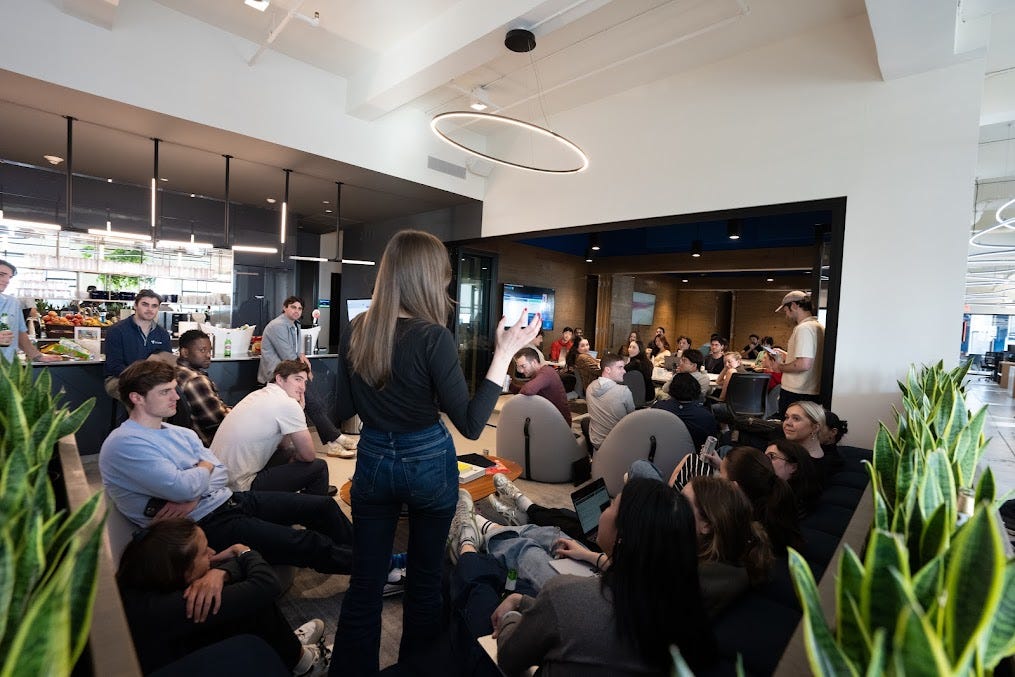
The first thing to know is that everyone else will be there with you. Avoca is not a remote company and does not seem interested in becoming one. Work, as you will learn, starts fast and you’re expected to take ownership. “Three days in and I was already on a live customer escalation call at 11PM,” an Avoca software engineer said. “That set the tone immediately: at Avoca, when a customer is in trouble, everyone shows up regardless of title or tenure.”
That sense of ownership extends all the way down to the little things. When Federico Crivelli, Head of Partnerships, asked about getting his laptop on the first week, “I was told there was a BestBuy a few blocks down the street.”
Much of how things get decided at Avoca simply comes down to who has the better argument. The culture is “brutally honest,” Rong said. “We dig into first principles and have real discussions about customer pain points. Nobody pulls rank. If you have conviction and data behind your point, it doesn’t matter if you’ve been here three days or three years.”
Along with this relatively flat hierarchy is a lot of room to act on what you think is important. “Early on, our human-in-the-loop service wasn’t working well,” Sissi Li Zhou, a technical account manager at Avoca, told me. “[So] Karim, our founding engineer, decided he was just going to build the infrastructure to scale that call center himself. He spent full nights at the office for weeks. We now have a call center with 100+ people because of it. That ‘we’ll figure it out’ mentality is what makes me think we’ll win.”
The founders, best friends and co-CEOs Tyson Chen and Apurva Shrivastava, are part of this rather than above it. “I work mostly with Apurva and he’s relentlessly focused on making Avoca successful,” Christian (a founding engineer) said. “It’s part of every conversation we have in some way. He’s great at communicating what’s important. He likes to sarcastically quip about the state of the world of software companies… And is a positive presence with everyone.”
Everyone at Avoca told me they’re impressed by how fast the team moves and how smart everyone around them is. Most startups say this to some extent, but one thing Avoca emphasized more than most was how customer-obsessed they are. There’s a policy at Avoca that every single full-time employee goes live on-site with a customer at least once a year, which I think reflects this obsession better than anything. Avoca clearly cares a lot about their customers. They stay up late shipping for them. They go sit in their trucks on jobs, figuring out what to improve. If you want, you can cross-reference these claims with the outcomes the company has achieved so far; it’s hard to argue customers aren’t happy.
Should you join Avoca?
I asked Tyson how he likes to pitch candidates.
“Avoca is one of the fastest-growing companies in NY that solves a real problem for the physical economy that powers this country. We just raised $125M at a $1B valuation from the top VCs, but it’s still the early innings. We are stacked with talent in every function and are also one of the few AI companies that is insulated from the advancements of the model companies [like] OpenAI and Anthropic.
“We’re 5 days in the office in NY, top of the line comp, and work closely with real business owners in the real world instead of just another SaaS selling to SaaS.”
A reason you might join not listed in Tyson’s list is why Federico joined: “asymmetric upside.” Federico had been chatting with Avoca and another startup, but joined Avoca because it “solves a multi-trillion dollar problem that everyone deals with [and could change] the way regular people around the world communicate with service-based businesses.”
I think there’s a unique opportunity here for the kind of person who is perhaps a bit jaded (or wants insulation from) the kinds of software that usually get funded in tech. Home services is an important but underserved market, and if you find it interesting—personally or financially or both—to make a huge impact on these businesses, you may want to consider Avoca.
The main disqualifier I heard about was a need for structure. “If you don’t drive your own vision and have strong conviction about what’s important, it’s easy to get lost in what needs to be done,” Rong said. “Nobody is going to hand you a neatly scoped ticket and tell you exactly what to build… The people who do well are the ones who see a wide-open field and sprint to the part that matters most. The people who struggle are the ones waiting to be told where to run.”
One place you could run right now is to Avoca’s Careers page. They are currently hiring across most departments in their New York City HQ and for a few roles in Santa Barbara. Cold emails can work, but “LinkedIn is very much welcome as well,” Tyson said.
Thanks to Avoca for supporting Next Play and making this essay possible.
Great pitch! Too bad I'm in CA :)