

✨ Hey there - this is a free edition of next play’s newsletter. This is part of our series Should You Join, where we go behind the scenes on interesting companies. Our hope is that documenting these sorts of details, which never really make it to big publication press releases, can help you a) discover more interesting opportunities and b) inspire you to think creatively (for any of your own endeavors). You can join our private Slack community here and access $1000s of dollars of product discounts here.
One side effect of AI is that it’s changed how a lot of roles work. And in some cases, it’s even created brand new roles. You have the GTM engineer now, for example. You have the ‘AI FDE’. And you have all sorts of people who still have the same job title but who now approach their job in different ways with AI, mostly with the goal of being more effective.
I would like to pitch a new role that you might also see catching on in the future: the customer engineer. This is not a forward-deployed engineer (who is embedded in a customer’s company). No, this is a person who’s embedded inside your company and resolves technical issues on their own, really fast, instead of escalating them.
Yes, yes, I know that support engineers exist. Today, those support engineers have the ambition to own the resolution end-to-end but lack the resources to accomplish it. I’m describing a version of the world where support engineers have the tools to own technical support requests until they’re solved, only ever escalating to engineering when there’s a bug.
You might expect some great outcomes from a world like this. Engineers would get to spend more time working on the product and less time investigating support issues. And from the customer POV, the space between problem and problem solved would be smaller; the customers of companies running support this way would be happier.
So what would it require for that kind of engineer, that kind of world, to exist?
Just like with GTM engineers and with this new ‘AI FDE’ approach, you might need new and powerful tooling. Software that you could put in the hands of current (and future) support engineers that would allow them to be a lot more effective and capable.
Perhaps what you would need, really, is Decimal: AI for technical support.
I sat down with co-founders Kevin Raji Cherian (ex-Databricks, Eightfold) and Sanjeet Hajarnis (ex-Eightfold, Uber, Facebook) and their team to learn about their product and their culture. By the end, I think you should have a clear answer to the question: Should you join Decimal?
The product
Picture the following: a developer at a mid-sized fintech has integrated your API. One day, their webhooks stop firing, so they submit a technical support ticket. What happens next?
Well, at most companies, a support rep takes over. They ask the customer for more information (since they can’t see the logs, code, or configuration). The customer answers and the rep escalates to a support engineer, who has more access but a longer queue. The support engineer pulls the logs and pings the on-call engineer, who quickly recognizes what the real problem is; they write an explanation for how to fix it, which is passed onto the customer.
Next week, the exact same problem happens with a different customer. And the exact same process is followed. Time is wasted; the problem takes too long to solve; it’s all kind of a mess.
The team at Decimal thinks that companies should have a far more efficient way to run things.
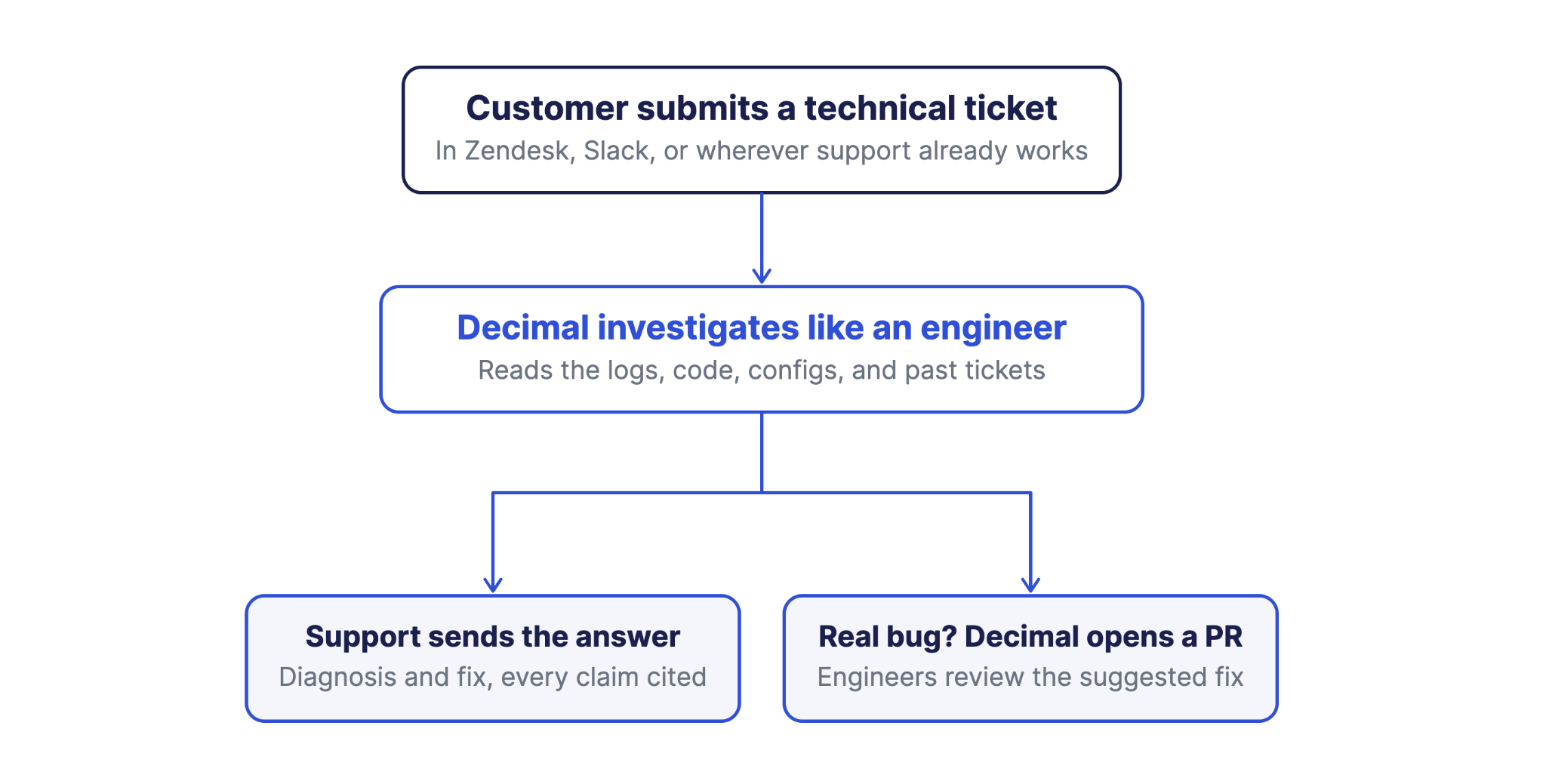
Decimal investigates the ticket (logs, codebase, etc.) just like an engineer would.
It drafts a reply with the diagnosis and the fix. All claims are sourced (no hallucination).
The support rep checks the evidence and sends it.
The customer’s problem is solved (1) much faster, and (2) without the need for support to involve an engineer on the team. If there is a real bug, Decimal sends a fix, the engineer review it, and the issue is resolved.
It isn’t easy to build a product like this; troubleshooting customer problems is not as simple as sending a ChatGPT prompt. Imagine a scenario, for example, where a customer issue contains “gigabytes of logs as an attachment,” Sanjeet said. “A naive solution of throwing the entire dump into an LLM just doesn’t work. It requires true ingenuity to make this work in production.”
Decimal also avoids the ‘solving the same problem over and over again’ loop because it remembers. Every resolution is stored, so the next customer with the same problem gets the answer without needing a re-investigation. And it works inside the tools support already uses.
A big difference between Decimal and a docs chatbot is that a chatbot just tells customers what the product is supposed to do. These chatbots “break down on the problems where a great support engineer would need to inspect code, query production logs, understand customer-specific state, [and more],” Manav Mehra, a founding engineer, told me. Decimal, by contrast, works like an engineer. It investigates and comes up with situation-specific solutions.
Granola, one of Decimal’s customers, now handles twice the ticket volume without adding headcount. Resilinc’s mean time to resolution went from 6.5 days to 2.5. Omnea averages a 3.8-minute first response. There are jokes these days about AI startups raising funding but still being ‘pre-product’ or ‘pre-idea’... Decimal, however, has built something real quickly.
The strategy and growth
An important part of the thesis here is the emergence of the Customer Engineer role. “The lines between support, success, solutions, and engineering at technical software companies are already getting blurred. This will only accelerate,” Sanjeet told me. “Customer-facing teams will need to become more hands-on and technical … and they’ll be required to own resolution end-to-end.”
In this world, Sanjeet said, “Decimal becomes the Customer Engineering Platform.”
Why now? Part of it is the way AI is changing how jobs are done and the emergence of the Customer Engineer. But part of it is also that AI made writing code cheaper. More code ships, yes, but so do more bugs (a recent report showed that bugs per developer are up 54% with high AI adoption). This creates more work to understand what the code actually does and handle support requests, which means you need more capacity to handle resolutions end-to-end.
It helps that the founders are good at this. Kevin worked on AI and infra at Databricks and Eightfold; Sanjeet on AI and engineering at Uber, Facebook, and Eightfold. “Sanjeet and I have worked together and known each other for close to a decade,” Kevin said. “Our strongest quality is our ability to work on really hard problems and keep going especially when it gets tough.”
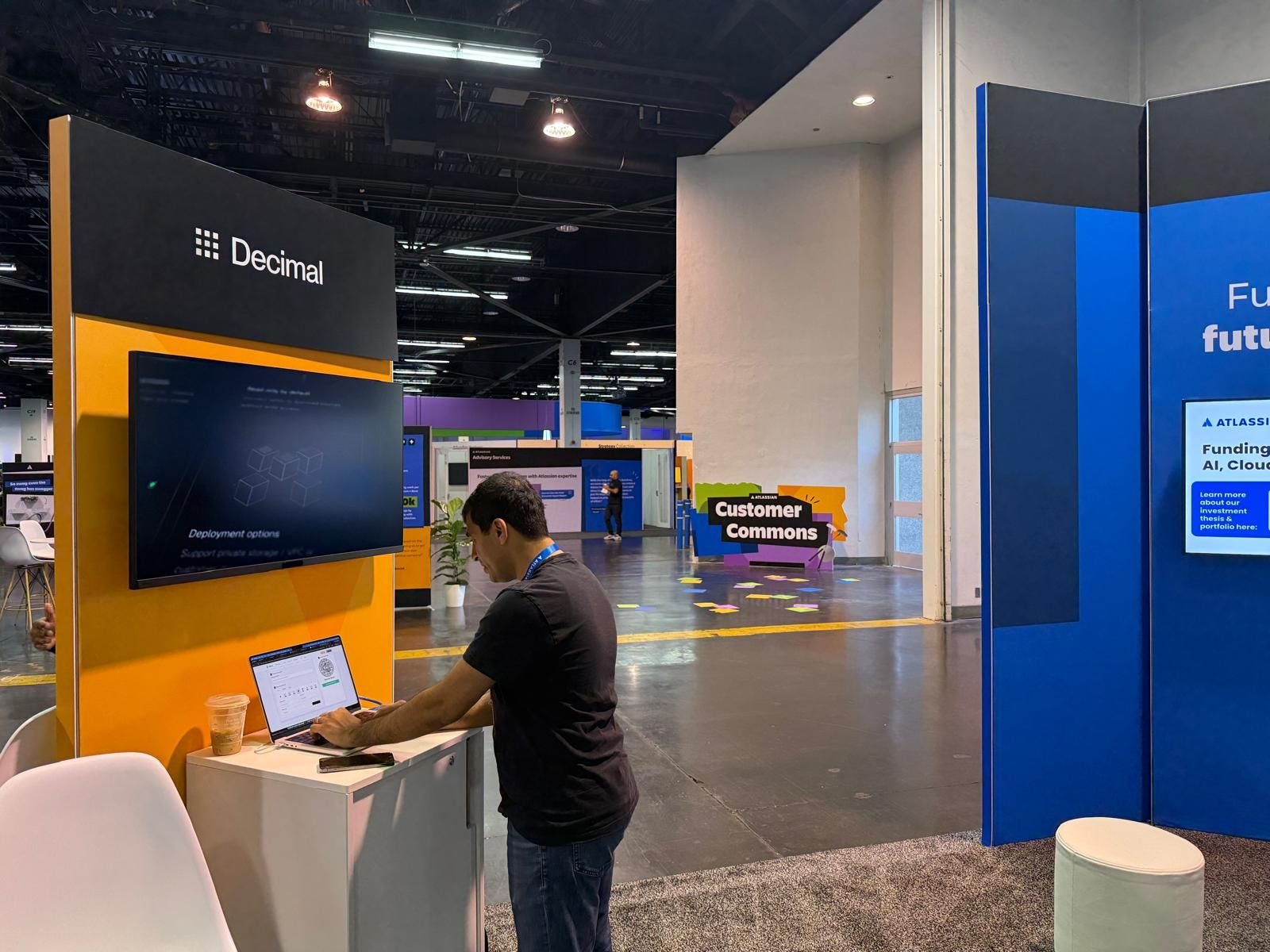
Growth so far has been founder-led. “Cold outbound on LinkedIn,” Kevin told me when I asked how they got their first customers. “Still the same & we just hired our first SDRs to scale this!” The company closed a seed round in June 2025 from Khosla Ventures (and many others). Their customers so far include Granola, Composio, Resilinc, Omnea, and Tealium. (Oh, and one founding engineer told me his first project led to a Fortune 10 customer signing.)
The longer-term goal, Kevin said, is “to own customer engineering as a category. We think there’s an immensely large business to be built sitting between support & engineering.”
The culture
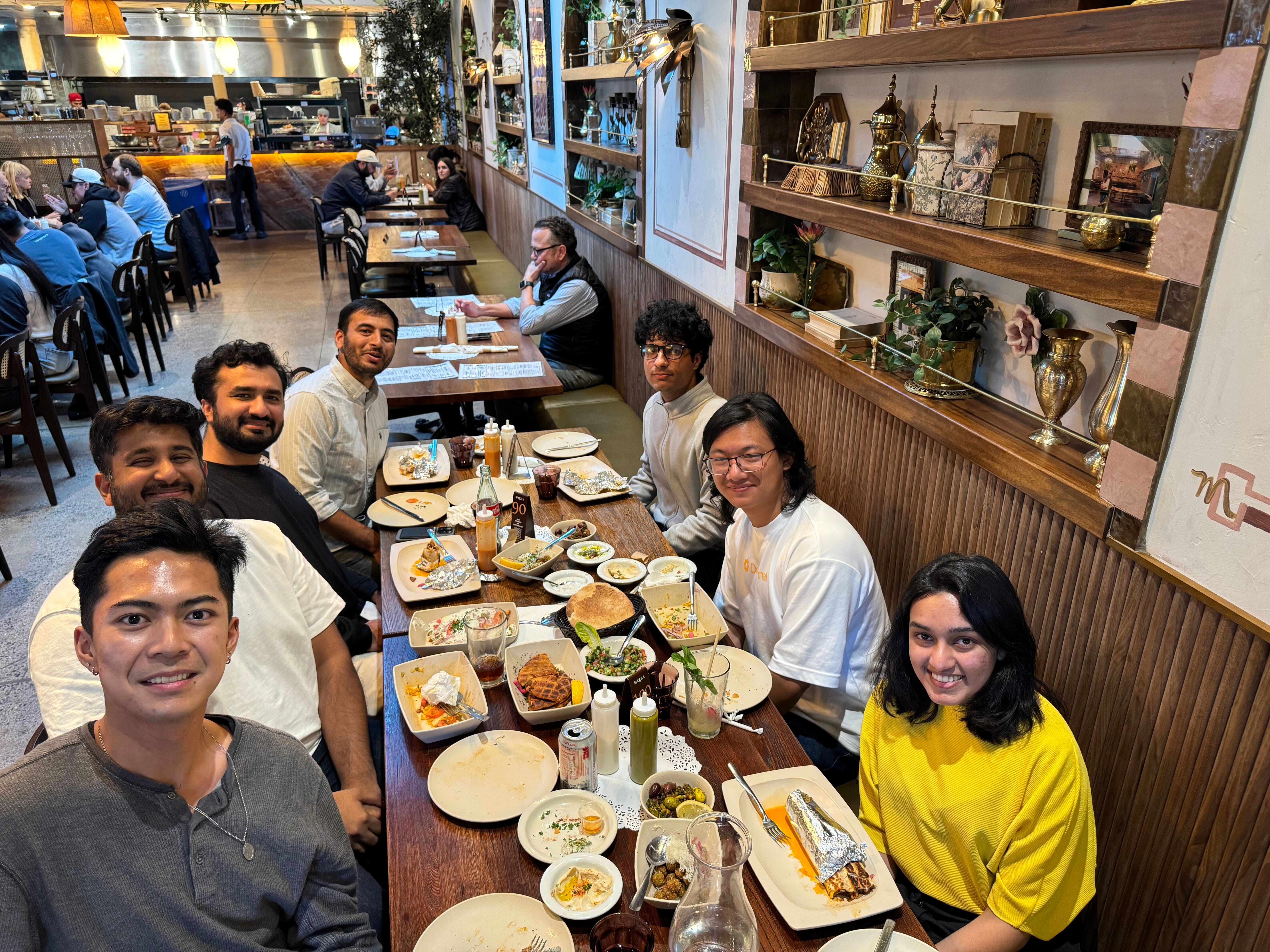
Decimal is a small team, just 6 as of this writing. Everyone works in person in San Mateo, and everyone I personally talked to had worked with Kevin and Sanjeet before, at Eightfold.
Right now, there’s no such thing as onboarding. Timothy Poon, a founding engineer, joined on a Monday and was assigned “a vague goal with a deadline of Wednesday morning. There was no gradual ramp-up or onboarding process - just a problem I needed to solve independently.”
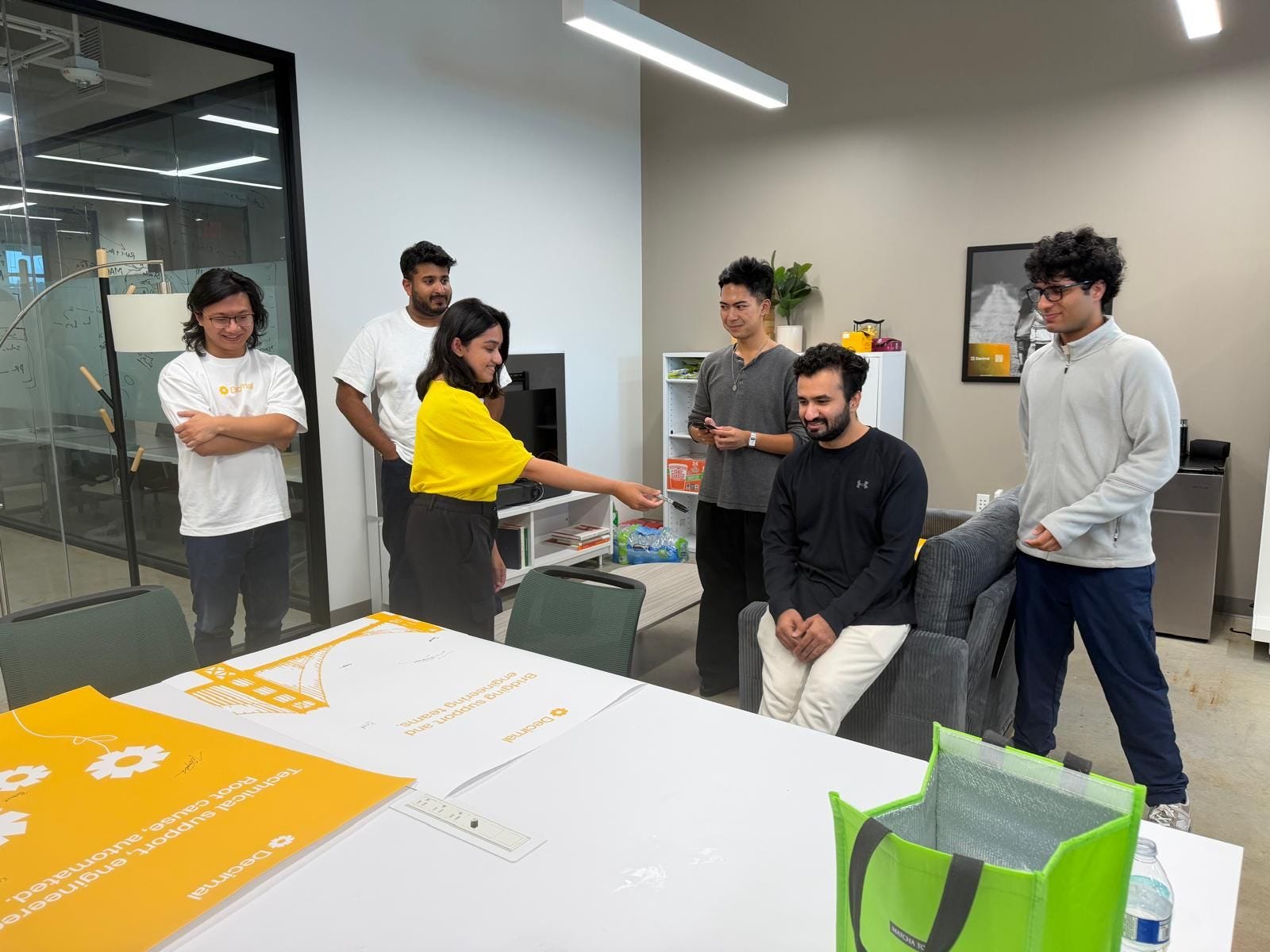
That’s more or less the vibe at Decimal as of today: intense and not many rules. Engineers aren’t handed specs. “If you own something, you’re expected to develop an opinion about the customer problem, the product, and the implementation,” Manav Mehra said. Engineers talk to customers themselves and decide what should be built. Engineers at Decimal have “more responsibility, and less process protecting them from that responsibility, than is fashionable at many tech companies.”
There are no recurring meetings; if something needs discussing, you walk over to someone. The office isn’t massive. Lunch tends to be late, and days run about ten hours.

Joining this early means you’d be working alongside both co-founders, so I asked about them. Per Timothy, Sanjeet is “very calm and cordial. He could be in the most frustrating situation in the world, and he would still be level-headed and friendly.” Kevin “has a very strong personality and style. He holds his views with strong conviction and is never afraid to speak his mind.”
What’s nice, said Manav, is that nobody on the team needs to sugarcoat things for the founders. “I don’t feel like I need to figure out what answer a founder wants to hear before giving my opinion. We argue about the problem, make a decision, and move on.”
Kevin’s take on the culture: “Intense + nice is what we try to be!”
Should you join Decimal?
Rarely do we write about startups this early for our Should You Join series, and joining Decimal may result in a different experience than joining a larger startup. There are fewer rules and there is less process and your individual work has a more noticeable impact on the company. You define your own scope, in many cases, and it’s your responsibility to form useful opinions about what you should be doing. Is this a good thing? Is it a bad thing? Well, it depends on the kind of person you are. But I think someone ambitious and self-directed could fit right in.
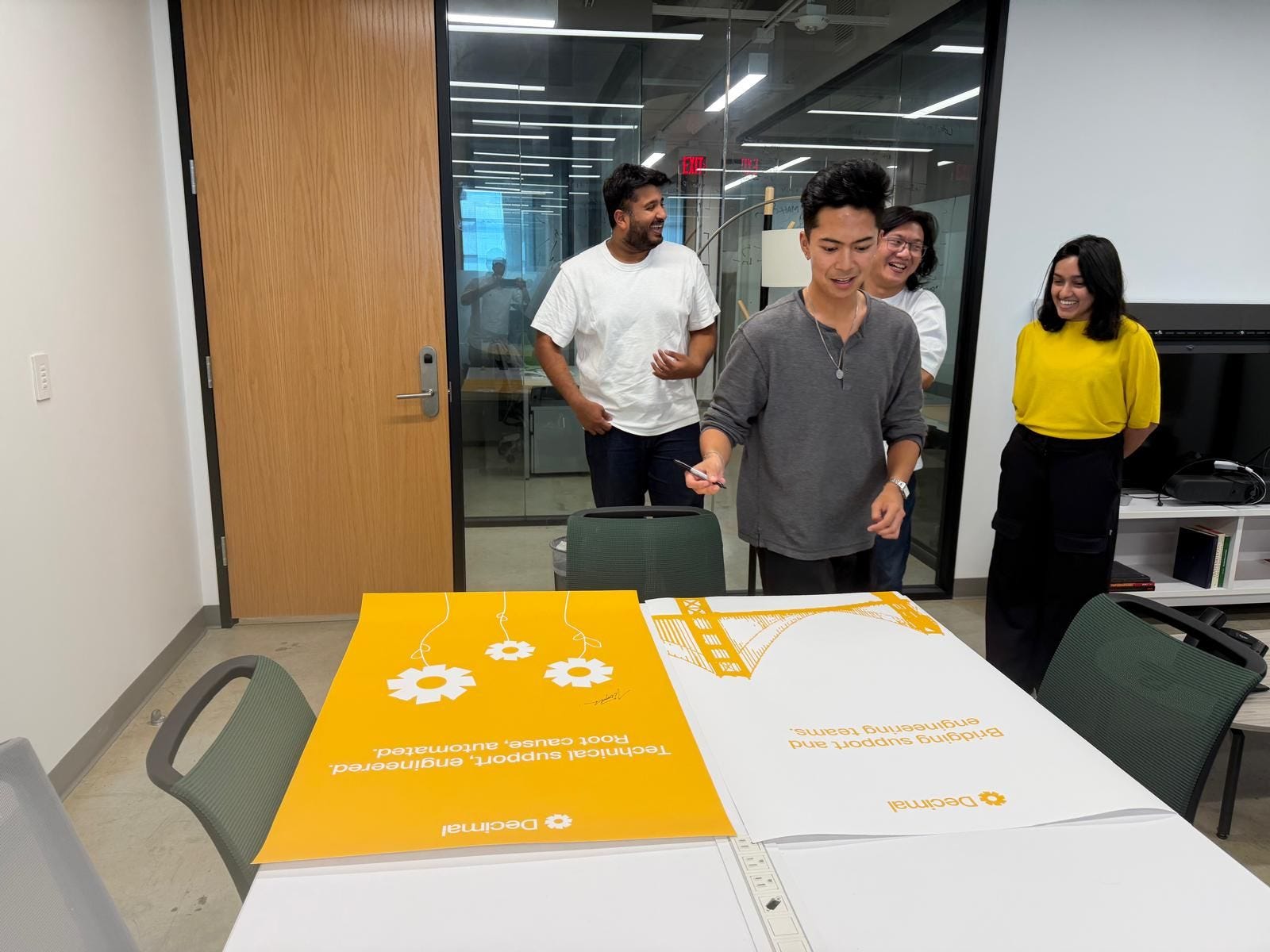
There is also the pitch. “Decimal will become an inevitability for every software company in the next two years,” Sanjeet said. “Without Decimal [there would be] an immense drag on their product and engineering team… Folks who join today will not only have an outsized impact on the product, but also on what Decimal becomes.”
Kevin and Sanjeet are looking for people who are “hungry, love hard problems, want a lot of ownership, and above all, want to win.” And because the company is so early, unconventional applications (like cold email - Kevin said he “loves” them) can be quite effective. Sanjeet said that the most successful applicants “are the ones who give us a deliverable (e.g. a demo project I can play with)” as opposed to just words.
If you are interested in joining to potentially help build Decimal into a product that becomes a household name in tech… Look at their open roles here. They’re currently hiring for an AE, founding SDR, and staff software engineer for their office in San Mateo. Though if you don’t see a role that fits what you do, there’s nothing illegal about emailing them anyway :)
Thanks to Decimal for supporting Next Play and making this essay possible.
Really like the customer engineer framing here. The proof will be whether Decimal holds up on messier tickets, not just the log-heavy ones the case studies highlight. And that onboarding story (or lack of one) tells you exactly what kind of place this is.
The 'customer engineer' role is a useful lens for Indian tech professionals weighing startup vs corporate.
Early-stage equity only pays if the company wins the category — that's a big bet against your EPF timeline.
Watch how much of the role is learning transferable skills versus niche tooling; that decides your fallback if the startup stalls.