

Should you join: Kepler
Kepler is solving one of the biggest unsolved problems in AI: trust.
✨ Hey there - this is a free edition of next play’s newsletter. This is part of our series Should You Join, where we go behind the scenes on interesting companies. Our hope is that documenting these sorts of details, which never really make it to big publication press releases, can help you a) discover more interesting opportunities and b) inspire you to think creatively (for any of your own endeavors). You can join our private Slack community here and access $1000s of dollars of product discounts here.
There’s a common arc for human technology that goes something like this:
Humans invent a new technology.
This technology is good, but has flaw(s) that prevent mass adoption.
Humans create new infrastructure that unlocks the full power of the technology.
Everyone wins, especially the humans who made that new infrastructure.
This happened with penicillin, which was promising but couldn’t be used at scale until humans came up with a new mass-production process in the ‘40s. It happened with electricity, which was limited by the short range of the DC current until AC took over. It happened with planes, which were speed-constrained by propellers until people invented the jet engine.
It feels a bit like we might be at phase 2 of that arc with AI.
Depending on who you listen to, AI is one of the greatest pieces of technology humanity has ever created. It’s going to transform everything. It’s going to make everything better. That’s what they say. And if you’ve ever used any kind of modern LLM, you can certainly see the potential; AI can do a lot of powerful stuff and it can sometimes feel impressive.
But I wouldn’t blame you if you looked around and asked… Where is all of the progress? Where is all of this mass adoption? One example of this lack of progress is in finance. Where are the investment banking analysts, or the private equity associates, suddenly being 10X more productive? Why are they still working 80+ hours per week (the pain AI was meant to solve)?
What gives? You could come up with a lot of reasons, but I’d argue there is one rather obvious explanation for why AI is still stuck at the door in a lot of major industries: accuracy.
LLMs hallucinate (i.e. generate the wrong information) a lot. This could be okay if you’re working on a personal project with no stakes. But if you’re an investment banker researching a deal, for instance, one wrong number can lose you millions of dollars.
Accuracy is a big deal, and today’s AI can rarely promise it.
Kepler, the startup we’re covering today, is building new infrastructure that aims to take AI through phase 3 of the technology arc and beyond; infrastructure that will, if successful, be a necessary layer in every industry where accuracy matters.
Their approach is to stop asking LLMs to do what they’re bad at, and to instead build a new deterministic trust layer. And they’ve started in an industry that is extremely allergic to getting it wrong: finance.
The product
Say you are an equity research analyst and you need to compare gross margins between AAPL and MSFT over the last four quarters. You would rather not spend valuable time doing this yourself, so you ask your favorite LLM.
The LLM comes back with a confident answer. It tells you that it is completely sure that it calculated the right numbers. And sure, it might have. But it also could have…
Generated a confident-looking number out of thin air.
Found a filing from a year ago and pretended it was this year’s.
Found the right filing but pulled the wrong line items from it.
Found the right line items but did the math wrong.
Found the right filings but cited the wrong sources.
Mixed filings from different periods or companies within the same answer.
[This list could be 100s of bullets long. But I’ll spare you.]
Bad news for you is that LLMs do some version of this—some version of getting it wrong—pretty often. With many finance questions, major models tend to get it wrong more often than they get it right. (For example, on the foundational task of pulling the right line item out of a 10-K, frontier models only get it right between 38% and 46% of the time.)
And so, if you are this equity research analyst, AI is mostly useless when you are dealing with anything that requires accuracy (which you often are). If you can’t trust the AI’s numbers then you need to double-check yourself, at which point you have saved no time at all.
The reason this hasn’t been solved yet is that “hallucinations are a structural property of how these systems work,” Vinoo Ganesh, co-founder and CEO, told me. There is no such thing as a hallucination-free LLM, Vinoo says, because LLMs are basically just big probability machines.
Most existing products in the space are just LLMs with finance reskins; the AI itself still generates numbers, which means it can hallucinate. Their approach is not to fix the LLM, but to instead build a separate layer underneath it:
The LLM only figures out what you’re asking
A separate, deterministic, non-AI system pulls the data and does the math
A semantic layer that ties everything together, making sure that the LLM and retrieval layer speak the same vocabulary (which is often unique per company)
When Kepler’s AI gives you an answer, it’s backed by real data that was calculated separately from your query to the LLM. You can click any number and see the exact filing, page, and line item it came from, which lets you be confident without running the numbers yourself. Kepler’s output shows up where work really happens (e.g. Excel, PowerPoint, Word), which is a lot better than a chat answer an analyst needs to copy and reformat and validate by hand.
“In finance, the model can’t be the whole system,” John McRaven, Kepler’s co-founder and CTO, said. “We treat it as one stage in a pipeline whose job is to hand the model exactly what it needs to succeed exactly at that stage.”
Kepler also learns how you do your job. Every desk at every fund has its own quirks: how they treat convertible debt, how they handle diluted shares, which assumptions go into an EV calculation. Tell Kepler once, and it applies the rule every time after that. A generic LLM averages toward consensus, but in finance, consensus loses money; personalization is important.
Kepler started with finance because it was an industry where wrong answers are extremely expensive (meaning people are willing to pay a lot to avoid them). But the accuracy problem with AI, as you might imagine, extends far beyond finance.
And if Kepler is able to succeed, you should expect to see their architecture show up everywhere else accuracy, auditability, and verifiability matter. (The team told me they’re already getting inbound from people in other industries asking to implement Kepler’s architecture on their datasets.)
The strategy
It is not outlandish to say that trustworthiness is one of the biggest problems that still needs to be solved for LLMs to achieve their full potential (however you would define that). A huge amount of the hesitation around using AI is not knowing whether you can trust the things it is saying to you, and a huge amount of the ridicule directed at AI companies takes the shape of “look at this dumb AI saying dumb untrue things.”

In the future, “the default answer to the question ‘how do I use AI in trustworthy ways is Kepler,” Vinoo said. Kepler will be used everywhere it matters: “in finance, in law, in medicine, in defense, in any domain where being wrong has real consequences.” In other words, if you want to produce accurate and verifiable work using AI, you’ll need to use Kepler’s infrastructure.
Finance may have been the smartest place to start, and the future holds a lot more. But the skeptic in you might voice concerns. “Why won’t the big model labs just do this better?” you might ask. There are two answers.
The first is that the labs are not really trying to do this. Every dollar a foundation model lab spends building per-customer data infrastructure, vertical-specific ontologies, and the coding of how Desk A treats convertible debt differently from Desk B, Vinoo says, “is not a dollar spent on the core model.” Their economics push them further up the stack.
The second is that Kepler isn’t really competing with the labs. Other “AI for finance” companies build features on top of a foundation model, and those features are at risk the day a lab ships something similar. Kepler builds the layer underneath. This infrastructure (which is a lot deeper into the plumbing than foundation labs go) is complementary with what companies like OpenAI and Anthropic are building. It opens up potential use cases for their LLMs, which can now be used in higher-trust workflows that previously (and still today) defaulted to manual work.
The team and growth
Co-founders Vinoo Ganesh and John McRaven spent a combined 18 years at Palantir, where they spent time working in demanding, accuracy-focused environments. John ran Palantir’s time-series and analytics products with customers like BP and Airbus. Vinoo led the Spark group across Foundry and led a number of customer engagements across financial and defense verticals (including in Afghanistan).
After Palantir, Vinoo ran a geospatial company called Veraset to $15MM ARR and an acquisition. He then worked as the Head of Business Engineering at Citadel, building for the PMs that are basically Kepler’s target customers today. The two founders have, in other words, already built deterministic data infrastructure at scale in some of the most difficult environments to do so. Kepler is the inevitable extension of this background.
The team around them takes the same impressive shape. Just look at some of their founding team: Susannah Meyer, founding engineer, came from Meta and was Head of Engineering at Enigma Labs. Sara Kromwijk spent eleven years at Palantir leading projects like Palantir’s ontology layer. Chris Martin spent 15 years at Palantir working on optimization problems across the organization. Sean Gorsky directed ML at Capital One. Rui Zhang managed a 100M+ chemicals business before joining the investment team at a 10B industrials PE firm. Eddie Hammond ran business operations across Oddity through its IPO.
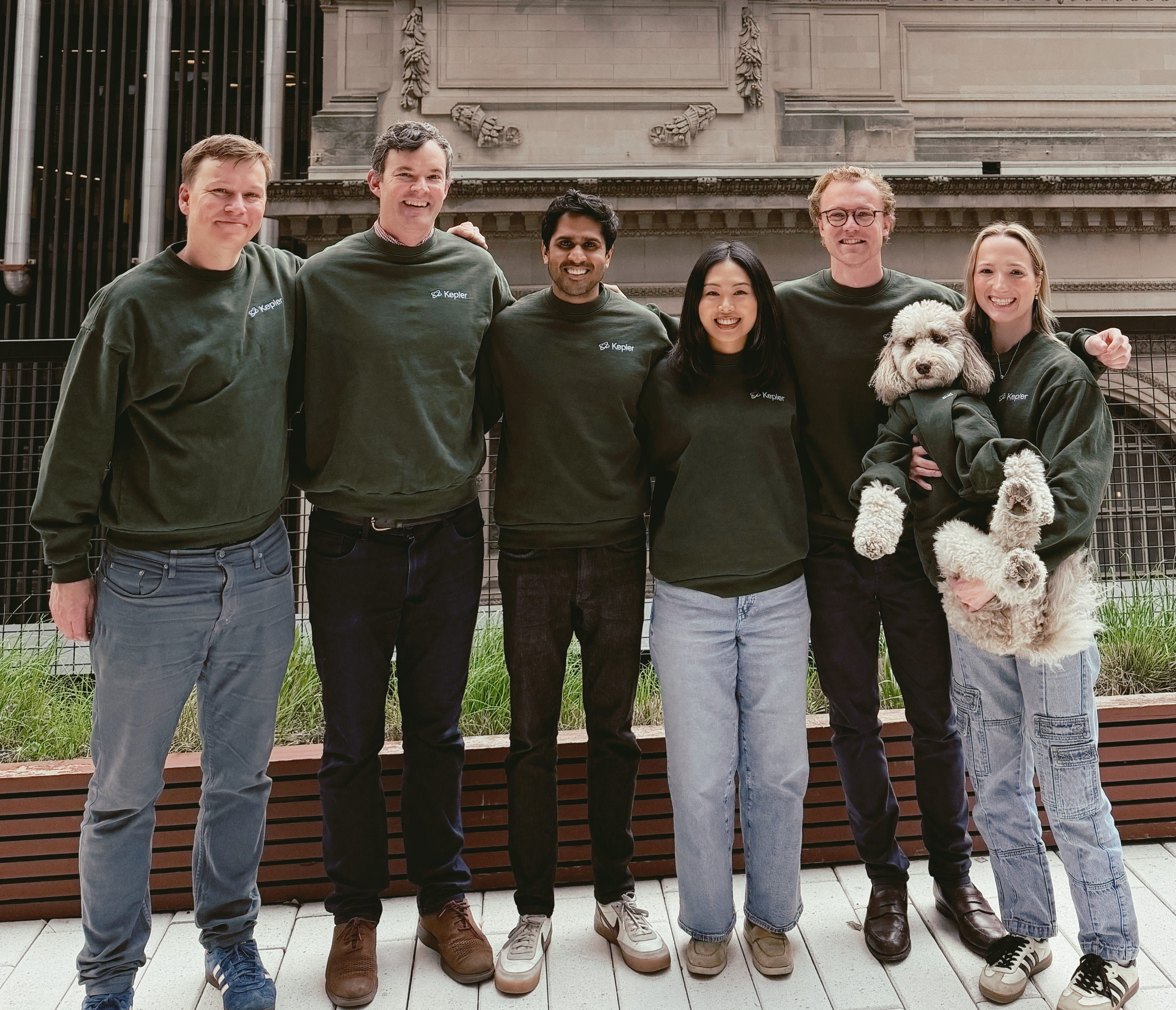
“They’re the kind of team who could get comfortable jobs at a frontier lab any day,” one person on the team told me. “But instead chose to build together.”
There’s less to say publicly about funding, partly by design, since Kepler hasn’t formally announced a round. But Vinoo confirmed they’ve raised $7M+ from operators who built the data and AI systems the rest of the industry now runs on (including the founders of OpenAI, Meta AI Research, MotherDuck, dbt Labs, Outerbounds, and Square/Block.)
Kepler keeps its growth numbers quiet by design. In finance, access to a tool like this is itself an edge, and many of their customers don’t want competitors knowing they use it, so staying low-profile is the point. ‘We have an unreal amount of customer inbound,’ Susannah Meyer said, ‘our entire focus right now is on shipping product to service that demand.’ Outside validation has started showing up regardless. In April, Anthropic published a piece about Kepler, the kind of recognition most startups don’t get this early.
The culture
Before writing a single line of code for Kepler, Vinoo and John spent sixteen hours in a small room with a goal to define the values they’d hire against. They walked out of the room with six: forward-deployed with product DNA, extreme ownership, production-first engineering, trust as the default, communicate with intent, and earn it every day.
Speaking of the bar, well, it’s high. Kepler is tackling one of the bigger problems in AI adoption right now, which means the team has to clear a high bar. “The bar here is set by people who spent eleven years at Palantir building ontology infrastructure, or who shipped production systems at Meta scale,” Vinoo told me. I think this is exciting for the right kind of person, and in fact most people at Kepler would tell you the talent density is part of why they joined.
The hiring process reflects this. There are no LeetCode interviews, no whiteboard puzzles, no rooms without internet access. “We give candidates a real problem we actually have to solve,” Vinoo told me of the hiring process for engineering, “and they use AI tools while solving it.” What he and John look for is how someone defines assumptions when the problem is ambiguous, whether they can ship fast, and whether they can push past the scope of what was asked.
Kepler is still small, so if you join you’d expect to spend meaningful time around Vinoo and John. So what are they like? Nearly everyone I spoke to referred to them as opposite sides of the coin. Vinoo is fast (“his brain runs at 100 miles per second,” someone said). John is the more deliberate counterweight. Eddie Hammond, who runs strategy and ops, put it this way: “Vinoo has the answer before you’ve finished the question, and he’s already pressure-testing it against the next three. John is the one who slows the room down and asks the underlying question nobody thought to bring up. Together they get it right the first time.”
The culture that arises as a result of all this is intense. The pace is fast and the bar is high. But, for the right person, it’s exciting to work on such a big problem alongside such great people.
“Most intense companies make you choose: be sharp or be liked,” Eddie said. “Kepler doesn’t. People are direct, the bar is high, and yet nobody keeps score on anyone else. That’s core to the culture.”
Should you join Kepler?
Kepler is small, but they already have an effective product being used by real firms in the field. If they accomplish even a fraction of their biggest ambitions, they could be worth a massive amount of money one day. And if you have read this essay so far and are convinced by the thesis, you might want to consider applying.
So what does a day at Kepler look like? Well, if you are an engineer, you might spend the morning three layers deep in retrieval infrastructure. By the afternoon, you might be sitting next to a portfolio manager, watching them do their job. You learn the way this fund defines enterprise value isn’t the textbook way; it’s some niche approach you’ve never seen before. So you encode the rule. Then you find out there are fifteen edge cases the analyst didn’t mention. The retrieval system underneath wasn’t built to handle them, so the engineer has to go rebuild that too. That might be a random Tuesday at Kepler.
I especially get the feeling that Kepler is good for people who want to work around people they can learn a lot from. Susannah Meyer (founding engineer) was leading engineering at a different early-stage startup before Kepler, and she left because she “wasn’t learning enough from the team,” she said. Kepler, by contrast, looked like the kind of place she could join and learn a lot alongside some great people. That bet is paying off.
And yes, Kepler is looking for people who are truly great at what they do (the pedigree of their existing team is good evidence), but more important than a fancy resume is what you’re able to do within a fast-paced, low-structure environment. “When we find people we get excited about, it’s because of a demonstrated path of ownership that shows they can thrive in a rapidly changing situation,” Vinoo said.
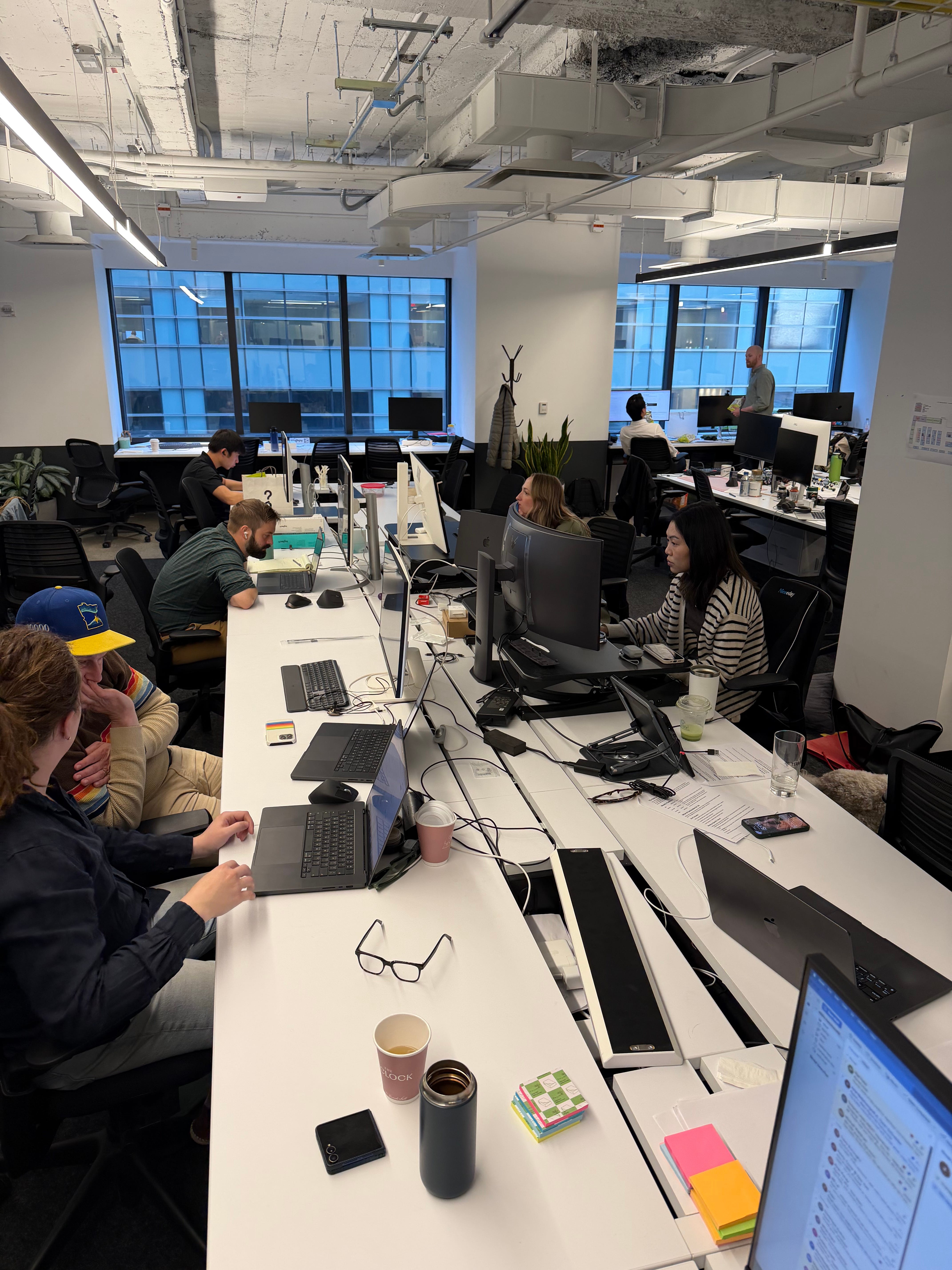
If you’re excited by the idea of going into Kepler’s New York City office, working alongside a bunch of talented people (and the office dog, Wagyu), taking ownership and shipping excellent work, then I’d encourage you to explore Kepler’s open roles.
Kepler specifically told me that they’re hiring engineers right now, and that “cold emailing is the single highest-signal way to get our attention.” They have just one ask of your email: skip the resume recap and skip the pitch. Instead, if you want a job at Kepler, send an email with one paragraph describing the most complex production system you’ve shipped end-to-end.
Send it to join@kepler.ai. They read every one.
Thanks to Kepler for supporting Next Play and making this essay possible.
https://substack.com/@zpftechnologies?r=86qmqm&utm_medium=ios&utm_source=stories&shareImageVariant=blur
Step into the frontier of quantum discoveries. Join our community advancing boundary-conditioned ZPF research—subscribe to support the mission and stay connected.
Any company that includes the dog in their corporate photo has values that aren’t just vibes, they’re furniture. The dog didn’t get invited into the picture. The dog picked the location. :)