

Should you join: Listen Labs
Inside the customer research startup that grew 15x last year and raised $100 million from Ribbit and Sequoia Capital
✨ Hey there - this is a free edition of next play’s newsletter. This is a Spotlight, part of a series where we go behind the scenes on interesting companies. What makes their business work? What is the culture like? What is the long-term strategy? How do they get their customers? And more. There’s so much noise out there; our goal is that these deep dives should be actually useful for you. You can join our private Slack community here and access $1000s of dollars of product discounts here.
Y Combinator famously offers two big pieces of advice to startups:
Write code.
Talk to users.
I’d argue that this is good practice for all companies; making a better product and understanding your users is generally upstream of earning more profit.
It also feels like we sort of have the first item on that list covered. Or at least we’re getting close. The comparatively underrated part seems to be that second piece of YC advice: talk to users.
Historically, if you needed to run a study on customer, product, or market, there was no great way to approach it. Research has long been one of the slowest, most expensive, and most unreliable processes in business.
The company we are writing about today, Listen Labs, is transforming that status quo by building a new kind of customer research platform that is faster and more cost-effective without compromising on quality.
The pitch is simple: Listen accelerates your research by designing studies, sourcing participants, conducting interviews, analyzing results, and making them easily presentable. Traditionally, this would be an expensive endeavor that takes months and requires working with multiple legacy solutions like Qualtrics, Gartner, or AlphaSights. Using a carefully trained AI researcher infused with best practices, Listen shortens the research to results loop to mere days.
Listen Labs announced a $69M Series B in January and already counts hundreds of massive enterprises as customers. So we chatted with their team to figure out how it all works: what is the plan for the business? Why do they believe it will win instead of competitors? What makes the culture unique? And should you join?

The product
Market research has been stagnant for decades. “Qualtrics has been running the same legacy-style surveys for years and is still worth $12B,” Alfred Wahlforss, CEO of Listen Labs, told me when asked about the market. “A single Fortune 500 company might spend $10M on Qualtrics and $100M on research agencies.”
Usually, “even on an expedited timeline you’re talking 4 to 6 weeks from true question to insight and action,” said Brian Davia, Head of Consumer and Business Insights at Sweetgreen, a Listen customer.
With the painstaking manual work done with AI, Listen Labs says you can go from a question to a useful answer in as fast as a few hours.
Here is one example of how you might interact with the product. Say you want to know which of two ad concepts resonates better with Gen Z women in tech. You tell that to Listen and their AI turns your plain English question into an effective interview plan that you review and approve. Then Listen sources young women in tech from its pool of over 30M people (or, your own user database if you prefer) and dispatches an AI interviewer to talk to them, simultaneously, in real-time video or audio conversations. Just like a human would, with thoughtful follow-up questions and clarifications.
A few hours later, you have an in-depth analysis of the findings, all traced back to the exact timestamps or transcripts, and reports ready to explore and share.
Ten years ago there was no version of the world where this would work. The big speed bottlenecks (like study creation, interviewing, and reporting) had ceilings. You couldn’t just go out and talk to all of your customers all at once. Now you can, in any language, at any hour, and in any medium, seemingly without compromising on quality, because today’s AI models are finally robust enough to be trained in the right way to ensure quality.
Listen’s traction has been encouraging. Customers range across startups and Fortune 100 companies like Microsoft, Alphabet, Robinhood, P&G, Nestle, NBCUniversal, and Anthropic. Using insights from Listen, Sweetgreen launched its popular Max Protein Bowl, Chubbies iterated on its kid’s swimwear line, and others ran studies on ads for the Super Bowl and Olympics.
In the nine months since they launched, Listen grew annualized revenue 15x, crossing eight figures. They have conducted over one million user interviews and raised $100 million from Sequoia, Ribbit Capital, Conviction, and others—including their $69M Series B announced in January. (Fun fact: Bryan Schreier, the Sequoia partner who led the deal on their side, was an early investor in Qualtrics.)
“Most of our growth now is inbound and word-of-mouth,” Alfred said. Listen’s AEs are back-to-back from 9AM to 9PM. “We’ve just started to build up our go-to-market machine.”
This is an impressive start. But how does Listen Labs win in the long run?
The strategy
Here’s how Alfred, the CEO, laid out the strategy:
“Phase 1: Displace legacy research vendors by providing a faster, better, cheaper way to provide customer research. Then democratize customer research by making it possible for companies to do it in places where they couldn’t before. Phase 2: Expand the platform to act on the insights in addition to collecting them. Phase 3: Become the de facto infrastructure for understanding people across all organizations, bringing forth a world that works in the way people want.
One piece that might help pull this off is a moat that most other AI companies do not have: Listen’s pre-qualified respondent pool of 30M people. This is the kind of thing that takes years and a lot of skill to build; you don’t vibe code your way to a pool of 30 million people in a weekend.
It’s partly this real, almost literal moat that sets Listen apart “from many other AI companies that are relatively thin AI wrappers,” Tobias Schindler, a founding engineer, told me. “We do the end-to-end user research process… That big AI labs would not get into.”
So Listen Labs may be somewhat insulated from one of the big fears around AI: that some upstart competitor could drink your milkshake simply by being clever, or that a company like Anthropic could trivially build their own in-house version and put you out of business. Listen has built a big, physical wall.
The early-mover advantage compounds in this space, too. “Every interview builds reputation scores on participants. We know who gives great answers. Every study makes the next one better,” Alfred said. There’s a clear flywheel for improving the product.
A final piece worth considering is the idea that Listen Labs’ success might create a Jevons paradox, where increasing efficiency increases demand. Companies don’t do as much research as they’d like to these days because it’s expensive, slow, and unreliable.
If research could become faster, cheaper, and more effective, though… The market could grow larger still. And that’d be a milkshake worth drinking.
The culture and team
Google had ping pong and foosball. Cursor has the whole “shoes off” thing. Walk into Listen Labs’ SF and NY offices and you will witness fika: a Swedish tradition where you’re meant to relax while enjoying coffee and pastries. Every Friday, the team gets together to welcome new team members, celebrate people who exhibited any of their six values (iterate to greatness, love the details, make it happen), and hear updates across sales, growth, and product. It’s also a time for Alfred and Florian to answer employee questions (they encourage “spicy” questions) that they solicit from the Listen platform.
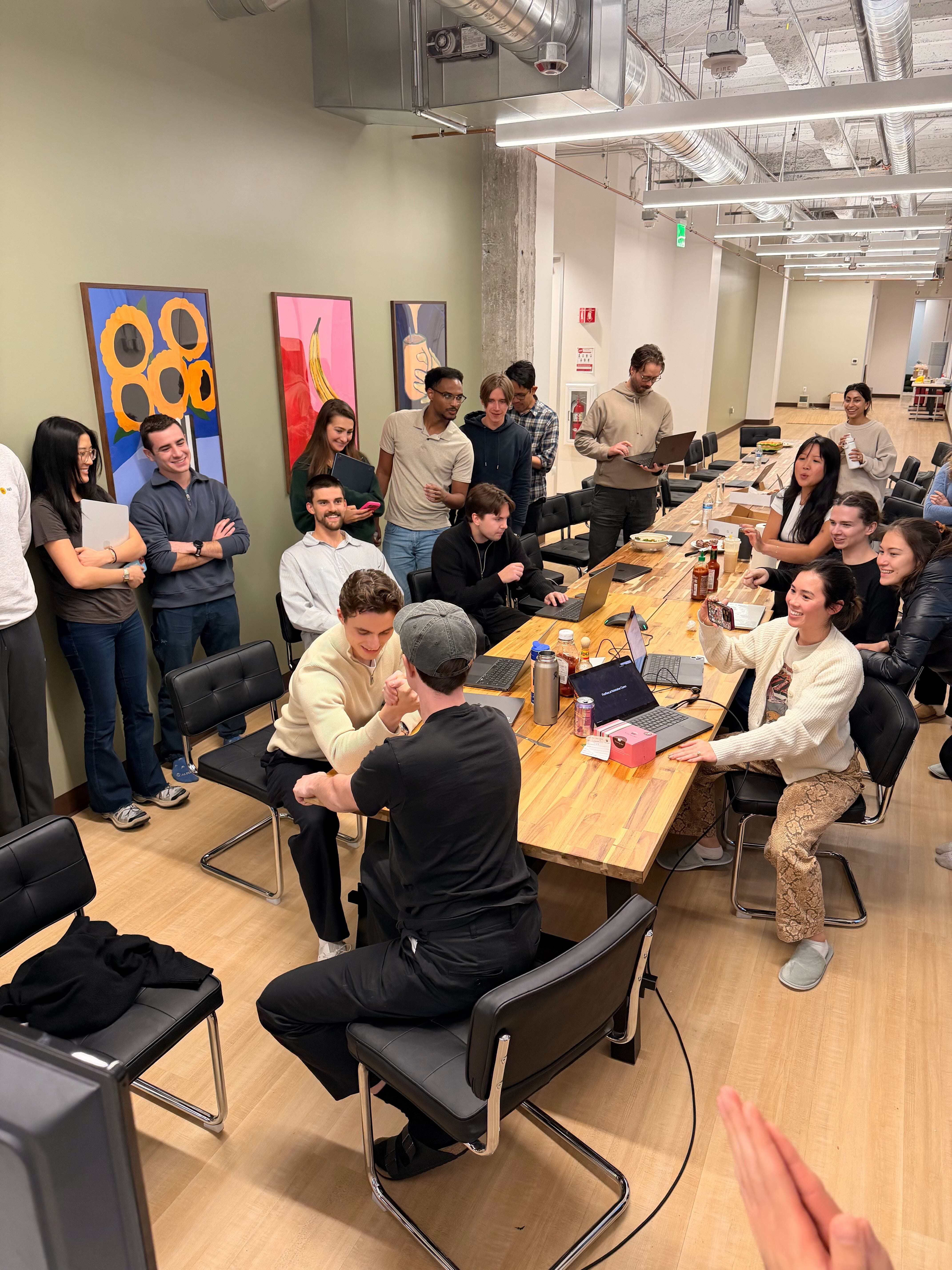
Fika is the only big company meeting that Listen Labs holds. “Otherwise, meetings are almost never had,” someone told me. Engineers reported one to two meetings a week or less.
There’s another unusual internal communications norm: employees are encouraged to send DMs to one another in a channel called #private-dms. The thinking behind this is to create more transparency, better collaboration, and more accountability. Because these conversations are open and public, it lets others chime in and add context or support where they otherwise wouldn’t be able to in a private DM. This sounds a little insane until you try it, I was told, at which point you realize it helps people move faster and stay up to speed on what’s happening.
Oh, and they take their shoes off in the office, too. For good measure.
The obvious follow-up: “Who will I be enjoying my coffee and pastries with?”
Co-founders Alfred Wahlforss and Florian Juengermann met at Harvard. Florian is a German national champion in competitive programming and has worked at Tesla Autopilot, reporting to Elon; Alfred previously founded a YC-backed healthcare startup.
The broader team has the resumes you might expect (ex-Rippling, ex-Affirm, ex-Twitter, and so on). The team also counts three IOI medalists. When engineer Krish Mehta started on Labor Day, he expected to be alone setting up his laptop. Instead the whole engineering team was in, and Florian was remotely provisioning him access to every system from a trans-Atlantic flight. By day three, Krish was working on major infrastructure refactor and by day five, pitching new platform features.
Alfred and Florian know all too well that to keep accelerating their hockey stick growth, they needed to keep attracting top talent. As a startup, competing with AI labs and Meta on $100 million offer packages is a non-starter, so they’ve found creative ways to stand out. In March, they threw a Berghain-themed techno party to celebrate their Series B, hosted at a multi-story condo in SF, complete with a discerning bouncer. They invited customers, potential candidates, and friends of Listen employees. The goal was primarily to have fun together, but also recruit customers and top talent.
In 2025, they bought a billboard in SF and plastered a challenging engineering puzzle on it with no logo or text. The posts on X went viral, reaching over 3 million impressions. SF Standard explained the challenge: “The test asks participants to design an algorithmic bouncer for the legendary German techno nightclub Berghain…The player whose algorithm rejects the least number of people” won an all-expenses-paid trip to Berlin. 1,000 people attempted the puzzle, 60 solved it, and 1 engineer went to Berlin, on Listen’s dime. It was another way for Listen to build its employer brand and filter for top engineers in an unorthodox way.

Should you join Listen Labs?
Sometimes I find it’s easiest to decide whether you should join by listening to why other people at the company joined. So I asked Erik Bartlett, one of Listen Lab’s founding engineers (who was also one of the first few hundred people to work at Affirm).
“I was about to turn 30, and felt like I might as well take some big strategic swings by going very early somewhere; I could always go back to big tech in a few years if things didn’t work out. A longtime friend who was part of the talent team at Pear VC introduced me to some of his portfolio companies. Listen (then Merlin AI) was the first one I chatted with.”
Listen Labs is later-stage than when Erik joined—they are Series B—but still early enough for you to get meaningful equity and mold something life-changing if things work out.
You might also be a fit if you’re the sort of person who will do anything that helps the company, not just a narrowly defined list of responsibilities. “If you only want to work on your features and don’t debug customer issues, it’s probably not a great fit,” a founding engineer said.
Ria Shah, a growth lead, said Listen optimizes for “moving faster over doing things the ‘right way’. We’re a culture of being very quick to execute. The pace demands your best work.”
Listen Labs is currently hiring across most departments. If you want to get creative with your application, you absolutely can. “One of our recent hires shared ten really amazing ideas, which showed he spent a lot of time thinking about our space and was passionate about joining the team,” Alfred said.
You can read about some of our ideas for getting hired here, if you’d like to join what would be—if successful—a startup that changes how companies make their most important decisions.
Thanks to Listen Labs for supporting Next Play and making this Spotlight possible.
1. “research takes months” is (thankfully) not true . It can take just an hour to talk to a few people about your idea. So it seems like this is already being built on a strawman or maybe trying to help companies justify why they haven’t invested in research in the past.
2. Large companies definitely need to figure out how to cut the cost and time of recruitment ( it truly is the real bottle neck in research), but I’m not sure why you wouldnt want to invest that time savings into actually talking to your customers? It’s literally the highest leverage thing you can do.
Overall,
I think leveraged for certain parts of the workflow and certain studies this can be powerful, but I can see this just leading to a lot of research theater that doesn’t lead to companies making better decisions.
And until I think they are able to show any evidence of that, it’s hard to be bullish on these types of companies.
The interesting question isn’t whether Listen replaces old research vendors. It’s whether it makes research cheap and fast enough that companies start doing 10x more of it. If that happens, this becomes less a substitution play and more a market expansion play.