

Should you join: Mintlify
The rise of AI might make Mintlify’s knowledge-as-infrastructure pitch stronger than ever.
✨ Hey there - this is a free edition of next play’s newsletter. This is part of our series Should You Join, where we go behind the scenes on interesting companies. Our hope is that documenting these sorts of details, which never really make it to big publication press releases, can help you a) discover more interesting opportunities and b) inspire you to think creatively (for any of your own endeavors). You can join our private Slack community here and access $1000s of dollars of product discounts here.
What would happen if you brought a coffee machine to an uncontacted tribe? A real fancy machine, maybe one of those expensive La Marzocco ones. The kind of machine capable of producing some of the best-tasting espresso in the world.
So you go to the tribe and you just hand it to the first person you see. What happens?
Well, nothing happens, most likely. The coffeemaker is capable of producing some delicious espresso if you use it, but it is a useless hunk of metal for someone who does not know how to interact with it. And so your gift might be received with little more than a shrug.
There is, however, one obvious solution: bring them great documentation. Hand them a beautiful instruction book that helps them figure out how to use the coffee machine so they can get a ton of value out of it. Now your gift is more than a hunk of metal. Now it is something extremely valuable. As you leave the tribe, they might ask you to bring more next time.
This is not too far off from what happens in the real world:
Products are (usually) only useful if people know how to get value out of them.
Companies are (usually) only successful if the people inside of them can create value.
Problem is, documentation is not easy. It’s not easy to write effective instructions for using your product or working at your company. It’s not easy to make that writing look good and be easy to navigate. It’s not easy to make sure every single line of your documentation is up-to-date, especially when your product changes near-daily. And, in today’s world, it is not easy to make sure your documentation is well-designed for AI agents to read and use it.
That is why today’s spotlighted company, Mintlify, exists. Documentation now serves both humans and AI agents, and what agents need is constantly evolving. Mintlify keeps you current automatically. Companies like Anthropic, Coinbase, Polymarket, and OpenClaw already use it; if you’ve read developer docs recently, there’s a good chance you’ve seen Mintlify in action.
AI agents now account for 60% of Mintlify’s traffic, and what they require changes constantly: llms.txt, MCP servers, content negotiation, structured markdown, and more. Meanwhile, humans increasingly expect to *chat* with docs rather than read them, and teams need AI to automate *writing* docs so humans don’t have to think about it.
This is the problem Mintlify solves: instead of scrambling to keep up with each new standard yourself, Mintlify handles it automatically—for developer docs, internal wikis, and help centers alike. To continue scaling this, last month Mintlify raised a $45M Series B at a $500M valuation. Now may be a particularly interesting time to join.
So I sat down with the team to ask: what does the product do today? Where is it heading in the future? How has the company grown so far? What’s the culture like, and who should consider joining? Answers to those questions—and others—below.

The product
Companies use Mintlify to produce and update documentation, both external and internal. The external documentation exists so customers and their AI agents can understand what a product does and how to best get value out of it. The internal documentation exists so employees—and their AI agents—can understand what the company does and how to best generate value for it.
This sounds rather simple. Aren’t you just describing a nice CMS? And the answer is no, not really. In fact there’s a good argument that one of the main reasons Mintlify succeeded early on was because they did not build a CMS; they recognized that developers are not content marketers. They don’t want to log into a fancy WordPress-like dashboard.
Instead, Mintlify’s approach from the start has always been docs-as-code. Which means developers, the ones generally responsible for documentation, can write documentation inside of a repository and ship it the same way they ship code. And the documentation they ship with Mintlify is beautiful, which was (and is) a rarity in the documentation world. Better yet, it is beautiful by default; developers don’t have to waste hours on design.
So that was phase one. For a while, Mintlify was considered by many to be the most beautiful and effective way to produce documentation. (They still are.) People were happy with it.
But times have changed. AI is here. AI agents are now reading the majority of documentation; they’re writing a lot of it, too. This means that, as a company, you need to make some changes. You need to make it easy for AI to understand your docs (or else it won’t use your product correctly, and end-users will drop it). You need to make it easier for humans to interact with your docs (people expect chat-like features in our current world). And you need to make it easier for ai to produce the docs themselves (so you can write better, faster).
As the world has evolved, Mintlify’s product has evolved with it. Some examples:
You can now structure your documentation in ways that make it easy for AI agents to read them (ex: Mintlify partnered with Anthropic to co-develop llms-full.txt for this).
You can build an AI assistant into your documentation so people can easily get answers.
You can use AI to help write, or completely write, your documentation.
What Mintlify is building now is what they call an “intelligent knowledge platform.” It is still a documentation product; but it’s an AI-native documentation product that treats documentation as important infrastructure, both inside and outside the company.
Now, that all sounds nice. But will they win?
The strategy
For some companies, the arrival of AI raises worrying questions.
“Will we survive?”
“Is AI going to make our product irrelevant?”
“Does our business model still work?”
These are often valid questions. With Mintlify, though, you could make a strong argument that the existence and continued popularity of AI (especially AI agents) has made an even stronger case for their business. That a world with billions of AI agents roaming around is a world where documentation probably becomes more important than ever.
It is a world where, as co-founder and CTO Hahnbee Lee said, “Mintlify is the knowledge infrastructure for every company.” If the company wins, then in 20 years “every organization uses Mintlify for both their external-facing knowledge — docs sites, help centers, API references — and their internal knowledge like wikis and runbooks. We become the single layer that captures, organizes, and serves a company’s knowledge to both humans and AI agents.”
It’s true that Mintlify is not the only company building tools for documentation. But one strong reason they believe they’ll win out is their AI-native approach. “Most competitors are retrofitting AI onto legacy architectures,” Patrick Foster, a software engineer at Mintlify, said. “We built for an AI-first world from day one.”
This approach has always been in Mintlify’s DNA. Early on, it was doing things like putting the documentation tools where developers actually wanted them (in the code editor) and shipping beautiful design by default. Now, it’s building a product full of new capabilities—llms.txt, MCP, agent-readable markdown, AI assistants—to make docs work in a very AI-obsessed world. Rather than retrofit features onto a platform built for humans, Mintlify is working backwards from a world where AI will become an increasingly important part of documentation.
“By mid-2027, nobody will be writing product documentation or internal wikis by hand,” Hahnbee Lee said. “Most people in the docs space still think of AI as an assistive tool. We think it replaces the writing entirely. The role of a docs team shifts from authoring content to curating and verifying what AI generates.” And, of course, the role of an end-user shifts from reading documents themselves to overseeing an AI agent that read the documents.
Documentation, then, is perhaps a humble way to describe what Mintlify is building: the knowledge layer that every product, team, and agent depends upon.
The growth
Like many of their fellow alumni, Mintlify’s first 100 or so customers came via startup connections and referrals while they were going through Y Combinator’s Winter 2022 batch. They added a ‘Powered by Mintlify’ badge to those startup customers’ docs sites. Eventually, those sites started getting serious traffic, thousands of developers were seeing Mintlify’s name every single day… And momentum only picked up from there as those viewers started trying Mintlify at their own companies
Now, Mintlify’s list of customers includes names like Anthropic, Coinbase, AT&T, Fidelity, and Kalshi: this is no longer a tiny startup selling to other tiny startups. Mintlify is for everyone.
They’ve also raised a lot of money. Mintlify’s most recent round, a $45M Series B led by a16z and Salesforce Ventures which valued them at $500M, brings the company to $67M total raised. All this investment is probably backed in part by a vision of the future where documentation becomes more important than ever, and in part by what’s happening right now: “Over 20,000 companies use Mintlify, and 100M+ people per year read docs powered by our platform,” Hahnbee said. One can only wonder at how many AI agents read, too.
If Mintlify were a smaller and earlier company, one version of this Spotlight would involve me writing that, while their growth is modest and they are still early, the future looks bright. But that’s not the version I’m writing. Rather, Mintlify has already shown impressive growth. They’ve already sold to virtually every size of company—from tiny startups to Fortune 500 companies—and are growing revenue fast. There is a lot to be happy about today; and, if things go well, there will be far more to be excited about over the years to come.
The team and culture
If you work at Mintlify, you can basically do “what you want,” I was told. “You can exercise your personal taste and style extremely easily — there’s no committee blocking you from shipping.” Meetings are “short and to the point” and work at the company is, like the product, focused on working backwards from outcomes: what do we want to achieve and how do we get there fast?
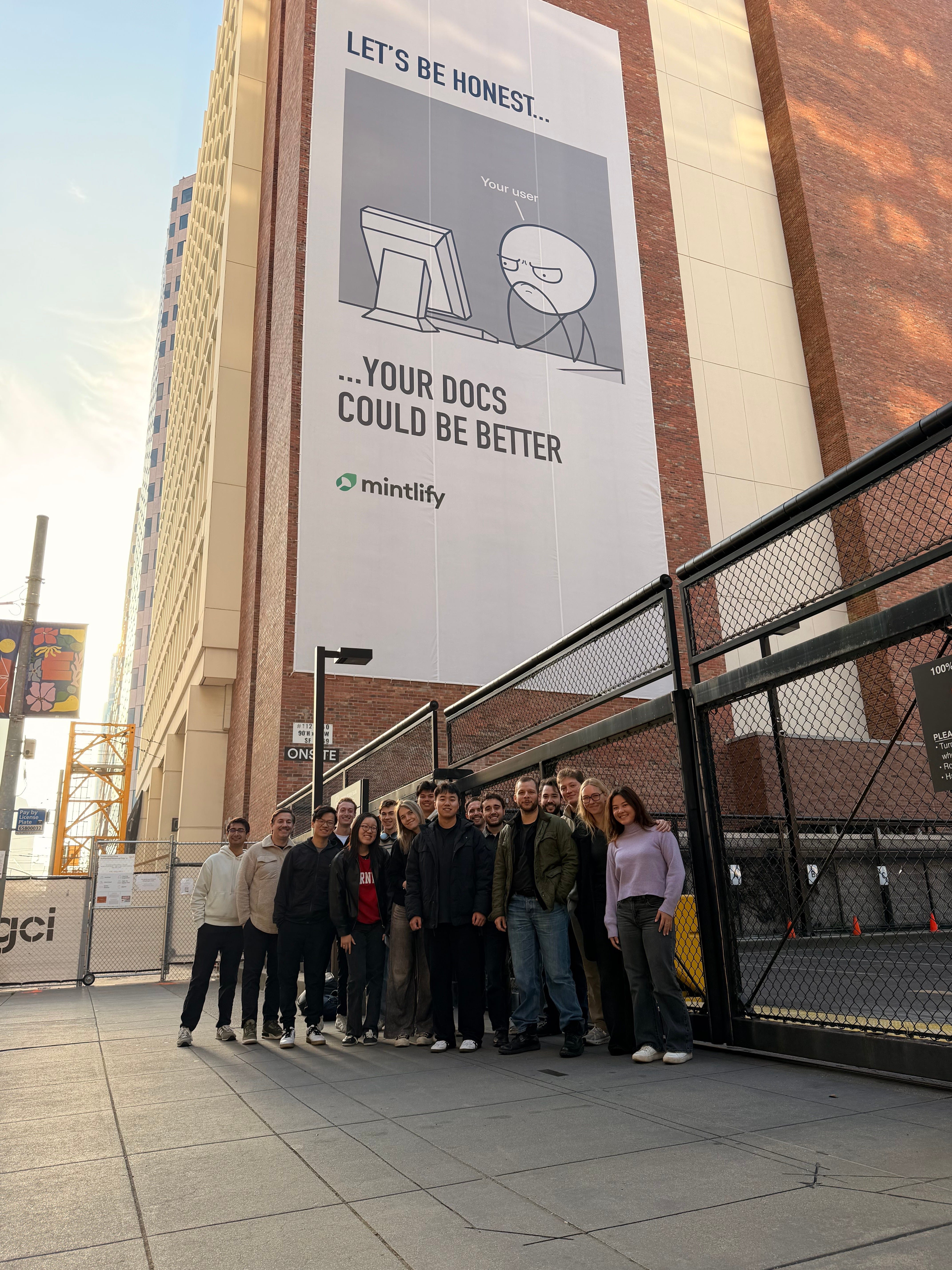
Reed Barnes, one of Mintlify’s software engineers, told me that “the team ships faster than companies 10x our size.” Jarod Hatch, an AE, said that the pace is “electric… Unlike anything I’ve experienced. I was on customer calls within my first few days, and the team was immediately supportive — sharing context, looping me into deals… It reminded me of the team culture in competitive sports: everyone pushing each other to be better, no egos, just results.”
Lots of startups say they ship fast. It’s easy to raise an eyebrow. The best way to double-check is to see what the company actually shipped. And, in 2025 alone, Mintlify shipped…
Mintlify Agent (self-updating docs that open PRs automatically)
MCP server auto-generator (one command turns docs into agent tools)
llms-full.txt (co-built with Anthropic, now industry standard)
AI assistant (chat with your docs, 23M+ queries monthly)
API Playground rebuild (completely re-architected interactive “try it” experience)
Web editor overhaul (clear, simple interface that commits cleanly back to Git)
Eight new themes (expanded visual options without custom CSS)
One-click LLM copy (“Copy for LLM” buttons plus agent analytics)
… And a whole lot more. AI is moving fast, but so is Mintlify and their team. Speaking of that team, there is one final question to ask: Should you join?
Should you join Mintlify?
There is a lot to like about Mintlify. They’ve grown fast and built a well-loved product, and the culture is rather low-BS and gives you the autonomy to exercise your own judgement and move fast. They’ve already signed many of the companies you could describe as their ‘dream customers,’ like Anthropic and Coinbase. And there is a good argument to be made that their product will only become more relevant as AI adoption increases.

But is it the right fit for you, specifically? Hahnbee Lee, Mintlify’s CTO, said that the company is a good place for someone who “wants ownership and fast feedback loops. People who succeed here are earnest, high-agency, and take real pride in their work. People who don’t work out tend to be the opposite: they need a lot of structure, wait to be told what to do, [and] treat their work as just a job rather than something you genuinely care about.”
It’s also worth considering Mintlify in the context of their stage; they’re fresh off a $45M Series B. If you are looking for a startup that (1) still has a ton of room to grow (e.g. to 10x, or more, your equity grant) but (2) has been somewhat de-risked, Mintlify’s current situation might be attractive. In other words, if building the world’s best knowledge infrastructure product sounds exciting to you, then there is no better time to join than today.
You can take a look at Mintlify’s open roles here. Most of the team works in-person in San Francisco, and they’re currently building out an NYC office (where they’re hiring AEs now and open to hiring others in the future). “If someone cold emails us with a sample project or a thoughtful take on something we’re building, that immediately stands out,” Hahnbee told me. If you decide to go that path, you could read some of our ideas here.
Thanks to Mintlify for supporting Next Play and making this Spotlight possible.
Great write up on a great company. Han and Hahnbee are building something special at Mintlify.
The reframe from "docs as content" to "docs as runtime dependency" is what stuck with me. Once AI agents are the primary readers, the knowledge layer suddenly needs versioning, freshness SLOs, and something that looks a lot like observability.
Teams treating docs as infra now may look the way teams who took logging seriously in 2014 look today: quietly compounding.