

Should you join: Siro
Inside the company building an AI coach that lives in every sales rep’s pocket
✨ Hey there - this is a free edition of next play’s newsletter. This is part of our series Should You Join, where we go behind the scenes on interesting companies. Our hope is that documenting these sorts of details, which never really make it to big publication press releases, can help you a) discover more interesting opportunities and b) inspire you to think creatively (for any of your own endeavors). You can join our private Slack community here and access $1000s of dollars of product discounts here.
Imagine for a moment that you are a regional sales leader at a successful company. You oversee dozens of territories and hundreds of sales reps with a small team of managers.
You operate with a lot of hard data already:
You know how every territory is performing
You know who the top and bottom reps are across every team
You know exactly which deals are in pipeline
And sure, this data is good. It helps you and your team be more effective. But there is one huge category of data that’s missing: the actual conversations reps have with customers.
You can see the outcomes of those conversations (did Rep X close Deal Y), but you cannot see the inputs (what did Rep X actually say to close Deal Y). So you could picture a world where one of your reps is using some brilliant processes that none of the other reps are aware of; or a world where one rep could be performing much better if they simply knew how to handle one specific objection better. But how would you know? You don’t have the data.
Today we’re covering Siro, a startup that gives sales leaders and teams access to that data.
Siro’s first product, an AI coach, solves the problem I’ve just described. Siro is already used by thousands of in-person sales teams to put a helpful AI coach in the pocket of every sales rep so they can improve before, during, and after every pitch. Siro is growing fast and, just last year, raised a $50M Series B from SignalFire.
In a world of AI companies building products for other software businesses, Siro’s product is rather unique. So I sat down with the team to figure out what they’re building, why, how they think they’ll win, and what it would be like to work at Siro. Hopefully you’ll find the business interesting and, by the end, be able to answer the question: should you join Siro?
The product
It wasn’t so long ago that you could join an online meeting without a dozen faceless AI scribes sitting there, hanging on your every word. But everything online is recorded now, for better or for worse. In sales, it’s often for the better; one big way Gong became an extremely popular tool was by turning customer calls into structured data that sales teams could use later on.
But online sales—people pitching B2B SaaS and the like—are the minority. Most of the 5.7M sales reps in the United States work in the field. And while online sales has had plenty of fancy AI revolutions over the past few years, in-person sales has been left behind.

Siro changes that by putting an AI coach in every sales rep’s pocket. Every time a sales rep goes to close a deal, Siro records. Before, during (if possible), and after the conversation with the customer, Siro coaches the rep on what they could be doing better. That’s the basic flow. (Siro does lots of other things, too, like updating the CRM on its own and flagging customers who are on the fence so a stalled deal can get a second shot.)
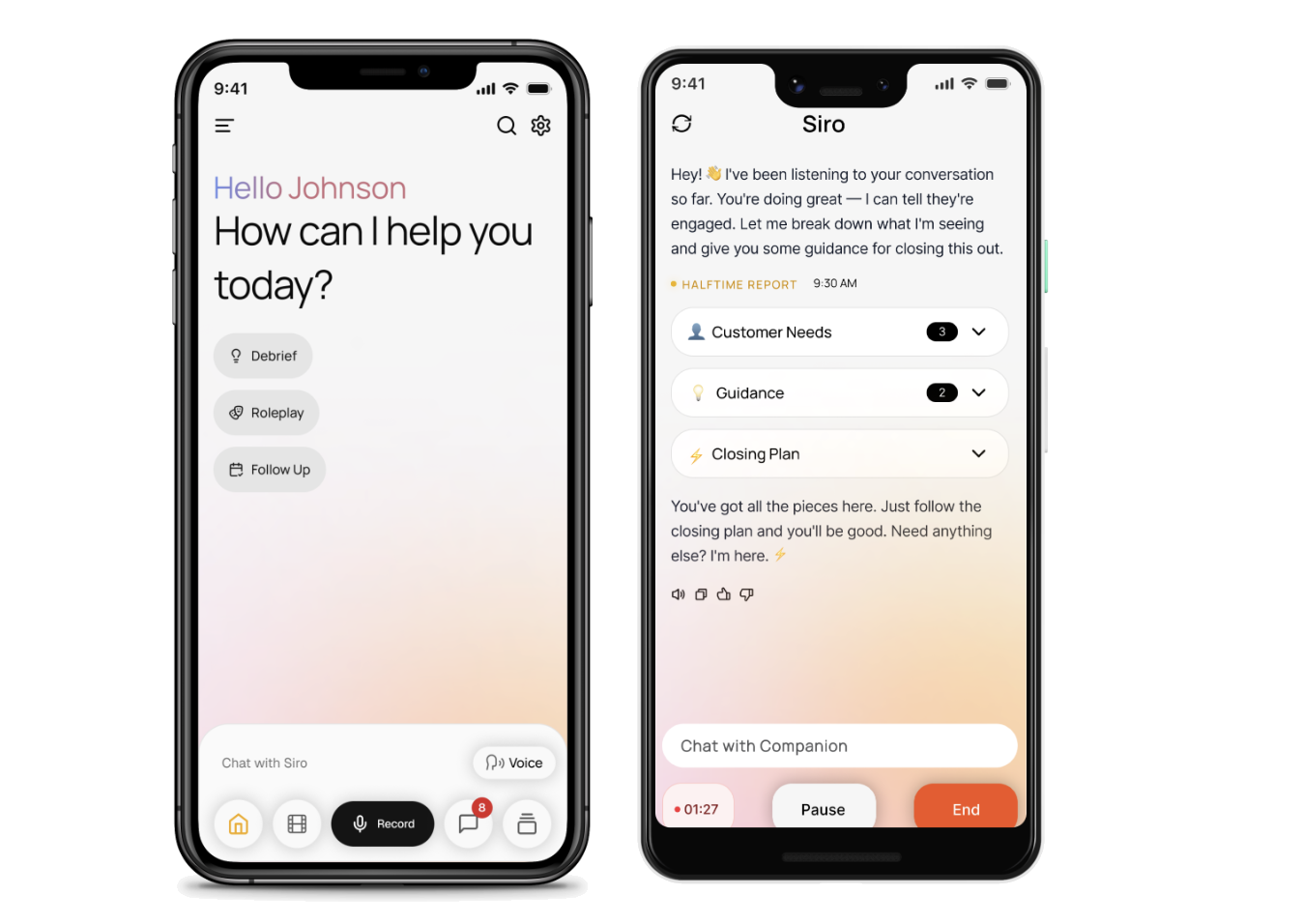
There’s something of a self-improving feedback loop here: Siro receives more data from your company’s reps every single day, and you (as a sales leader) get more insight into what works for your reps and your company and your customers. As you and Siro learn what works, your reps can get better coaching; as your reps improve, they generate better customer conversations; as the conversations get better, so does everything you can learn from them.
By building this, Siro has opened the door to a new kind of world. In-person sales used to be a massive black hole. Deals were won but it was hard to know why. Sales leaders had to intuit why Rep Y was performing better than Rep Z instead of actually knowing it. Sales reps couldn’t improve as fast as they’d like (there was no coach riding along with them every day). But Siro’s product is aiming to make all of these things, and more, finally possible.
The strategy
The obvious reason a company would want to pay for Siro is that better reps = more money. But I want to consider the other ways Siro might, as their CEO Jake Cronin told me, become “a very large public company [that is the] Jarvis for everyone on in-person sales teams.”
One angle that Siro would argue, and perhaps they are right, is that customer conversations are the most important data a business has. Sure, they are useful for helping reps become more effective. But they are useful in all sorts of other ways. You learn what concerns your customers have. You learn what they care about. You learn what kind of pricing they’re comfortable with. You learn what language works with them. You learn what kind of people they are. And if you have the data sufficiently organized, you learn all of these things with a lot of granularity; by location, by demographic, by product, by time of year, by whatever you want. Knowing all of these things can help you make significantly more effective decisions about your business.
For decades, for companies that mostly do business in-person simply have not had useful access to all of that customer data. Like I mentioned earlier, this is a rather large category; most sales reps are in person! Siro is already used across home improvement, solar, roofing, pest control, HVAC, auto dealerships, medical devices, senior living, and more—anywhere a real person tries to close a customer in person. There might be a tendency for tech people who read a newsletter like Next Play to immediately think of ‘sales’ as people pitching software on Zoom, but the market is a lot bigger than that.
“After doing diligence on the space, [we] found out that the problem was [huge], and the addressable market was even bigger than Gong’s,” Ben Knaus, Siro’s Head of Enterprise Sales, told me. There is a lot of money to be had here, a lot of problems to be solved. Few other companies are taking Siro’s approach.
Siro is building something semi-unique in the realm of AI tools: a product that aims to enhance, not replace, work that’s happening in the real world. “In a world where AI is displacing many jobs, in-person sales skills are the most durable skills against AI disruption,” Jake said. “Humans have an unfair advantage over AI when it comes to getting people’s attention and building trust. Siro hones those skills.”
If you were underwriting Siro as a company to potentially consider joining, this uniqueness would probably be something you’d want to think about. Siro is not building software for other software companies, nor are they trying to build AI agents that completely replace sales teams. Instead, they’re taking a bet that they can make the most impact by enhancing a skillset they believe will remain fully human for the short, medium, and maybe long-term.
“The future will be what we imagine it to be,” Jonathan Richman, VP of Customer Success, said. “There’s no good parallel to what we’re building, unless you count science fiction.”

The growth
Growth, or at least sales, has always been CEO Jake Cronin’s thing. Back in college he sold Cutco knives door-to-door and became pretty damn good at it. Seeing an opportunity, Jake opened a small office to hire other sales reps and train them up. But he didn’t have the time to train all of the reps equally; it was hard to have quality across the board. Years later: Siro.
Perhaps it’s not surprising, then, that Siro’s first 100 customers came from Jake & co. selling in-person at trade shows. Those shows “are still important,” Jake said, but “cold calls, warm referrals, and inbound” have also entered the mix as ways Siro gets their customers today.
The numbers have gone up fast. “We’ve grown more than 10x over the past 2 years,” Jake said, “and we plan to 3x again this year. Thousands of customers, $75M funding raised, 100-person team.” Reps have now recorded tens of millions of conversations on the platform.
More validation comes from ServiceTitan, which back in 2024 picked Siro to power its own field sales product; Salesforce followed with an integration the next year. It’s nice to see other companies (large, important ones in the space) deciding Siro is what reps should be using.
Investors have moved fast, too. Siro raised a combined $18M seed and Series A from CRV, Fika Ventures, Index Ventures, and others. Then, in May 2025, SignalFire led a $50M Series B.
“We drive the most ROI by far,” Jake said. “We win >70% of competitive deals because our product and team are built to drive results. We aren’t a flash-in-the-pan company.”
The culture
There are some companies where onboarding looks like weeks or months of slow ramp-up before you eventually end up doing the job they hired you for. At Siro, starting work is more like diving “into the deep end,” Ben Knaus said. “[I was] on customer calls in a few days. Saving a massive deal that immediately needs saving by sending a [huge] email to a CEO of a company doing billions of dollars in revenue. Immediately given a ton of responsibility & ownership.”
Jake himself is, like the rest of leadership, hands-on and transparent. “Everyone is aware of the company direction at all times,” Jonathan Richman said. Jake leads in-person meetings with the whole company every Thursday, and when he’s done pitching something, he’ll ask the room what he’s getting wrong, what should be changed, what should be improved.
This sense of honesty and transparency seems to be present in every corner of Siro’s office. “We’re incredibly transparent with our business results; ARR, cash burn, runway, pipeline,” Amos Shinkle, Director of Product, said. And nothing is off-limits for debate, even if you’re not from the department: marketing can opine on finance, sales can make recommendations to engineering, product can push customer success. The best idea wins.

As you’d expect, things move fast and hours can be long. “We push boundaries harder and faster than nearly any other,” Grant Shisler, GM of Automotive, said. “We’re not afraid to ship things aggressively and be ready to fix them if need be.”
Most people I chatted to worked a lot: all the way from 9ish hours a day up to 13 or 14. This isn’t really out of the ordinary for a startup at Siro’s stage, but I did appreciate how people described all of this work. “When you love what you think about all day, and you love who you work with all day, work doesn’t really feel like work,” one person said. Another told me that the product Siro builds is “so obviously impacting [customers’] lives, it’s incredibly rewarding work to do, and therefore easy for everybody to go ten toes down and put the work in.”

Should you join Siro?
If you applied to Siro and ended up in an interview, they’d probably pitch you something like this.
It’s rare to find lucrative, exciting opportunities that are good for the world.
Siro is actually helpful for business and makes sales reps’ lives much better.
Siro’s market is massive.
Therefore Siro is both big and good for the world.
You’ll work alongside an awesome team from a beautiful NYC office.
You’ll also get a lot better at whatever it is you do.
People who succeed at the company like working on a team, Jake said. “They’re entrepreneurial and thrive in ambiguity. They like to build & win together with our customers. People who have failed or left may have wanted a stronger playbook, larger management team, or fewer day-to-day challenges.”

“We are certainly in the jungle,” Jonathan (VP of Customer Success) said, “but it just feels like home because of the people who are along for the journey.”
If you’re someone who is resistant to change, Siro may not be a fit. “I shipped 4 PRs last week,” Siro’s Director of Product, Amos, told me, “and that wasn’t in my job description when I joined. Priorities changed, you’re going to drop stuff that you started, you have to be OK with that.”
If Siro does sound exciting to you, if it sounds like a jungle you’d like to explore with a bunch of other talented people, I’d encourage you to check out their open roles here. They’re currently hiring across most departments for their New York City office.
You can send a cold email (or similar) if you want to go beyond the traditional application route, but be thoughtful. “Outbound quality is important,” Jake said. “There are no kudos for trying - it can’t be spammy or generic or AI slop.” If you do think you have a great pitch, send it.
Thanks to Siro for supporting Next Play and making this essay possible.