

Should you join: Tabs
Inside the startup building the financial infrastructure for the token economy
✨ Hey there - this is a free edition of next play’s newsletter. This is part of our series Should You Join, where we go behind the scenes on interesting companies. Our hope is that documenting these sorts of details, which never really make it to big publication press releases, can help you a) discover more interesting opportunities and b) inspire you to think creatively (for any of your own endeavors). You can join our private Slack community here and access $1000s of dollars of product discounts here.
There is a term I recently heard for the first time: the financial singularity.
The ‘normal’ singularity, of course, is generally defined as the point at which self-improving AI triggers runaway growth beyond human control or prediction. Maybe you’ve heard of it.
The financial singularity, I was told, is different: “[it’s] the point at which the entire finance function runs autonomously, not just billing and collections. The entire contract to cash workflow. A contract comes in, the agent reads it, invoices the customer, follows up, applies the cash, recognizes the revenue, closes the books, and escalates only what genuinely needs a human.”
You can theorize about a number of potentially great outcomes for the world if this were to happen. Perhaps companies would get paid faster. Perhaps they would make more strategic decisions. Perhaps a team of one or two could run finance for a company doing $100M. Perhaps companies would grow faster and make better decisions and improve the world.
It’s now that I should tell you about the person who told me this term: Ali Hussain, CEO and co-founder of the AI revenue automation startup, Tabs, which I’m covering today.
While the ‘financial singularity’ sounds like a lofty idea, Tabs has spent the past three years shipping real products to help companies get there. To, more concretely, help companies close their books clean and fast. Do this, Ali believes, and you unlock a lot of downstream benefits.
Tabs has already raised over $90M from investors like Lightspeed, General Catalyst, and Primary, signed hundreds of customers, and grown ARR more than 5x in the last 18 months. The rest of this essay is designed to help you understand what Tabs is building, why it’s different, what it’s like to work there, and whether or not you should join.
The product
Somewhere in every business, there is one person (more often, dozens or hundreds of people) whose job is to turn signed contracts into accurately recognized money in the bank. An average day for a person like this might be: arrive at the office, open a signed contract, find the terms that matter, key them into a billing system, create a custom invoice, send the invoice, chase down the invoice, and accurately recognize the payment once it comes through.

Problems start to crop up as the company grows. One such problem is that, if you want to do this well, it requires a lot of manual work. Talented people spend hours every day doing fairly tedious, routine work. You can get software to automate some of this, but the existing software tends to be impersonal and templated. It’s a step-change but not a serious fix.
Inefficiencies, too, become the default. It takes too long to get paid. You aren’t sure which customers have paid what. Data lives in silos. It’s hard to understand the gap between what you’ve invoiced and what you will get paid. “If you get [this] right,” Ali said, “everything downstream (RevRec, forecasting, collections) gets easier. We’re building foundational infrastructure and the commercial context graph that has the data and context to truly make accounting & revenue the most strategic function in the company,” he said.
On a practical level, Tabs is an AI billing and revenue automation platform. It connects to your contracts, your CRM, and your accounting system. It reads every contract, pulls the terms that matter, creates and sends the invoices, chases the unpaid ones, applies the cash, and recognizes the revenue. All in one platform, all run by AI (with human input when needed).
“Revenue ops isn’t broken because nobody built a good invoice tool,” Deepak Bapat, co-founder and CTO of Tabs, told me. “It’s broken because everything lives in silos. But when [Tabs] encounters an ambiguous payment, it doesn’t guess. It knows which contracts are active, which invoices are outstanding, and what the customer’s historical behavior looks like.”
So you could imagine the following situations:
A payment comes in with a blank memo
A customer pays a number that doesn’t match any invoice
A contract’s price ramps over year 1 with a usage-based discount
A customer signs an amendment mid-term that changes their rate
A payment lands 40 days late
Revenue recognition for a contract ≠ when cash comes in
Late payment needs a personalized, one-to-one followup
These are just a few rather simple examples of 1000s of things that traditional software generally can’t solve, things that people used to do manually. Tabs solves them all. (If you want an example, read their story about how Statsig scaled to $1B with a one-person finance team.)
The Tabs launch in 2024 had a narrower focus: AI for accounts receivable. Read the contract, bill, collect. Revenue recognition and reporting came next. By 2025, much of the work was being done by AI agents. The scope moved from sending an invoice to closing the books.
Tabs uses autonomous AI agents rather than other interfaces (like chat) because they believe it is more effective. “Chat is the worst agent interface for vertical software,” Deepak said. “Most of the industry is racing to build better conversations. We’re building toward fewer of them.”
The strategy
So, back to the financial singularity. This grand vision for a world where AI agents (in this case, Tabs’ AI agents) are automating most of the finance for companies and allowing them to be more strategic, get their money faster, and so on. “In 20 years, Tabs is the system of record for every financial event between a company and its customers,” Deepak said.
How do they get there? And why Tabs?
One factor is timing. Tabs is arguably the market leader in AI-native revenue automation. They’re ahead of their competitors, are quite well-funded, and have plenty of traction (which I will cover in more depth shortly). The market timing is favorable, too; there’s been a big shift to usage-based billing (and other more complex billing methods) in the past couple of years, which makes contract-to-cash workflows a lot more complex. Finance teams are moving off of their clunkier legacy platforms to find something new, and many of them are moving to Tabs.
Having a head start is particularly important, Tabs’ co-founders told me, because of the way data compounds to make their AI agents more effective. “The commercial graph gets richer with every contract, every payment, every customer that goes live. That compounds in a way competitors can’t replicate by starting fresh,” Deepak told me.
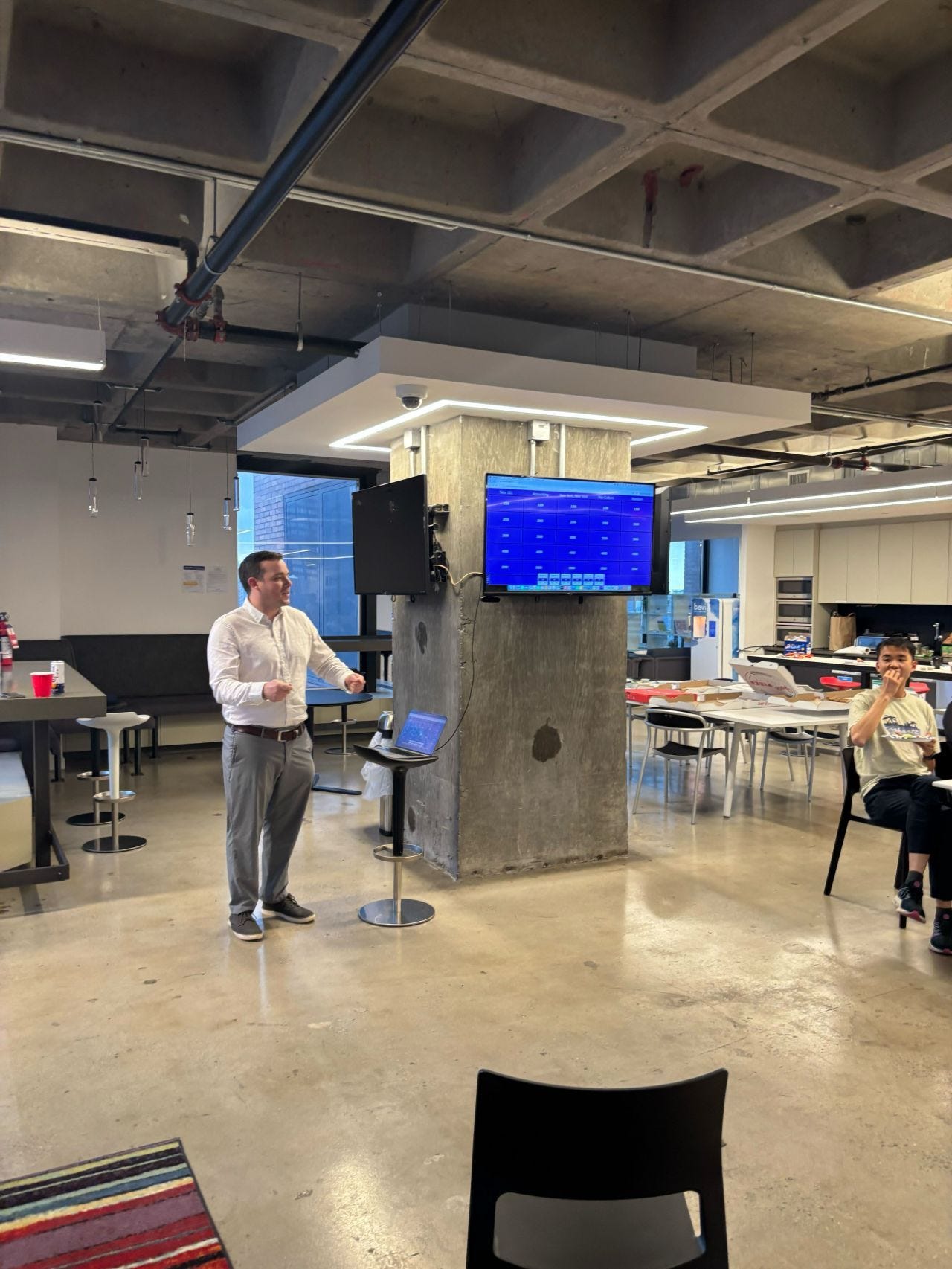
The goal at Tabs has always been to build a broad revenue platform teams can use to house everything under one umbrella. Deepak said the team made three bets early: “in-person when everyone went remote, functional depth with lean operations, [and] platform over point solution from day one, even when it was harder and slower.” And the team has, in many ways, already built much of the platform.
“[Tabs] is the only platform that runs the full lifecycle,” Ali said, “billing, cash application, revenue recognition, and reporting, all connected and automated.”
Success over the long run looks something like a marathon. “The person who wins a long race isn’t the fastest [in one specific moment], it’s whoever slows down the least. We’ve always been building for where the market was going, not where it was.”
As for the financial singularity, well, the Tabs team doesn’t believe they have arrived just yet. But “we’re partway there,” Ali told me. And if you want to underwrite all of these big claims with something tangible, I’d suggest you look at Tabs’ growth and traction so far.
The growth
Ali, Deepak, and Rebecca Schwartz founded Tabs in late 2022. The company stayed in stealth for roughly the first year and a half, spending most of their time talking to CFOs and controllers to figure out why revenue and billing were still this broken. In 2024, they launched publicly.
Early Tabs customers came from those conversations they had while building the product. Tabs sold founder-to-founder via their own connections and referrals, and many of the early adopters were AI-native companies with the kind of messy usage-based contracts Tabs is great at.
Money followed traction. Tabs raised a $7M seed from Lightspeed in April of 2024, a $25M Series A led by General Catalyst that October, and a $55M Series B led by Lightspeed in September 2025 (nice to see the same firm lead multiple rounds).
They now have more than 300 customers and ARR is up more than 5x in the last 18 months. Billions of dollars in annualized billing volume now run through the platform, and Tabs just had what the founders told me is the best quarter in company history.
The culture
When I ask most people at startups what meetings are like, they often say encouraging but ultimately boilerplate stuff: short and to the point, productive, helpful. When I asked Naomi Pohl, an Engineering Manager at Tabs, I heard something else. “I sometimes walk out of meetings [surprised by] how intense the debate was; turns out that’s just how people operate here, and it is a sign of a healthy culture.”
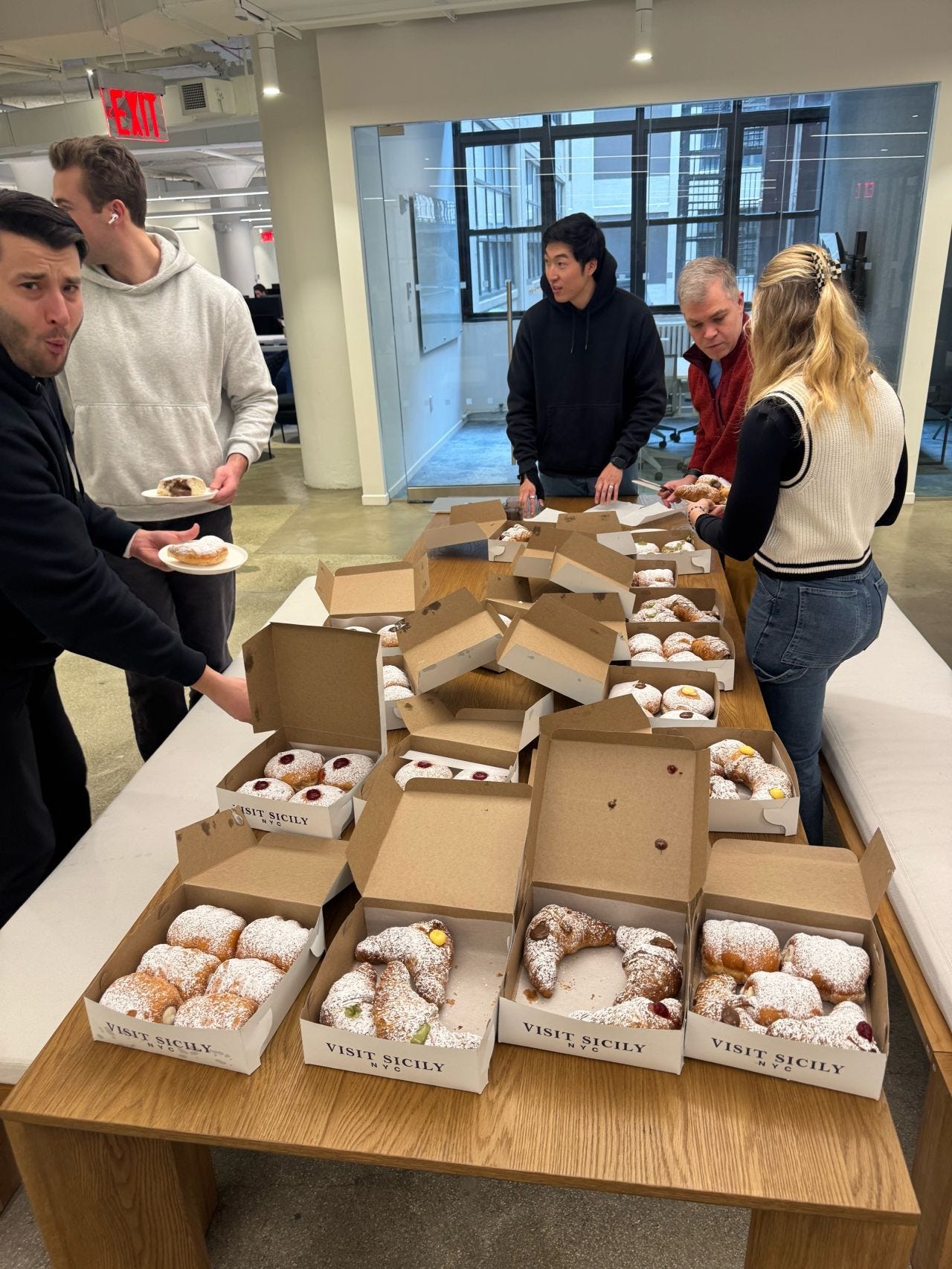
Perhaps the best takeaway from that anecdote is how deeply people at Tabs seem to care about their work. You don’t get that kind of passion at a startup where people aren’t very invested. “I’ve worked at startups where everyone checks out at 5pm,” Nicholas Gatti, who is in sales, told me. “Those companies went nowhere and it ruined the culture. I’m amazed how everyone shows up everyday excited to tackle hard problems.”
That care also shows up in how close Tabs works with their customers. “We have a very direct connection between client-facing teams and our engineering teams” Nicolas Buitrago, an Engineering Manager, said. “If a client-facing team is dealing with a bug or issue … It is encouraged they go over to the engineering desk to help get their issue resolved. In a typical company there is a fence of PMs to guard engineering resources … We are high ownership.”
“Our PMs have full access to Cursor, and a couple have even merged PRs into production,” Naomi said. This is not common (though the culture seems to be moving that way) and it’s another useful example of the kind of ownership you could expect to have at Tabs.
Partly, this high ownership and high care environment stems from being in the same room. Tabs works in person, five days a week, in New York. It’s easy for customer success people to solve problems with engineers because the engineers are right there. It’s natural to have intense debates that resolve cordially because everyone is talking face-to-face. (The in-office decision was made from the start, by the way, at a time when remote was a bit more popular.)
Should you join Tabs?
I asked Nicolas what kind of people do and don’t work out. “There’s a certain kind of talented engineer that doesn’t fit in at Tabs. The ticket chugger whose focus is on dequeuing tickets and only doing the work specified… If someone is expecting all of this to have already been answered for them and just wants to kill it on a few pre-chewed problems, this isn’t the place.”
I don’t think Nicolas’ diagnosis is engineering-specific. “If you want to work on hard problems, move quickly, have real ownership, and help define an entirely new category,” Ali said, “this is the kind of company where you can do the best work of your career.”
Other themes: move fast, make calls with incomplete information, have an appetite for agency, and be curious. Think hard about problems. Oh, and “don’t be a dick,” Deepak said.
I’d also encourage you to think about where Tabs sits in the market. Look at their traction so far. Compare them to the other options on the market. It’s hard to argue that they are not currently ahead in their category (AI-native revenue automation), and customers seem happy. Do you believe in the thesis? Does this feel like the right long-term play?
If you applied today, you’d be joining at Series B, which for lots of people is a nice time to join; the startup is probably less risky than it was at the seed stage but you can still get enough equity to be meaningful if, and when, Tabs makes some kind of exit.
But an exit—and the financial singularity—is likely still years away. What Tabs needs now are talented people to help them build the best possible version of their product and become the revenue automation platform for every company on the planet. If you think you could help them do that in some way, check out their open roles here.
Cold emails work, if you’re curious. Messages with “a sample project, a relevant analysis, or a specific take on B2B billing get read. Generic applications get filtered,” Ali said.
(Here are some ways to get creative, if you need inspiration.)
Thanks to Tabs for supporting Next Play and making this essay possible.
Love the "fewer conversations, not better ones" line. I'm not super familiar with the space but most of contract-to-cash seems to be ambiguity resolution, and that's a data problem before it's a UI one.