

Should you join: Amperos
Inside the AI-native neofirm fixing how American healthcare gets paid.
✨ Hey there - this is a free edition of next play’s newsletter. This is part of our series Should You Join, where we go behind the scenes on interesting companies. Our hope is that documenting these sorts of details, which never really make it to big publication press releases, can help you a) discover more interesting opportunities and b) inspire you to think creatively (for any of your own endeavors). You can join our private Slack community here and access $1000s of dollars of product discounts here.
What happens after you leave the doctor’s office?
Perhaps the doctor, alone for a brief moment, writes a few notes in your file before moving onto the next patient. Down the hall, somebody behind a computer types in some numbers and files an invoice to insurance on your behalf. The practice gets paid, the doctor keeps working, and the wheels of the system continue to turn smoothly.
That paragraph might be the understatement of the century. If only it were that simple for a provider to get paid for seeing a patient.
“Once an invoice goes out the door,” Alvin Wu, co-founder of Amperos, told me, “there is a rat’s nest of manual work standing between the provider and their money… It is one of the most broken back-office problems in America, and almost nobody outside of healthcare knows it exists.” This problem—getting paid as a healthcare provider—is what Amperos is solving.

Right now, more than 1 in 5 invoices that healthcare providers send to insurers go unpaid (to the tune of $260B+ per year). Those numbers have only continued to grow over the past decade. Healthcare providers do some of the most important work in the country, and yet it is becoming increasingly difficult for them to actually get paid.
If Amperos succeeds, then healthcare providers can stop chasing invoices, recover many billions more dollars, and redirect that money to what they do best: serving patients.
So what, exactly, is Amperos doing to make this a reality? How are they solving this huge, but difficult-to-solve, problem? What is their trajectory? And, of course: should you join?
The product
Years ago, before he co-founded Amperos, now-CEO Michal Miernowski worked with admin leaders at healthcare clinics. One of these clients was a clinic with 100 doctors on the payroll but 300 people working in collections to ensure those doctors got paid. “The imbalance struck me. Why did it take 3 people to chase payment for the work of 1 doctor?,” Michal said.
It sounds a bit insane, but that situation is more of the norm than an outlier. Collections is a huge problem, and the existing solutions have been the default for decades. Providers have had to choose to either build a team in-house (even though there aren’t enough people in the U.S. to do the job, Michal said) or to outsource to a traditional firm using offshore labor (which is sometimes slow and often full of quality issues).
There is also an AI arms race starting in healthcare, and insurers have been faster to adopt than providers have. Most healthcare insurers now use AI, many of which use it to decide whether to approve or deny claims. The old-school approaches will likely only become less effective as insurers use AI to deny claims faster, and sometimes at higher rates, than ever before.
So what is Amperos doing to fix this? The traditional startup approach would have been to build software, package it, then hand it off to a customer to use to achieve the outcome they want: in this case, collecting more money for their work. Amperos is, rather, an AI-native neofirm: a company that customers pay not for access to only software, but to get actual outcomes.
If you are a healthcare provider, “getting actual outcomes” means paying Amperos to run collections for you. They do it faster, cheaper, and far more effectively than any option you’ve had in the past. So you get a huge amount of money back in your (and your doctors’) pockets, and you get it faster.
Amperos has, of course, built a mountain of advanced internal software to give them an edge: like agentic AI voice systems that call insurance companies, computer-use agents that log into hundreds of portals to research claims or send appeals, and a denial-intelligence layer that ingests every payer interaction to identify causes upstream. With innovations like these (and others), the relatively small team at Amperos is able to do what used to take an army.
This neofirm approach is one of an increasingly popular group in AI. We recently wrote about Manifest (for lawyers) and Knit (for market research), both of which are taking somewhat similar approaches. Sequoia wrote about how this business model would be the next $1T company. OpenAI and Anthropic both launched neofirm-esque projects this year.
The strategy
All kinds of people and companies say they want to “fix healthcare.” But, as nice as that sounds, it’s also rather vague. What are we talking about? What does it mean? And, if you wanted to “fix healthcare,” what would be the best way of going about it?
While not as “sexy” as tackling longevity or building a personal health assistant, tackling the healthcare back office is one of the fastest ways to have a disproportionate impact on the average American’s experience of healthcare. After all, almost all Americans today still experience healthcare in the office of a physician, and that physician’s practice needs to get paid for their work to keep the lights on and continue serving those patients.
“Our goal is to redefine the financial infrastructure of American healthcare,” co-founder Alvin Wu said. “And we started in the back office because that is where the pain is most acute and most measurable… That let us build a product with clear feedback loops and clear ROI. But the back office was never the destination. It is the entry point.”

So the master plan is, roughly, this: first, put Amperos at the center of major healthcare providers in America by solving one of their biggest problems (collections). Then, become the payments layer for all American healthcare. “As we work more claims,” Alvin said, “we accumulate a precise, longitudinal record of how every major health insurance company behaves. Which codes they systematically downcode. Which denial reasons are pretextual. Which appeal arguments work and which do not. Nobody else has this.”
Today, that intelligence does not exist in one place at all; Amperos is the company in a position to collect and aggregate it.
Eventually, that data tells Amperos something nobody else knows: exactly when a given provider will get paid, and how much. “Providers stop waiting 60, 90, 180 days for reimbursement,” Alvin said. “We pay them in days and take a small margin based on the risk profile of their payors. The underwriting model is the data model.” Nobody, Alvin says, can build that model without doing all of the upfront work Amperos is doing now.
If Amperos wins, then in 20 years they are no mere collections company. Instead, they are the payment platform sitting between providers and payors. The layer through which American healthcare gets paid.
The growth
The pitch for Amperos sounds obviously good. But then again, a lot of startups have compelling pitches. What you may be interested in, as a way to underwrite the pitch, is some actual data. So I asked the team and did some research. TL;DR: things are going well for Amperos.
Nearly two years ago, Amperos went through the Neo startup accelerator in 2024 (an accelerator that has backed Cognition, Kalshi, Cursor, and others). About a year later, they raised a $4.2M seed round led by Susan Liu at Uncork. And less than a year later, in April of this year, Bessemer Venture Partners led Amperos’s $16M Series A; you can read the announcement from Amperos here.
The traction with customers is equally (if not more) impressive. Within just the first year of signing their first annual contract, Amperos has scaled to serve over 3,000 clinical locations across all 50 states. Amperos has signed some of the largest specialty-focused and fastest growing clinical networks, including DOCS Dermatology, Boulder Care, and others.
“We sell to larger, enterprise providers,” Alvin said, “which means we can build a huge business without 100s of customers and we really get to focus on the dozens that we serve.” The first of their customers came through cold outreach, whereas now it’s about an even split between referrals, outreach and inbound. (Referrals are a big deal when one new customer can mean many millions more dollars.)
By the time they raised their Series A this year, Amperos was recovering about $700M a year for their customers. Customers recover 22% more revenue per claim compared with traditional vendors, and at half the cost. Amperos reduces aged and unpaid claims by 60%+, resolves denials 5x faster, and (in one of my favorite anecdotes), one customer told Amperos that “we weren’t even touching 27% of our claims” before they signed on with Amperos.
Perhaps most surprising is the headcount: Amperos has been able to do all of this with about 20 people. A traditional firm serving as many clinics as Amperos does would probably need hundreds, if not thousands, of people on payroll to do this. There is a long way to go, but a 20-person team recovering $700M a year is a pretty good start.
The team and culture
Amperos does a lot with a rather small team. The velocity at Amperos is comparable to “top-tier startups,” Alvin told me. The team works hard. “We want to win together.”
But winning together does not come at the cost of life outside of work, because “[that’s where] you build the creativity, inspiration, and taste to do your best work when you are in the office.” Instead of focusing on sheer time spent in or outside the office, the Amperos team focuses on what makes a team effective and able to move quickly: “high ownership, quick decision making and building with low ego.”
As for the work itself, “there’s opportunity to take on more ownership [than at other companies],” Adam Gluck, a software engineer at Amperos, said. “I feel like my ideas are more likely to be implemented.”
“It’s very easy to try new things at Amperos,” Annie Qiu, Head of Engineering, said. “I can use new tools without waiting for a lengthy review process. We move very fast here, and looking back over the past year, I’m surprised by how much we accomplished.”
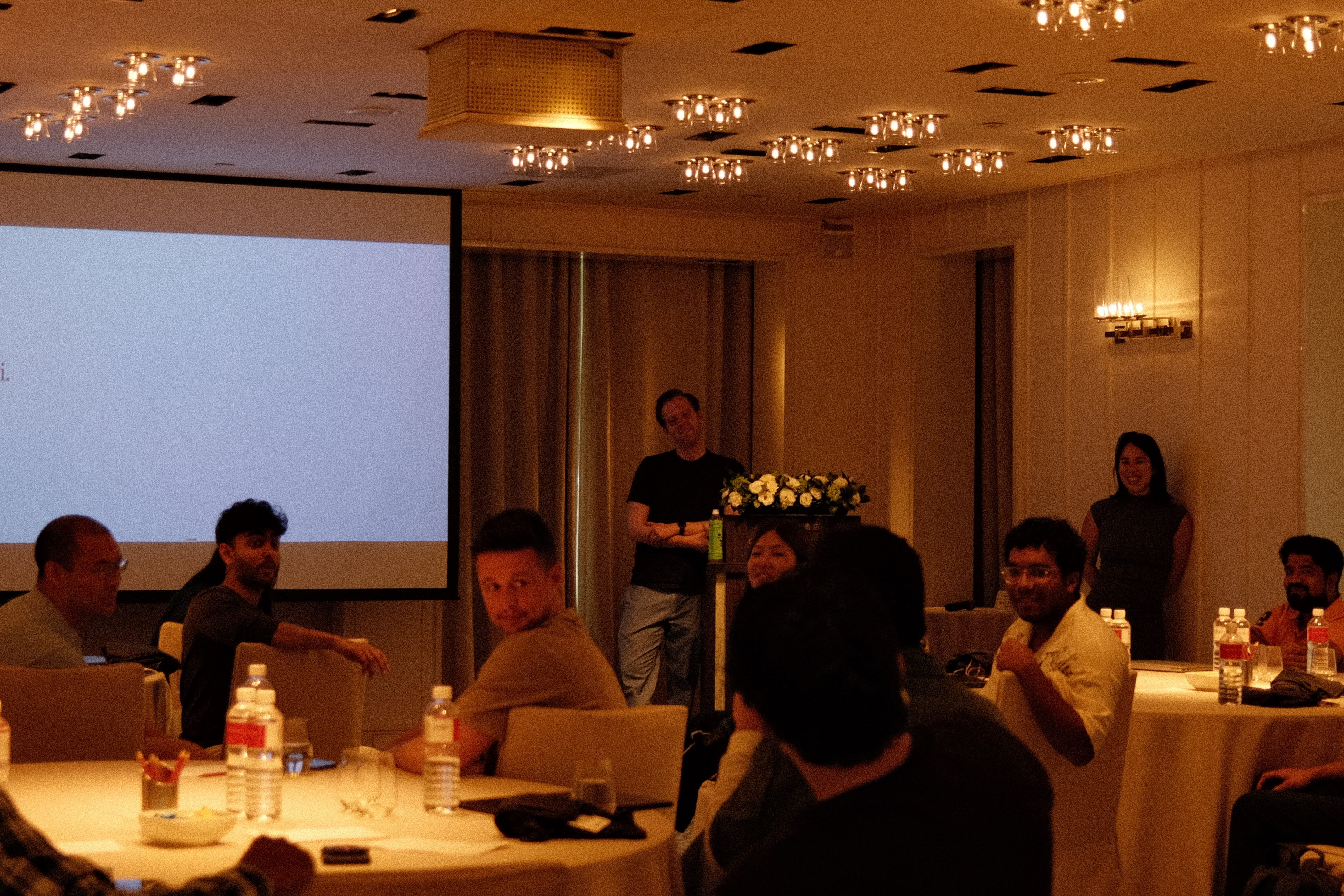
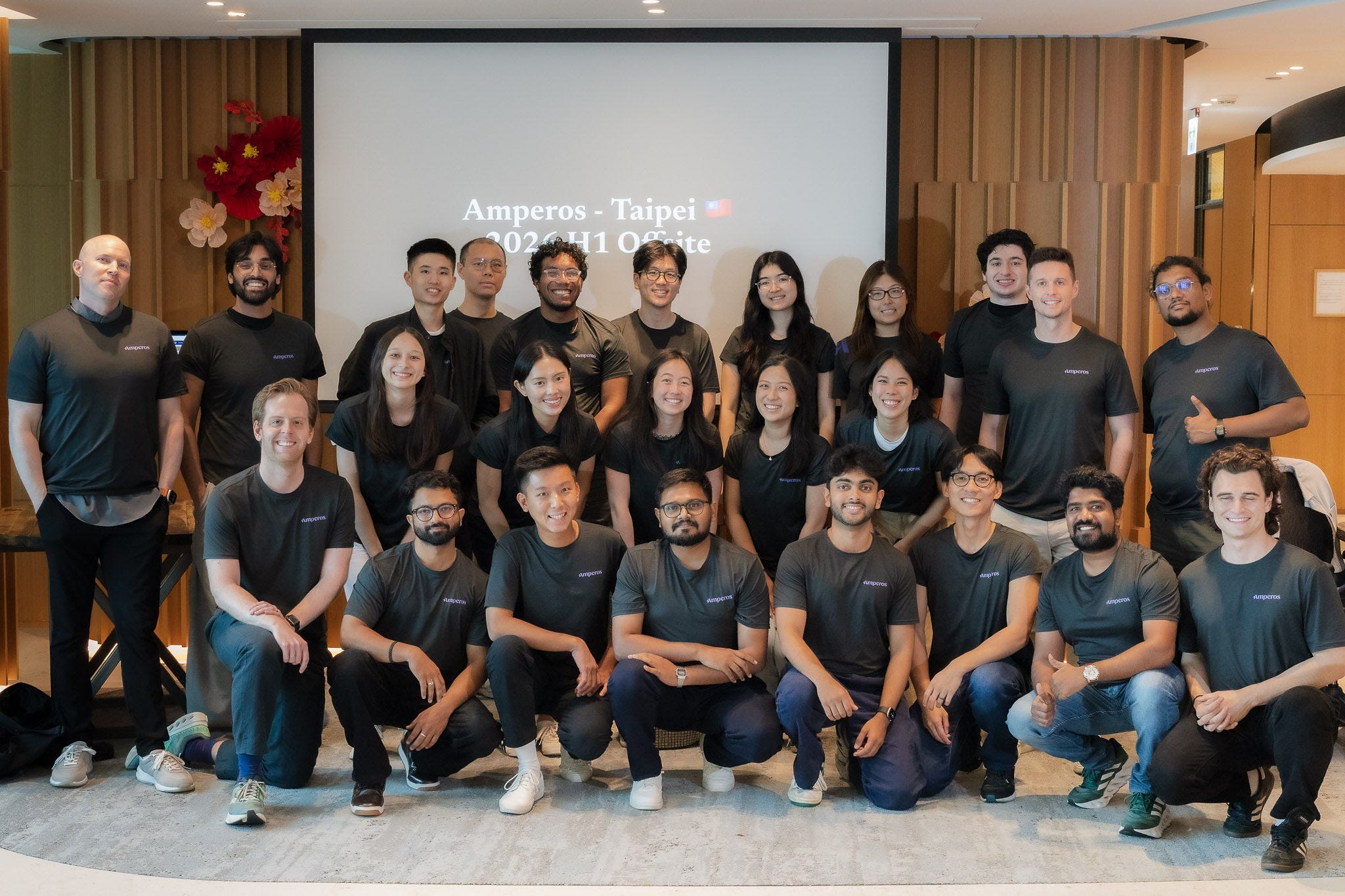
I also get the sense that the team likes to have fun. They’re recently back from an offsite in Taipei, which I’ve been told was an excellent time. Back in New York, there’s a piano in the office (and an air fryer, a detail that numerous people enthusiastically mentioned). There are fun activities. People make lots of jokes. “Between escape rooms, joke of the day, and the company air fryer,” Adam said, “coming to work is always fun.”

It’s easy to roll your eyes at this stuff. But all startups say they have a good culture! This is downstream of something more important, though, which is that the Amperos team seems to actually like each other—starting with leadership. “All 3 of the founders are so humble, approachable, and low ego,” Jackie Osborn, who joined from Stripe, said. “They care about our users, have very high empathy, and just want to do what’s right.”
“Density of talent on a team compounds in the same way data does,” Alvin told me. “One exceptional engineer who cares about their craft, operates with full ownership, and makes the people around them better is worth more than ten people who need to be managed.”
Perhaps as a result of this culture and intentional approach to hiring, nobody at Amperos has ever quit. “We are intentional about building two products at Amperos,” Alvin said. “Our core business and the experience of working at Amperos.”
Should you join Amperos?
There are a few categories of people I would push to seriously consider joining Amperos.
The first is people who care about ownership. Amperos hires for it, and it’s a big focus of how they get work done. People who work well at Amperos “find the problem, dig until they understand the root cause, fix it, and tell people it is fixed,” Alvin said. “That combination of ownership and follow-through is rarer than it sounds.” If you are a particularly autonomous and proactive person who can take a lot of ownership over your work, you’ll fit in.
The second is people (especially engineers!) who are open to—or eager to—learn an industry as opposed to operating in a silo. “If someone is looking to focus purely on deep technical work, this may not be the best fit,” Annie said. “We expect engineers to go beyond code and invest in learning the healthcare domain, because that’s critical to building the right solutions.”
The third category is people who move fast and don’t need much process to do it. “Our build velocity is something that might push [people] away,” Prakhar Gupta, a software engineer, said. Amperos is not a fit for people who “prefer to be as thoughtful as they possibly can be before tackling a task.” There’s a bias towards action at Amperos.
For everyone else, the case is fairly straightforward. Annie, who joined from Stripe after a year of building MVPs for other startups, put it well: “Amperos stood out because of how tight-knit their founders are and how each of them excels in their role. They already had a strong sales pipeline, their product narrative was very specific, and their technical product was built on years of voice agent research. It was clear they were well positioned for exponential growth.”
If she’s right, now might be a good time to go check out open roles at Amperos. They’re currently hiring across most departments for their office in New York City and a new hub they are building out in San Francisco.
Thanks to Amperos for supporting Next Play and making this essay possible.