

Should you join: Knit
Inside the startup taking a differentiated approach to AI-native market research.
✨ Hey there - this is a free edition of next play’s newsletter. This is part of our series Should You Join, where we go behind the scenes on interesting companies. Our hope is that documenting these sorts of details, which never really make it to big publication press releases, can help you a) discover more interesting opportunities and b) inspire you to think creatively (for any of your own endeavors). You can join our private Slack community here and access $1000s of dollars of product discounts here.
Running a successful company is all about making good decisions. What to do with your product, who to hire, what messaging to use, what direction to take the business, and everything else: it’s hard to win if you can’t make good decisions about things like these.
But if you want to make good decisions, you need good information, quickly. You need answers! What do our customers think about this product of ours? How much would they pay? Does our messaging land? What do people want?
Unfortunately, there is no magic crystal ball that can immediately (and accurately) answer all of these questions for you. Instead, you have to do “market research.” In the past, that meant partnering with a probably-slow and probably-expensive research firm that would take months to get you answers. Sometimes it was useful; other times, the question had moved on without you.
But what was always true was that market research was painfully slow and inefficient.
The arrival of AI has changed the field drastically. Legacy firms have scrambled to retrofit AI onto their old workflows. There is also a fresh crop of AI-native market research “platforms” that are taking new approaches to make research faster and more effective.
But there is one startup—Knit—which is not taking the “software platform” approach. Knit, rather, has built the first AI-native market research firm. Just seven months ago, we wrote about their story and growth. We wrote about them because they’re a particularly differentiated startup that’s signed a number of impressive customers (including Amazon, T-Mobile, Paramount, Mars Wrigley and 50+ other Enterprises) and is growing fast. Today, we’re writing about them again, this time to help you answer one specific question: Should you join?
The product
Plenty of AI startups that exist today are building their products in what you could describe as the traditional SaaS model: they make an AI-enabled software tool, which customers get access to by paying money. This can work. It does, for lots of AI startups.
But in certain industries, like market research (and law) there is a different kind of AI-native startup emerging. A kind of company that Knit COO Chris Hicks described as an “AI-enabled neofirm.” These are services-focused companies that are AI-native from day 1, delivering better, faster end-to-end outcomes for their customers while still preserving human judgment.
This services-based approach is an effective way to describe Knit, which bills itself as “The AI-native research firm.” And I’m telling you about this now because it informs how you should think of the product. Don’t envision it as a DIY platform; rather, envision it as paying for an outcome. In Knit’s case, think of it as paying for an answer (or a series of answers) getting your full job done.
The way Knit works is simple:
Companies bring a strategic business question.
Knit’s Forward-Deployed Researcher (FDR) works alongside purpose-built AI agents to run the research end-to-end.
Within days, stakeholders have their answers.
The answers, by the way, are unified (not across separate platforms) and presented in exactly the formats, and with exactly the analysis, that leadership needs to make decisions about them. In other words, the answers you get with Knit are useful. The crystal ball works. You ask a question, you get the correctly-formatted answer, and now you can go decide what to do next.
Knit says their approach is faster, more effective, and unlocks entirely new ways of research compared to what traditional research firms offer, which is perhaps why all kinds of companies—including Amazon, T-Mobile, and Paramount—have partnered with Knit to do their market research to make better business decisions, faster.
One thing that’s worth calling out about Knit’s approach is that, both today and when we wrote about them in the fall, Knit has had a strong opinion about keeping human judgment in the loop. There are plenty of AI startups which have the goal of replacing humans, but Knit believes that keeping human researchers involved (e.g. in their Forward-Deployed Researcher roles) is part of what it takes to produce truly great work in this space. This is an interesting (and unique) thesis, and I suspect that it is at least part of why they believe they will win.
The strategy
Perhaps one of the most important long-term bets Knit is making is that providing services, not just software, is the right path for the company. “We believe that some of the most important and valuable companies in an AI-native world are going to be AI-native services,” Aneesh Dhawan, co-founder and CEO of Knit, told me. “We are rethinking entirely what doing the ‘whole job’ as an AI-native research firm will look like - and what it can do for customers.”
This market isn’t niche. Services (not software) are where the majority of budgets actually live, and a number of AI-native companies are positioning themselves to capture a lot of that spend. Just last week, OpenAI launched its Deployment Company: a $4B venture to embed forward-deployed engineers inside of enterprise companies. One week earlier, Anthropic announced a similar venture. And investors are catching on, too; Sequoia recently wrote that “the next $1T company will be a software company masquerading as a services firm.”
If you are the kind of person who hears about a new piece of AI software every day and is possibly getting a little jaded about the whole thing, Knit might be a breath of fresh air. Because one thing you can certainly say about them is that their approach is different. It is, in some sense, more ‘real’. In our spotlight on Thursday, the founder of Manifest told us that his company is “not selling pickaxes. We’re mining.” I think there’s a similar pitch here.
There is good reason to believe that this strategy has merit. In some industries, and market research may well be one of them, it is not good enough to simply hand over a piece of software. The reason Palantir had (and has) FDEs, the reason Northslope has them, was that it was the most effective way for their clients to get amazing results with their software. The same may be true about Knit’s FDRs—it is quite possible that a software tool is not enough.
Of course, there are other strategic bets at play. One is that combining quant and qual research together on the same platform (i.e. a comprehensive platform instead of a siloed solution) differentiates Knit. “Most companies in this space are picking off one slice of market research,” Jake Shanesy, Director of Product, said. “Knit is going after the entire arc.”
Another point in Knit’s favor is that they are AI-native. Legacy market research companies, the ones that have been operating for decades, can’t really say this. Many of them are trying to retrofit AI onto their current workflows (to varying degrees of success), but Knit is a much newer and faster company that has been building with AI from the start.
There’s also a structural competitor that few other competitors really have: actual researchers help drive the product. Chris Doty, Researcher on Staff, is one of them. His job is to translate years of research knowledge into product vision and direction. “We are building a platform for our end users,” Chris said. “Not just one that our engineering team thinks will work for them.”
I was curious, because it is the kind of thing I would ask if I wanted to join: what does success look like for Knit? In the short term and the long term?
“Short-term success looks like becoming the most important research company ever built,” Aneesh said; a rather impressive ‘short-term’ goal. “Knit is capturing the $130B being spent today on research services by delivering a 10x better experience than legacy companies… In fact, at some of our customers, up to 50% of the research being run is for use cases that never existed. This is net new research never done before.” Aneesh is referring to the Jevons paradox here: as the efficiency of research increases, demand does, too.
But research, Aneesh says, is just the “wedge to becoming a digital customer brain. Think of each data point on Knit as a neuron. The more research you run and context you feed in, the more synapses form between them, surfacing connections no human researcher could hold in their head at once… And when the next big decision comes, the answer is already there.”
“So to answer the question: Knit becomes the decision intelligence layer for the AI-native world.”
The growth
Knit was founded in early 2023 by Aneesh Dhawan and Raahish Kalaria. The first version of the product was simpler than what exists today. The modern version, the “AI-native neo-firm” with forward-deployed researchers and a unified quant-plus-qual platform, came together over the following two years as they signed customers like T-Mobile and NASCAR.
Knit closed a $16.1M Series A in September 2025, co-led by GFT Ventures and Ashton Kutcher’s Sound Ventures, after growing 5X the previous year. Today, the company has 70+ full-time employees, and more than 50 enterprise customers (half of which are Fortune 500 companies).
Selling to enterprise is hard, and selling to Fortune 500 enterprise is harder: long procurement cycles, internal budget fights, security reviews that take forever, and a strong default towards the legacy vendors they’ve used for years. But Knit has sold to them, and has sold to them fast (<120 days on average). The average customer more than doubles their spend in the first year.
This is all encouraging news. But, if Knit is going to reach the heights Aneesh described when I asked him about the long-term strategy, then their ceiling is perhaps 100x (or more) where they are today; a prospect both exciting and daunting. To get there, they’ll need a hell of a team.
The team and culture
There are some companies where the culture is nebulous. Talk to twenty people and you will get twenty different answers about how things work. Knit is not one of those companies. Knit, to me, seems to have a clearly-defined idea of what makes them special and how they work.
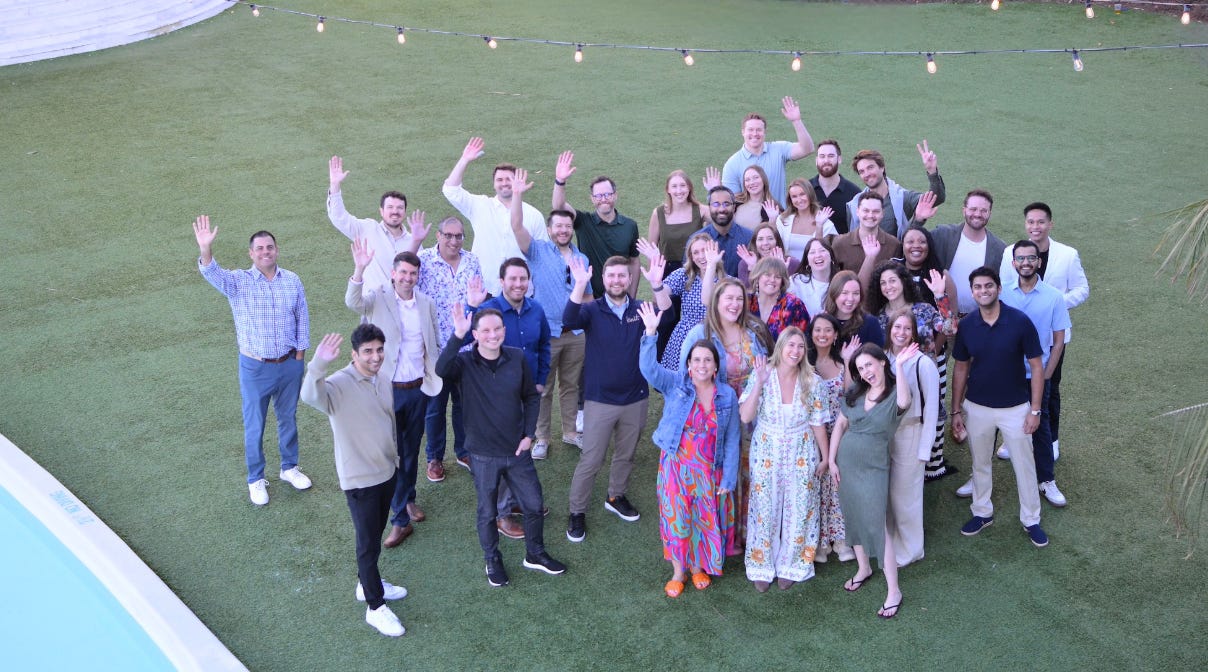
I asked the team all kinds of questions: what the founders are like, what meetings are like, what makes Knit different, what someone smart who quit might say. A few things stood out.
The talent bar is pretty serious. Most startups (okay, every startup) will tell you they hire well. Not all of them talk about it with the conviction people at Knit do. Jake Shanesy, who joined as Director of Product after a decade in B2B SaaS, said the talent density was “unlike anything I’d seen — people who could be coasting at bigger companies choosing to be in the trenches.”
Rachel Weems, Head of Engineering and one of the first engineers at DoorDash, put it more bluntly. “The founders at Knit hire people 10x better than themselves, who will in turn hire people 10x better than themselves.”
You will have an impact in your first week. On Jake’s first week, he was “in customer calls, shipping decisions, and writing specs. The expectation was that I’d already done the homework before showing up — and I had.” On her first week, Rachel was learning the codebase and putting together the new engineering interview process. Cullen Bates, a software engineer, was pushing changes by the end of his second day and owning a project by the start of week two.
The 30/60/90 day plan that Jeremy Grompone, Talent Acquisition lead, received was “a bit eye opening. It didn’t come off as micromanagement, but as a true guide on how to own the role they hired you for.” If you join Knit, I wouldn’t expect to slowly coast in for the first couple of months; I would expect to start doing serious work on day 1.
The founders are everywhere and “incredibly grounded.” Aneesh and Raahish, co-founder and CTO, are not the sorts of founders who set strategy and disappear into investor meetings. Jake described the founders’ defining quality as “ambitious humility — enormous conviction about where we’re going, paired with zero ego about being wrong on the way there.” He also said that the founders “carry an unusual amount of context across every part of the org — product, eng, GTM, customer.”
Erica Foster, Director of Product Marketing, said she’s “never seen a CEO as actively hands on in as many projects in a truly meaningful way as Aneesh.” Founder Mode-esque.
The work is hard. Nobody complained about it, though. Jeremy described the rhythm as being focused on what you do, not when you do it or how long it takes you to do it. Output and its results are the goal. You can see this in the way Knit runs meetings: they are short and always end in a decision. Not much fluff or “let’s just align on this” calendar blocks where you have small talk for an hour. (Hurray!)
“We don’t sugarcoat,” Aneesh said, describing how he pitches candidates. “It is hard work. But what makes it worth it is the impact you have. The work we do at Knit influences billion-dollar decisions for some of the most iconic brands in the world.”
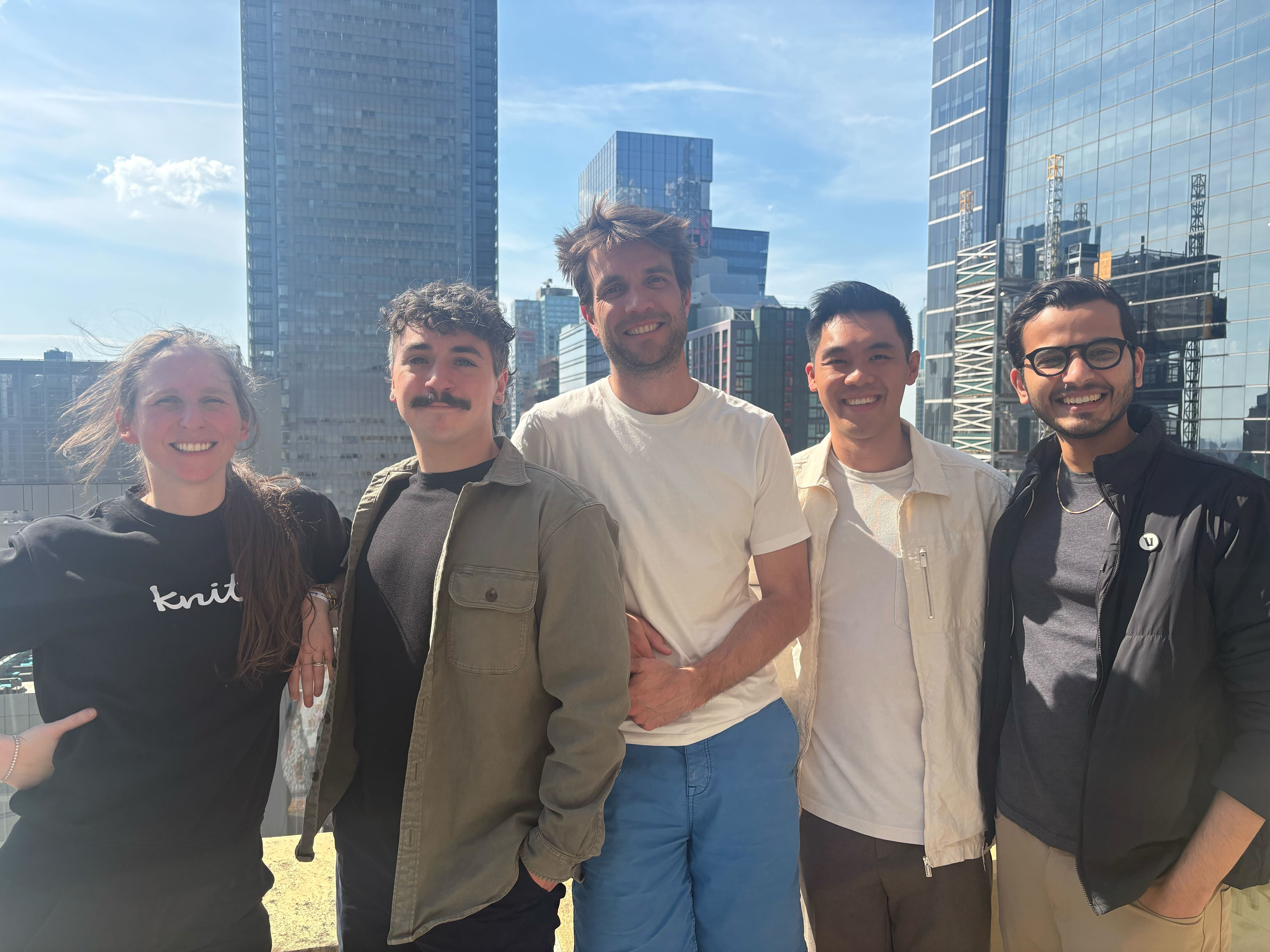
Should you join Knit?
Knit’s careers page is right here. What should you do about it? I’ve written a lot about the product and what the culture and expectations are. So perhaps it’s fitting to filter some people out by writing about the things you cannot expect to do at Knit:
You cannot wait to be told what to do.
You cannot work slowly and precisely on everything. (Cullen said the engineering team moves fast and ships scrappy versions to iterate on.)
You cannot operate on tenure. The best argument wins.
Knit’s team of 70+ full-time employees is spread throughout the US, with headquarters of ~25 folks in NYC. While engineering and PM roles are required in NYC, check out their careers page for which positions are remote or centralized around other smaller Knit hubs (Chicago, DC, and San Francisco). In general, though, I’d say that Knit is one of those rare companies that has roles both for people who are excited about working in-person and for people who work remote.
Stage is another reason you might join. Arnaud Mondoulet, principal software engineer, pointed out that Knit is in “a sweet spot. You have product-market fit and traction, less risk than [seed stage], and still tons to build.”
If all of the above sounds interesting, then I think you might join Knit because you see an opportunity to get in early with an excellent team with a company that could one day be worth many, many billions of dollars. Aneesh’s short-term vision—to become the most important research company ever built—is already big. The long-term vision is even bigger. I think that, if you are convinced by the vision and encouraged by the traction so far, you might want to check out Knit’s open roles. They are currently hiring across most departments.
Thanks to Knit for supporting Next Play and making this essay possible.